

Youth NEET: District-Level Employment and Human Capital Challenge

Source: The Hindu
Why in News?
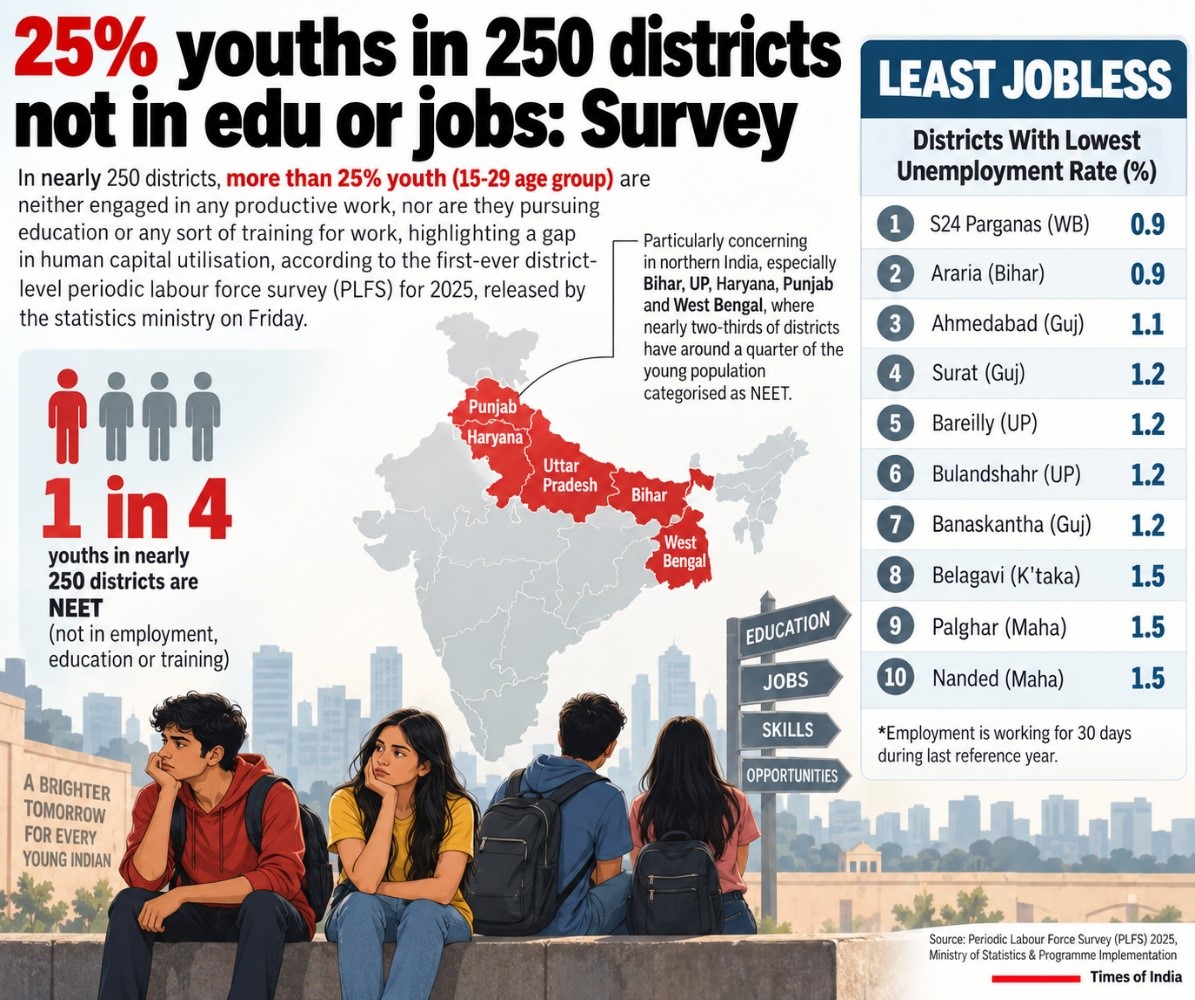
- The first-ever district-level Periodic Labour Force Survey (PLFS) for 2025 has highlighted significant regional disparities in youth participation in employment, education and training.
- In nearly 250 districts, more than 25% of young people aged 15–29 are classified as NEET — Not in Employment, Education or Training.
- The finding points to underutilisation of India’s young workforce and a potential human-capital challenge.
- The problem is particularly visible in northern and eastern India, including Bihar, Uttar Pradesh, Haryana, Punjab and West Bengal.
- In nearly two-thirds of districts in these states, around one-fourth of the youth population falls into the NEET category.
Regional Employment Patterns
- The district-level data reveal considerable variation in labour-market outcomes across India.
- Several districts reported relatively low unemployment rates, including:
- South 24 Parganas, West Bengal — 0.9%.
- Araria, Bihar — 0.9%.
- Ahmedabad, Gujarat — 1.1%.
- Surat, Gujarat — 1.2%.
- Bareilly and Bulandshahr, Uttar Pradesh — 1.2%.
- Belagavi, Karnataka — 1.5%.
- Palghar and Nanded, Maharashtra — 1.5%.
- The survey defines employment based on whether a person worked for at least 30 days during the reference year.
- Low unemployment, however, does not necessarily imply high-quality employment or adequate labour-force participation, making the NEET indicator important for understanding youth exclusion.
Why High Youth NEET Matters?
- NEET status represents a loss of productive human capital because young people are neither acquiring formal education and skills nor participating in employment.
- Persistent NEET status can lead to:
- Skill deterioration and reduced employability.
- Lower lifetime earnings.
- Greater dependence on households.
- Social and economic exclusion.
- Reduced demographic-dividend gains.
- The problem can be particularly significant for young women, where social norms, unpaid care responsibilities, mobility constraints and limited access to suitable employment can restrict participation.
- District-level disparities also indicate that national averages can conceal significant local labour-market weaknesses.
 The findings underline the need to move beyond measuring unemployment alone and examine labour-force participation, quality of employment and access to education and training.
Policy Priorities
- District-specific employment strategies should be developed according to local economic structures and skill requirements.
- Strengthen vocational education, apprenticeships and industry-linked training to improve the transition from education to employment.
- Expand employment opportunities in labour-intensive manufacturing, services, tourism, agriculture-linked industries and emerging sectors.
- Improve women’s participation through safe transport, childcare support, flexible work opportunities and measures addressing social barriers.
- Strengthen career counselling, job-matching platforms and local employment exchanges.
- Link skilling programmes with actual local employer demand rather than focusing primarily on enrolment or certification.
- District-level PLFS data can help governments identify high-NEET regions and target employment, education and skilling interventions accordingly.
Way Forward
- India’s demographic dividend depends not merely on having a large young population but on converting young people into productive human capital.
- The policy focus should therefore shift from unemployment alone towards a broader framework covering:
- Education.
- Skills.
- Employment.
- Labour-force participation.
- Quality and productivity of work.
- Regular district-level labour-market data can enable more targeted policy interventions and improve accountability.
- Reducing the NEET population is essential for inclusive growth, higher productivity and the achievement of India’s long-term development objectives.
