

Zero FIR, Zero Logic: A Case Study in Criminal Law Misapplication

Zero FIR, Zero Logic: A Case Study in Criminal Law Misapplication
Relevance: GS Paper II (Indian Constitution, Fundamental Rights, Criminal Justice System)
Why in the News?
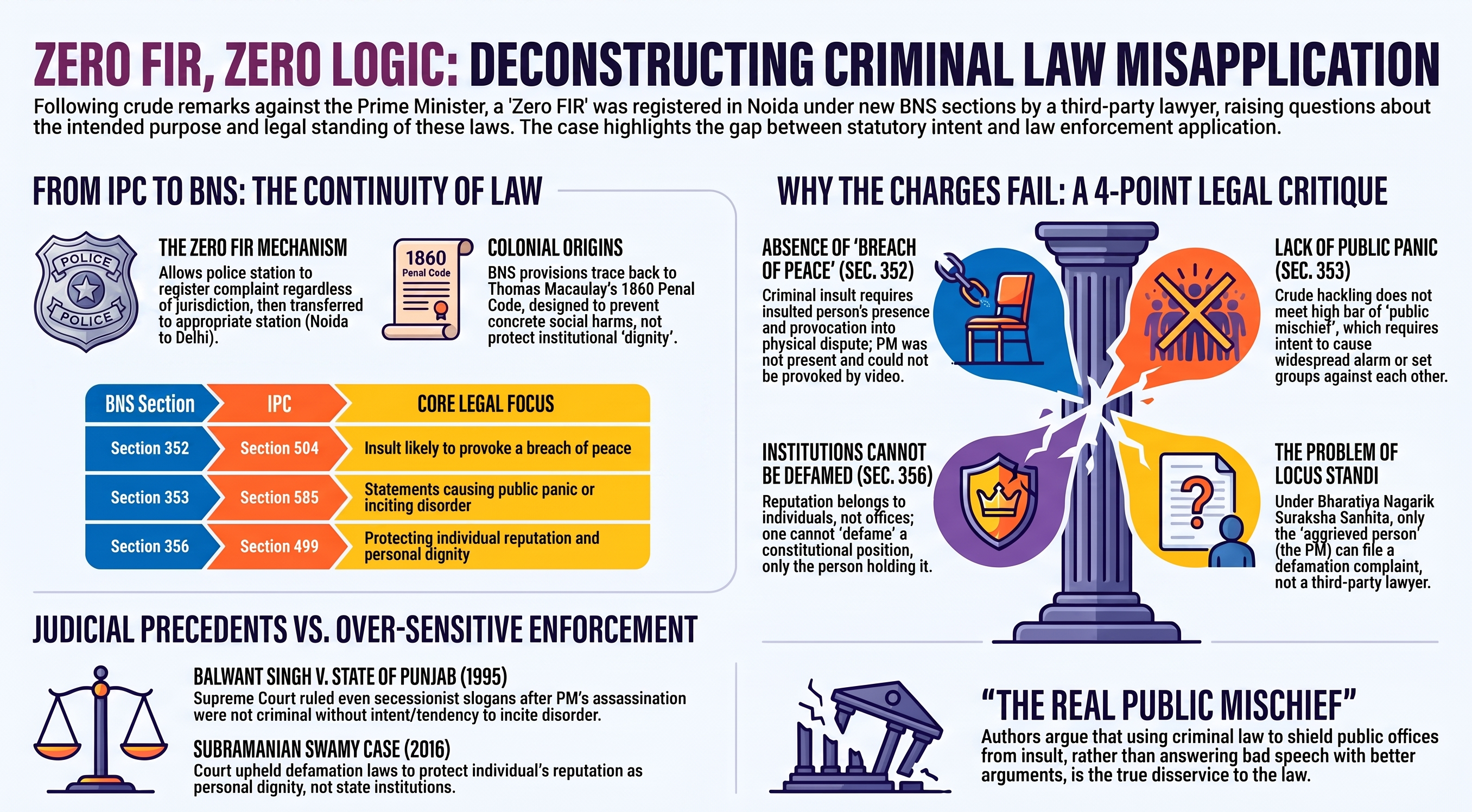
Crude remarks about the PM at the July 23 Jantar Mantar protest led Noida police to register a zero FIR (registered outside jurisdiction, transferred onward — here, to Delhi) on July 29, invoking Sections 352, 353(1), and 356(1) of the Bharatiya Nyaya Sanhita (BNS) — insult, public mischief, and defamation. The complaint came not from the PM but from a lawyer who had merely watched a video, arguing the words "lowered the dignity of a constitutional office." The authors argue this FIR is legally unsound on multiple counts, even though the remarks themselves were indefensible.
Colonial Origins and Original Purpose
All three provisions trace back to Macaulay's 1860 Penal Code: Section 356 (defamation) was old Section 499, protecting individual reputation; Section 352 (insult) was old Section 504, covering insult likely to provoke a breach of peace; Section 353 (public mischief) was old Section 505, covering statements causing public panic or inciting disorder. Read together, each guards against a concrete harm — a ruined reputation, a brawl, a public disturbance — none of them protect the "dignity" of an office as such.
Why the Charges Don't Hold, Per the Authors?
- Insult (Sec. 352): requires the insult be likely to provoke the person insulted into breaching the peace. The PM wasn't present at Jantar Mantar and couldn't be provoked into a public dispute by a video — and had publicly forgiven the accused. The Supreme Court, in Balwant Singh (1995), acquitted men who shouted secessionist slogans on the evening of Indira Gandhi's assassination, holding that words raised without intent or tendency to incite disorder are not criminal — and cautioned that over-sensitive law enforcement, not offensive speech itself, invites trouble.
- Public mischief (Sec. 353): requires intent to cause public fear/alarm or set groups against each other. Crude abuse of a leader at a protest doesn't endanger public tranquillity — if slogans for national break-up hours after a PM's assassination didn't clear this bar (per Balwant Singh), heckling another leader falls well short.
- Defamation (Sec. 356): the "strangest" charge — in Subramanian Swamy (2016), the Supreme Court upheld the defamation provision specifically because it protects an individual's reputation as part of personal dignity. Reputation belongs to persons, not institutions — one cannot "defame" an office.
- Locus standi: under the Bharatiya Nagarik Suraksha Sanhita, courts may take cognisance of defamation only on a complaint by the aggrieved person. Since the PM has not complained, a lawyer self-appointing as "guardian" of another's reputation has no standing to bring the case at all.
The Authors' Core Argument
The remarks deserved condemnation, not criminal prosecution — "the answer to bad speech in a democracy is condemnation and better argument," both of which were already available and had already occurred (the protest's core grievance had forced a minister's resignation). Using postcolonial criminal law provisions — designed to protect individuals from concrete harm — to shield a public office from insult is, in the authors' words, "the real public mischief."
Significance for Mains
- A clean illustration of applying statutory interpretation and judicial precedent to test whether a real-world FIR fits the legal elements of the offence — useful for law/polity answers requiring precedent-based reasoning.
- Connects to the broader free speech vs. state/institutional dignity debate — relevant alongside the BitChat takedown and Right to Protest notes covered earlier, all part of a recurring 2026 pattern of free-expression controversies.
- Highlights procedural safeguards (locus standi in defamation) as a check against misuse of criminal law for political ends — relevant to questions on abuse of process and criminal justice reform.
- Useful for distinguishing BNS provisions from their IPC predecessors (Secs. 499, 504, 505) — a common prelims-style comparison point given the BNS's recent enactment.
