
AIR 74
Harsh Nehra
Anthropology 303/500VAID'S ICS – Best UPSC Anthropology Coaching in Delhi Since 1985

Sampoorna 2026 · Now in two tracks
GST included
Compare Plans →One 40-test system. Two levels of guided improvement.
Build complete syllabus coverage through tests, evaluation, model approaches and mentorship. Choose Sampoorna Pro when you also want structured intervention before, during and after every test.
Programme runs 12 September 2026 to 24 February 2027 · GST included · Registration opens on this page, you are not sent to another site.
Anthropology optional marks from the IAS 2025 result, for students who prepared in the Vaid’s ICS classroom.




Every student writes the same forty tests. The difference is how much guided intervention you want around them.
For students who want complete syllabus testing, evaluation and mentor support.
For students who want guided improvement before, during and after every test.
Everything in Sampoorna +
Upgrade to Pro for just ₹5,000 more
The common foundation included in both Sampoorna and Sampoorna Pro.
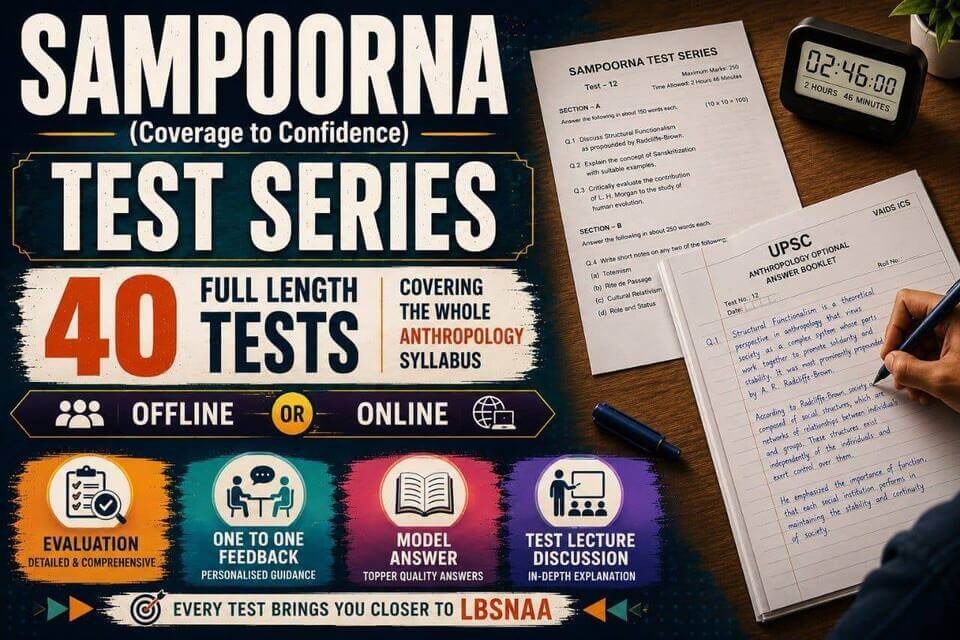
All 40 tests together cover every unit of Paper 1 and Paper 2 — structured in the same sequence as the UPSC syllabus.
A dedicated mentor guides you throughout the program — continuous feedback on content, structure, and presentation.
Model answers provided after every test — showing the exact approach, thinker integration, and structure that examiners reward.
Detailed post-test discussions for every paper — analysing the questions, the expected answers, and common mistakes.
Every test includes Previous Year Questions from 2013–2024 — ensuring you practice on the actual questions that have appeared in UPSC Mains.
Runs as per the published 12 September 2026 to 24 February 2027 test schedule, with calibrated pacing from unit tests to final simulations.
Tests conducted under exam conditions — real question format, real time pressure, real answer sheet discipline.
Available in both online and offline formats — flexible enough for students across India and Vaids ICS classroom students alike.
Sampoorna Pro is designed around the improvement cycle: prepare with direction, write the test, diagnose performance, enrich weak areas, discuss corrections and simulate Mains under pressure.
| Pro Addition | What You Get | Purpose |
|---|---|---|
| Pre-Test Syllabus Approach | Live + recorded session before each test | Enter every test with a clear syllabus approach and answer direction. |
| Answer Enrichment Sessions | Focused enrichment after the test cycle | Strengthen answers with scholars, examples, diagrams and value addition. |
| Personal Improvement Report | Individual performance diagnosis | Turn evaluation comments into a clear improvement agenda. |
| Mentor Discussion | Offline / online mentor discussion | Resolve recurring weaknesses and define next-step priorities. |
| Anthropology Current Affairs | Current-affairs integration | Add relevant contemporary examples to Paper 1 and Paper 2 answers. |
| Mains Simulation Camp | Dedicated exam-simulation support | Bring preparation together under realistic Mains conditions. |
| 100 Case Studies | Curated Anthropology case-study bank | Make examples easier to recall and deploy in high-value answers. |
Upgrade to Pro for just ₹5,000 more
Sampoorna builds systematically — micro and mini tests for concept-by-concept coverage, sectional tests for integrated practice, and full-length comprehensive papers for exam simulation.
One or two syllabus units per test. Paper 1 (Tests 1–17) and Paper 2 (Tests 18–28). Focused coverage of each concept — ideal for building unit-by-unit depth before integrated practice.
Six sectional tests covering larger sections of the syllabus — building the ability to integrate knowledge across multiple units in a single sitting. 10-day gap between each sectional test.
Six full-length comprehensive papers — 2 weeks between each. Full exam simulation. Complete Paper 1 and Paper 2 coverage. The final preparation arc before UPSC Mains 2027.
Every test date, syllabus coverage, and paper — in one place.
| Test | Date | Paper | Syllabus Coverage |
|---|---|---|---|
| Test 1 | 12 Sep 2026 | Paper 1 | 1.1–1.3 — Meaning, Scope & Development of Anthropology; Relationships with other disciplines; Main branches of Anthropology |
| Test 2 | 15 Sep 2026 | Paper 1 | 1.4 — Human Evolution; Biological & Cultural factors; Theories of Organic Evolution (Pre-Darwinian, Darwinian, Post-Darwinian); Synthetic theory |
| Test 3 | 19 Sep 2026 | Paper 1 | 1.5 & 1.7 — Characteristics of Primates; Primate Taxonomy; Primate Behaviour; Fossil Primates; Living Major Primates; Comparative Anatomy; DNA structure; Gene; Mutation; Chromosomes |
| Test 4 | 23 Sep 2026 | Paper 1 | 1.5 & 1.6 — Primate Taxonomy & Adaptations; Phylogenetic status of Australopithecines; Homo erectus; Neanderthal; Rhodesian man; Homo sapiens (Cromagnon, Grimaldi) |
| Test 5 | 25 Sep 2026 | Paper 1 | 1.8 — Prehistoric Archaeology; Chronology: Relative & Absolute dating; Cultural Evolution: Palaeolithic, Mesolithic, Neolithic, Chalcolithic, Bronze Age, Iron Age |
| Test 6 | 28 Sep 2026 | Paper 1 | 2.1 & 2.2 — Nature of Culture; Concept of Civilization; Ethnocentrism vs. Cultural Relativism; Nature of Society; Social Institution; Social Groups; Social Stratification |
| Test | Date | Paper | Syllabus Coverage |
|---|---|---|---|
| Test 1 | 12 Sep 2026 | Paper 1 | 1.1–1.3 — Meaning, Scope & Development of Anthropology; Relationships with other disciplines; Main branches of Anthropology |
| Test 2 | 15 Sep 2026 | Paper 1 | 1.4 — Human Evolution; Biological & Cultural factors; Theories of Organic Evolution (Pre-Darwinian, Darwinian, Post-Darwinian); Synthetic theory |
| Test 3 | 19 Sep 2026 | Paper 1 | 1.5 & 1.7 — Characteristics of Primates; Primate Taxonomy; Primate Behaviour; Fossil Primates; Living Major Primates; Comparative Anatomy; DNA structure; Gene; Mutation; Chromosomes |
| Test 4 | 23 Sep 2026 | Paper 1 | 1.5 & 1.6 — Primate Taxonomy & Adaptations; Phylogenetic status of Australopithecines; Homo erectus; Neanderthal; Rhodesian man; Homo sapiens (Cromagnon, Grimaldi) |
| Test 5 | 25 Sep 2026 | Paper 1 | 1.8 — Prehistoric Archaeology; Chronology: Relative & Absolute dating; Cultural Evolution: Palaeolithic, Mesolithic, Neolithic, Chalcolithic, Bronze Age, Iron Age |
| Test 6 | 28 Sep 2026 | Paper 1 | 2.1 & 2.2 — Nature of Culture; Concept of Civilization; Ethnocentrism vs. Cultural Relativism; Nature of Society; Social Institution; Social Groups; Social Stratification |
| Test 7 | 01 Oct 2026 | Paper 1 | 2.3, 2.4 & 2.5 — Marriage (definition, laws, types, payments); Family (types, functions, impact of urbanisation); Kinship (descent, filiation, alliance, terminology) |
| Test 8 | 05 Oct 2026 | Paper 1 | Units 3, 4 & 5 — Economic Organisation (formalist-substantivist, reciprocity, redistribution, market); Political Organisation (band–state, power, authority); Religion (animism, totemism, fetishism, magico-religious functionaries) |
| Test 9 | 07 Oct 2026 | Paper 1 | Unit 6 (a–e) — Anthropological Theories: Classical Evolutionism (Tylor, Morgan, Frazer); Boas & Diffusionism; Functionalism (Malinowski); Structural-Functionalism (Radcliffe-Brown); Structuralism (Lévi-Strauss); Culture & Personality |
| Test 10 | 10 Oct 2026 | Paper 1 | Unit 6 (f–j) — Neo-evolutionism (Childe, White, Steward, Sahlins, Service); Cultural Materialism (Harris); Symbolic theories (Turner, Geertz); Cognitive theories; Post-modernism in Anthropology |
| Test 11 | 13 Oct 2026 | Paper 1 | Units 7 & 8 — Culture, Language & Communication (verbal, non-verbal, social context); Research Methods (fieldwork tradition, tools of data collection, analysis & presentation) |
| Test 12 | 16 Oct 2026 | Paper 1 | 9.1 & 9.2 — Human Genetics: Pedigree analysis, twin study, cytogenetic methods, DNA technology; Mendelian genetics: single factor, multifactor, lethal, polygenic inheritance |
| Test 13 | 19 Oct 2026 | Paper 1 | 9.3 & 9.4 — Genetic polymorphism; Hardy-Weinberg law; mutation, isolation, migration, selection, genetic drift; Chromosomal aberrations: Klinefelter, Turner, Down syndrome, Patau, Edward |
| Test 14 | 22 Oct 2026 | Paper 1 | 9.5 & 9.6 — Race and Racism; Racial criteria; ABO, Rh blood groups; HLA; physiological characteristics in different cultural groups |
| Test 15 | 24 Oct 2026 | Paper 1 | 9.7 & 9.8 — Ecological Anthropology; Bio-cultural adaptations; Physiological responses to hot desert, cold, high altitude; Epidemiological Anthropology; Nutritional deficiency diseases |
| Test 16 | 26 Oct 2026 | Paper 1 | Units 10 & 11.1 — Human Growth & Development (stages, factors, ageing, somatotypes); Menarche, menopause; Fertility patterns |
| Test 17 | 28 Oct 2026 | Paper 1 | 11.2, 11.3 & 12 — Demographic theories; Biological & socio-ecological factors in fertility & mortality; Applications of Anthropology: forensic, nutritional, sports, applied genetics, DNA technology |
| Test | Date | Paper | Syllabus Coverage |
|---|---|---|---|
| Test 18 | 30 Oct 2026 | Paper 2 | 2.1 (P2) — Evolution of Indian Culture & Civilisation: Prehistoric (Palaeolithic to Neolithic-Chalcolithic); Protohistoric — Indus Civilisation; Pre-Harappan, Harappan and Post-Harappan cultures |
| Test 19 | 02 Nov 2026 | P1 + P2 | 1.8 (Paper 1) + 1.1 (Paper 2) — Combined coverage: Prehistoric cultures + Indian civilisation evolution |
| Test 20 | 05 Nov 2026 | Paper 2 | 1.2 & Unit 2 — Palaeo-Anthropological evidence from India (Siwaliks, Narmada basin — Ramapithecus, Sivapithecus, Narmada Man); Ethno-archaeology; Demographic Profile of India |
| Test 21 | 07 Nov 2026 | Paper 2 | 3.1 & 3.2 — Traditional Indian Social System (Varnashram, Purushartha, Karma, Rina, Rebirth); Caste system: Structure, characteristics, Varna-caste, theories of origin, dominant caste, mobility, Jajmani system |
| Test 22 | 10 Nov 2026 | Paper 2 | 3.2, 3.3 & 3.4 — Caste: Tribe-caste continuum; Sacred Complex; Nature-Man-Spirit Complex; Impact of Buddhism, Jainism, Islam and Christianity on Indian society |
| Test 23 | 12 Nov 2026 | Paper 2 | Unit 4 — Emergence and growth of Anthropology in India; Scholar-administrators of 18th–20th century; Contributions of Indian anthropologists to tribal and caste studies |
| Test 24 | 14 Nov 2026 | Paper 2 | Unit 5 — Indian Village as a social system; Agrarian relations; Linguistic and religious minorities; Sanskritization, Westernization, Modernization; Panchayati Raj; Media and social change |
| Test 25 | 17 Nov 2026 | Paper 2 | 6.1 & 6.2 — Tribal situation in India: Bio-genetic variability, linguistic and socio-economic characteristics; Problems: land alienation, poverty, indebtedness, literacy, unemployment, health |
| Test 26 | 20 Nov 2026 | Paper 2 | 6.3 & 7.1 — Development projects and tribal displacement; Forest policy and tribals; Constitutional safeguards for Scheduled Tribes, Scheduled Castes, and OBCs |
| Test 27 | 24 Nov 2026 | Paper 2 | 7.2, 7.3, 8.1, 8.2 & 9.1 — Social change in tribal societies; Ethnicity and ethnic conflicts; Regionalism; Pseudo-tribalism; Tribe and nation state; PTGs and their development; Role of NGOs |
| Test 28 | 27 Nov 2026 | Paper 2 | 9.1, 9.2 & 9.3 — Tribal administration and policies; Role of Anthropology in tribal and rural development; Contributions of Anthropology to understanding regionalism, communalism, ethnic movements |
| Test | Date | Type | Coverage |
|---|---|---|---|
| Test 29 | 04 Dec 2026 | Sectional 1 | 10 days gap from Test 28 onwards between each sectional test |
| Test 30 | 11 Dec 2026 | Sectional 2 | 10 days gap between each test |
| Test 31 | 19 Dec 2026 | Sectional 3 | 10 days gap between each test |
| Test 32 | 26 Dec 2026 | Sectional 4 | 10 days gap between each test |
| Test 33 | 02 Jan 2027 | Sectional 5 | 10 days gap between each test |
| Test 34 | 11 Jan 2027 | Sectional 6 | 10 days gap between each test |
| Test | Date | Type | Coverage |
|---|---|---|---|
| Tests 35–36 | 25 Jan 2027 | Comprehensive 1+2 | 2 weeks gap between each comprehensive set. Full-length paper simulation — complete Paper 1 and Paper 2 coverage. |
| Tests 37–38 | 08 Feb 2027 | Comprehensive 3+4 | 2 weeks gap between each comprehensive set. |
| Tests 39–40 | 24 Feb 2027 | Comprehensive 5+6 | Final comprehensive set — last pre-Mains full-length simulation. End of Sampoorna 2026 program. |
See the actual question standard, evaluation quality, and answer approach before registering.
See the format, question standard, and difficulty level of a micro/mini test.
View Sample →A second micro/mini test sample — showing the PYQ + fresh question combination.
View Sample →A full-length comprehensive test — the standard you will reach by Phase 3 of Sampoorna.
View Sample →See an actual evaluated answer copy — the feedback quality, margin comments, and score guidance.
View Sample →Sampoorna is not just a test series — it is a mentored preparation program. Every student gets a dedicated mentor who tracks their progress across all 40 tests, identifies recurring weaknesses, and provides specific guidance throughout the program.
Your mentor reviews every evaluated copy and identifies the specific patterns in your answers that need correction — not just one-off feedback but trend identification across tests.
Detailed post-test discussions refine your answer writing approach — understanding not just what to write but how to frame arguments, integrate thinkers, and structure for maximum marks.
Whether you are in Delhi attending classes at Vaids ICS or studying remotely, mentorship is equally available in both modes.
Sampoorna is designed around the four problems that cause the most Anthropology optional students to underperform despite knowing the content.
Sampoorna provides a fixed test every 3–4 days — creating accountability that self-study cannot. Missing a test has a consequence: you fall behind the sequence.
The 40-test sequence mirrors the UPSC syllabus order — you cover each concept before being tested on it, with cumulative tests integrating prior learning.
Every Sampoorna test integrates PYQs from 2013–2024 relevant to that unit — ensuring you practice on the exact questions that have appeared before and are likely to appear again.
40 tests means 40 opportunities to write, receive feedback, correct, and improve — the only reliable path from content knowledge to marks on the answer sheet.
Sampoorna ₹14,999 ₹19,999 · Sampoorna Pro ₹19,999 ₹24,999 · GST included
Complete 40-test core track with evaluation, model answers and 1-to-1 mentorship.
Everything in Sampoorna plus pre-test approach, enrichment, improvement reports, case studies and the simulation camp.
Step 1 of 2 · takes about a minute