Kinship in Anthropology: Complete UPSC Anthropology Study Guide
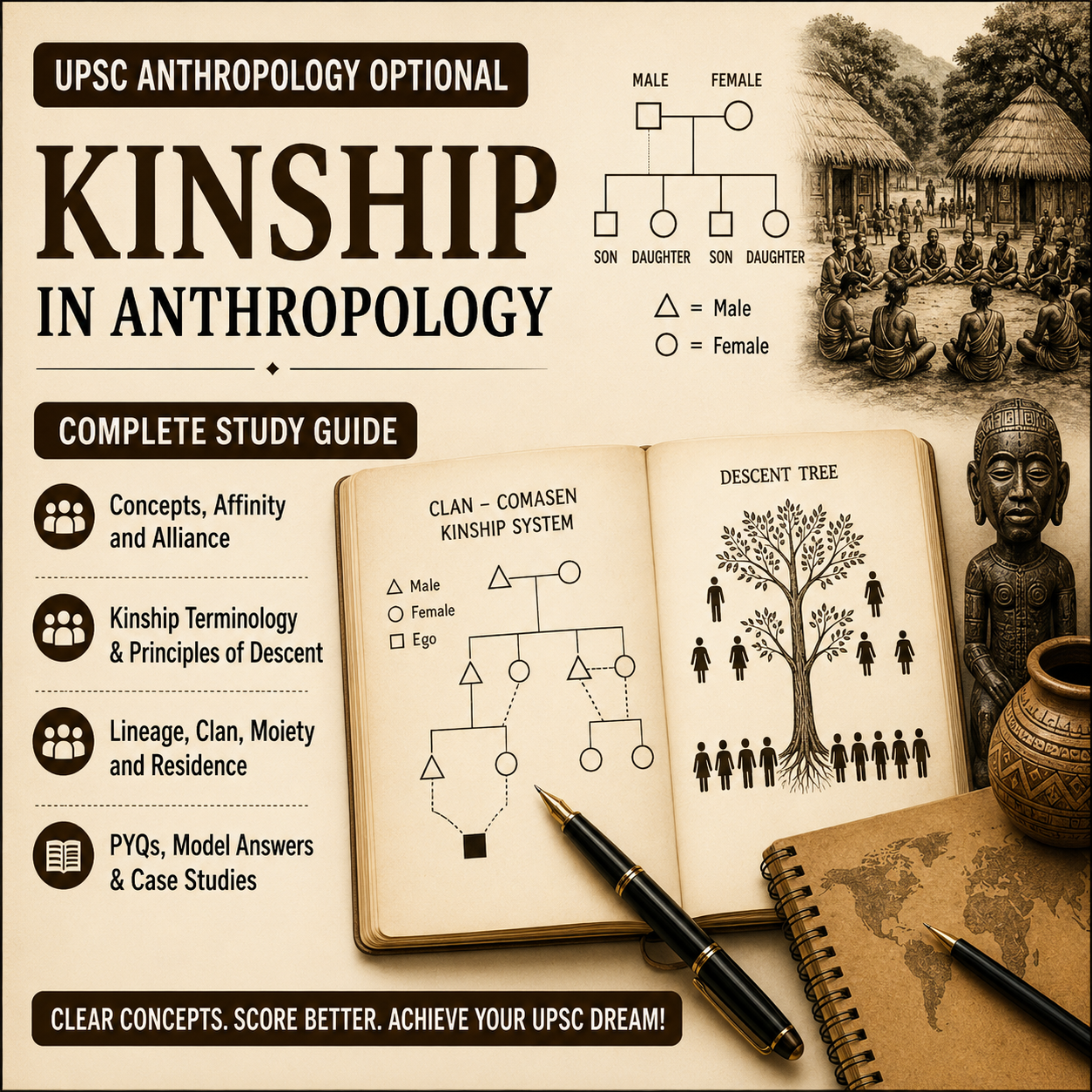
Sarvagya · Anthropology Content Hub · vaidsics.com Kinship — Complete Study Guide UPSC Anthropology Optional · Paper 1 & Paper 2 Created by Antim N. Vaid | Affiliated by Vaid Sir | 27th May 2026 How to Use This Document For complete beginners — Read the Beginner’s Glossary first. Every technical term is explained there in plain English before it appears in the main text. For students who have some background: Use the Table of Contents to jump to weak areas Focus on the Vaid Sir Exam Tips — these are the highest-yield points Prioritise the diagrams for Crow-Omaha, Descent Tree, and Lineage Hierarchy — these are frequently misunderstood Read all model answers — each demonstrates a different structure and length Table of Contents 1 Beginner’s Glossary 2 What is Kinship? 3 Kroeber’s 8 Determinants 4 Consanguinity and Affinity 5 Principles of Descent 6 Descent Groups — Lineage to Moiety 7 Rules of Residence 8 Kinship Terminology 9 Descent vs. Alliance 10 Previous Year Questions (2013–2024) 11 Model Answer Content & Structure 12 Case Studies & Recent Researches 1. Beginner’s Glossary Before you read anything else, read this glossary. Every technical word used in this document is explained here in plain English. The first time a term appears in the main text, its plain English meaning is also given in brackets. Kinship The system of relationships that connects people through blood and marriage — the social map of who is related to whom. Example: Your family tree — parents, siblings, cousins, in-laws. Consanguinity Being related by blood — having a common biological ancestor. Example: You and your brother are consanguineal kin. Affinity Being related by marriage — connected through a spouse. Example: Your wife’s parents are your affinal kin (in-laws). Descent The rule that decides which family group you belong to — traced through either your father’s or mother’s side. Example: In most of North India, you belong to your father’s gotra — that is patrilineal descent. Unilineal Tracing family membership through only ONE line — either the father’s side or the mother’s side. Example: The Gonds trace only through the father; the Khasi trace only through the mother. Patrilineal Family membership and property passes through the FATHER’s line. Example: Your father’s surname, gotra, and ancestral land — this is patrilineal. Matrilineal Family membership and property passes through the MOTHER’s line. Example: Among the Khasi of Meghalaya, children belong to the mother’s clan. Lineage A family group where everyone can actually NAME and TRACE every ancestor back to the founding person. Example: A Brahmin family that can recite their gotra ancestry back to a specific rishi. Clan A larger family group where members BELIEVE they share a common ancestor but cannot prove the exact connection. Example: Millions of people share the same clan name but cannot trace exactly how they are related. Exogamy The rule that you must MARRY OUTSIDE your own family/clan group. Example: You cannot marry someone from the same gotra — this is exogamy. Endogamy The rule that you must MARRY WITHIN a specific group. Example: Caste endogamy — you must marry within your own caste. Totemism The practice of a group identifying with a natural object, animal, or plant as their symbolic ancestor or protector. Example: A clan that considers the tiger as their founding ancestor and does not hunt or eat tigers. Moiety When a society is divided into exactly TWO halves for marriage and ceremonies. Example: Village A and Village B — everyone in A must marry someone from B and vice versa. Phratry A grouping of two or more clans that recognise some shared identity. Example: Three clans that all believe they came from the same original ancestor group. Affinal Related through marriage (not blood). Example: Your mother-in-law is an affinal relative. Filiation The direct, personal relationship between a PARENT and their CHILD — not about group membership. Example: The bond between you and your father, regardless of which lineage you belong to. Complementary Filiation In a patrilineal society, the personal tie you have with your MOTHER’s side of the family (who are not in your descent group). Example: Your mother’s brother (MoBr) is not in your patrilineal group but still has special obligations to you. Corporate Group A group that acts as a single legal/social unit — owns property, makes decisions, continues after members die. Example: A lineage that collectively owns ancestral land. Avunculate The special relationship between a man and his mother’s brother (maternal uncle) — particularly important in matrilineal societies. Example: In some tribes, the maternal uncle (MoBr) has more authority over you than your own father. Levirate The custom where a widow marries her deceased husband’s BROTHER. Example: After her husband dies, she marries his younger brother — this keeps her within the same family group. Sororate The custom where a widower marries his deceased wife’s SISTER. Example: After his wife dies, he marries her younger sister — this maintains the alliance between the two families. Ego In kinship diagrams, ‘Ego’ = YOU — the reference person from whose perspective all relationships are mapped. Example: All kinship terms are defined relative to Ego’s position. Cross-Cousins Children of a BROTHER and SISTER — your father’s sister’s children, or your mother’s brother’s children. Example: Your FaSiDa (father’s sister’s daughter) is your cross-cousin. Parallel Cousins Children of TWO BROTHERS or TWO SISTERS — your father’s brother’s children or your mother’s sister’s children. Example: Your FaBrSo (father’s brother’s son) is your parallel cousin — treated like a sibling in most tribal societies. Putative Descent Believed but not proven ancestry — you CLAIM a common ancestor but cannot trace the exact genealogy. Example: Clan members claim descent from a common ancestor but cannot name every person in between. Prescriptive Marriage A marriage rule where you MUST marry a specific category of person. Example: In some South Indian tribes, a man MUST marry his MoBrDa (mother’s brother’s daughter). Preferential Marriage A marriage rule where you are ENCOURAGED (but not required) to marry a certain … Read more