Anthropology Optional for UPSC: Complete Strategy, Syllabus, Books, PYQs, Notes & Answer Writing Guide (2027)
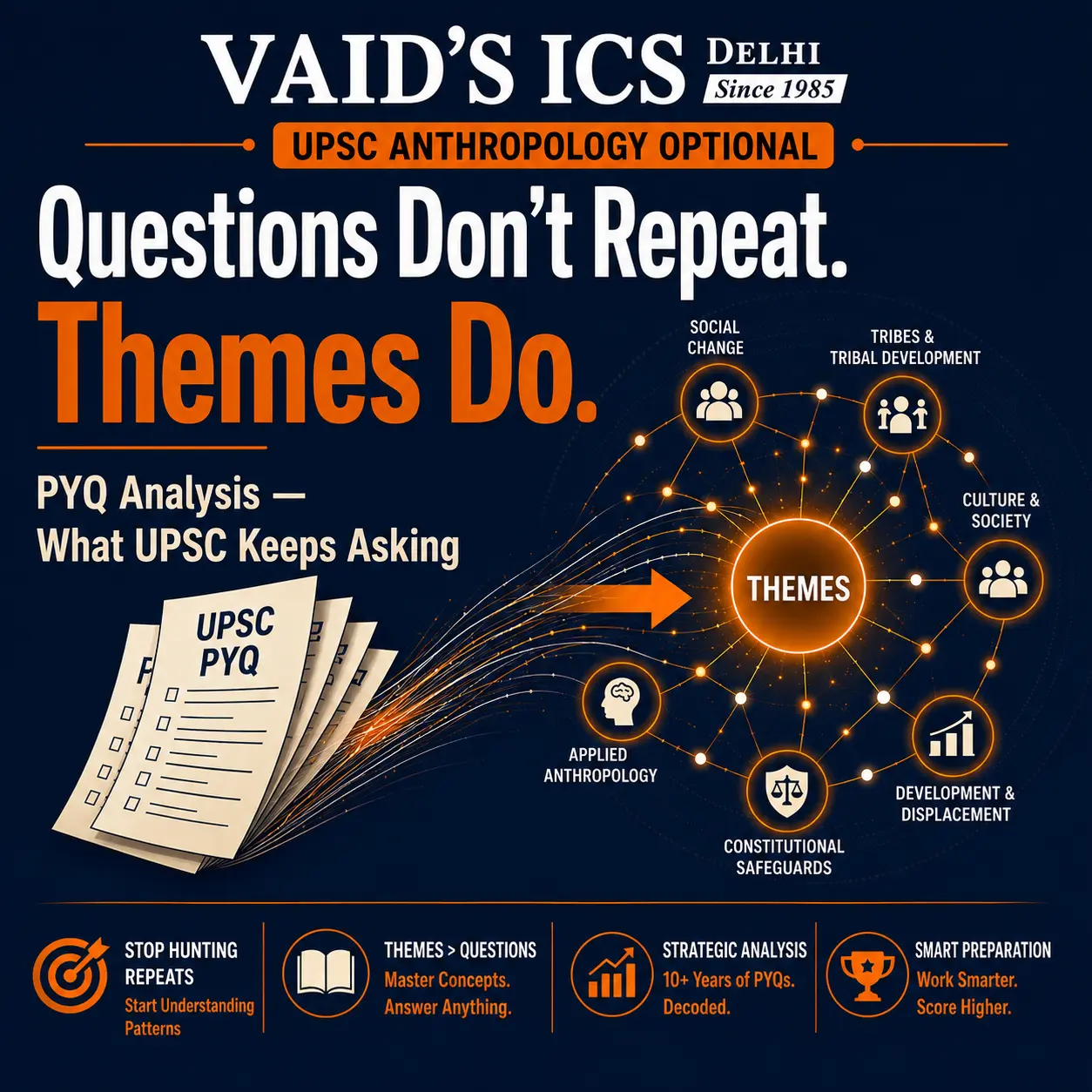
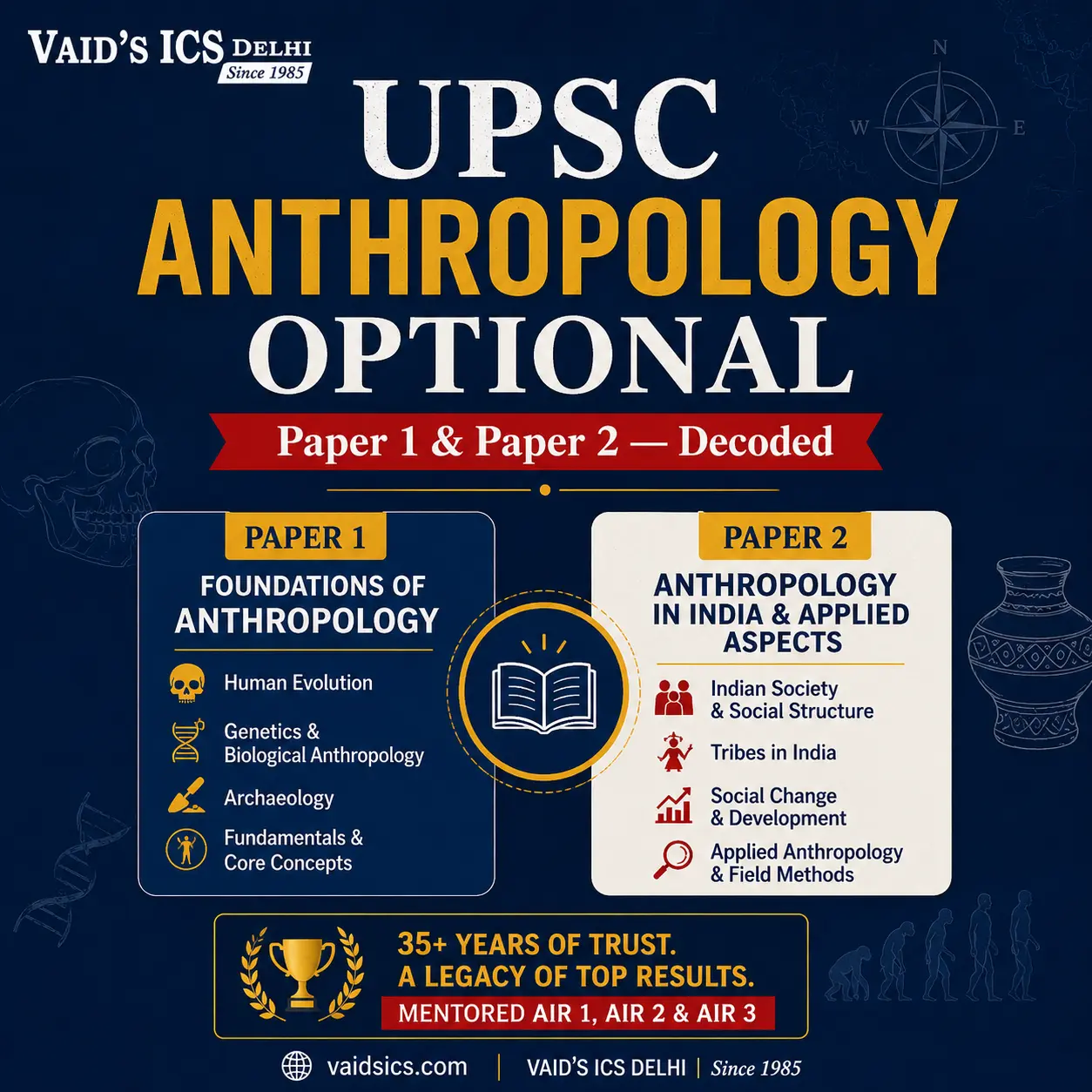
By the VAID’S ICS Anthropology Team · reviewed under Vaid Sir’s 40+ year Anthropology mentorship Last updated: June 2026 Quick answer Anthropology Optional is a two-paper UPSC Mains subject — Paper 1 covers conceptual and biological anthropology (theory, thinkers, kinship, evolution), while Paper 2 covers Indian and applied anthropology (tribal India, social change, development). It is best prepared not by collecting material, but as a system: read the syllabus through UPSC’s lens, analyse PYQ themes, build answer-ready notes, prepare the two papers in different modes, practise structured answer writing with feedback, and revise selectively. Most aspirants do not struggle in Anthropology because the subject is difficult. They struggle because they prepare a system subject the way they would prepare a reading subject. Anthropology rewards a specific kind of preparation: conceptual clarity, intelligent PYQ reading, answer-ready notes, relevant diagrams, structured answer writing, timely feedback, and selective revision. Aspirants who work this way tend to finish the optional with real control over it. Aspirants who keep collecting PDFs, switching booklists and re-reading passively often stay busy for months without ever becoming exam-ready. This guide is the central hub for Anthropology Optional preparation for UPSC 2027. It will not repeat the syllabus mechanically or recycle the usual lines about the subject being “short” or “scoring.” Its purpose is to show you how Anthropology actually behaves in the exam, and what a serious preparation system looks like — from choosing the optional, to syllabus reading, PYQ analysis, books, notes, Paper 1 and Paper 2 strategy, answer writing, diagrams, test series and a realistic roadmap. Read it once, fully, to understand the architecture of the subject. Then return to the sections that match your stage of preparation. Anthropology Optional at a glance Structure: two papers (Paper 1 — conceptual & biological; Paper 2 — Indian & applied), 250 marks each. Who it suits: beginners, science and engineering students, humanities students, and working professionals who can prepare with structure. What it rewards: conceptual clarity, PYQ-oriented preparation, diagrams, case studies and consistent answer writing — not volume of material. Realistic timeline: roughly a year alongside General Studies, with answer writing running throughout, not at the end. Most common failure: treating Paper 1 and Paper 2 the same way, and postponing answer writing. On this page Start Here: Find Your Entry Point Why Anthropology Needs a Serious Preparation System What Anthropology Optional Actually Means in UPSC Who Should Choose Anthropology — and Who Should Be Careful What Makes Anthropology Different from Other Optionals Common Mistakes Anthropology Aspirants Make Reading the Syllabus Through UPSC’s Lens What PYQs Reveal About UPSC’s Thinking The Resource Problem in Anthropology Books and Resources by Category How Toppers Build Anthropology Notes Paper 1 Strategy Paper 2 Strategy Paper 1 vs Paper 2: Two Different Answer Modes The Anthropology Answer Writing System Diagrams, Case Studies and Value Addition Test Series and the Feedback Loop A One-Year Anthropology Roadmap for UPSC 2027 Why Some Students Score Very Well in Anthropology Where Mentorship Actually Matters The VAID’S ICS Anthropology Legacy Frequently Asked Questions A Final Word About the Author Start Here: Find Your Entry Point This is a long guide because Anthropology has many moving parts — but you do not need all of them at once. Find yourself in the cards below and start there. Think of it the way you would treat advice from a teacher who knows where most aspirants get stuck. Still deciding Read Who Should Choose Anthropology — and Who Should Be Careful below, then go deeper with Why Anthropology Aspirants Are Choosing Anthropology and Is Anthropology a Good Optional for UPSC? Complete beginner Begin with Reading the Syllabus Through UPSC’s Lens, then Books and Resources by Category, and follow the full sequence in How to Start Anthropology Optional from Zero. Can’t write answers yet The most common plateau. Go to What PYQs Reveal, The Answer Writing System, Diagrams & Value Addition, and Test Series and the Feedback Loop. Too many resources Read The Resource Problem in Anthropology and How Toppers Build Anthropology Notes to cut down to what actually matters. Targeting UPSC 2027 seriously? Go to A One-Year Anthropology Roadmap for UPSC 2027 and work backwards from your attempt. If you are unsure, simply read top to bottom once — the order of this guide follows the order in which a well-prepared aspirant actually builds the subject. Why Anthropology Needs a Serious Preparation System Anthropology has a reputation for being compact, logical and manageable. That reputation is not wrong — but it quietly produces the wrong preparation behaviour. Because the syllabus looks finite, many aspirants treat it as something to finish rather than something to master. That is where the damage begins. UPSC does not reward familiarity with the subject. It rewards the ability to use it: to take a concept, apply it to the exact demand of a question, support it with a thinker, study, example or diagram, and present all of this under time pressure in a form the examiner can reward quickly. That is not reading. That is performance. A serious Anthropology preparation system rests on a few non-negotiable habits: Understand the syllabus before you start collecting resources. Read PYQs to see how UPSC frames recurring themes. Build notes that can produce answers, not merely store information. Use diagrams and case studies only where they add value. Begin answer writing before the syllabus feels “fully complete.” Get feedback and correct recurring mistakes. Revise selectively instead of re-reading everything. Random reading creates familiarity. A structured system creates marks. That single difference explains why two aspirants can read almost the same material and still produce very different answers in the exam hall. What Anthropology Optional Actually Means in UPSC In one line Anthropology Optional for UPSC is a two-paper Mains subject (Paper 1 and Paper 2, 250 marks each) that studies humans across biological, social, cultural and applied dimensions, framed specifically for the civil services examination. Anthropology Optional in UPSC is not the same as anthropology in a university … Read more