
Reviewed by Vaid Sir, Anthropology Mentor · Source: Science Advances, November 2025.
Why This Study Matters
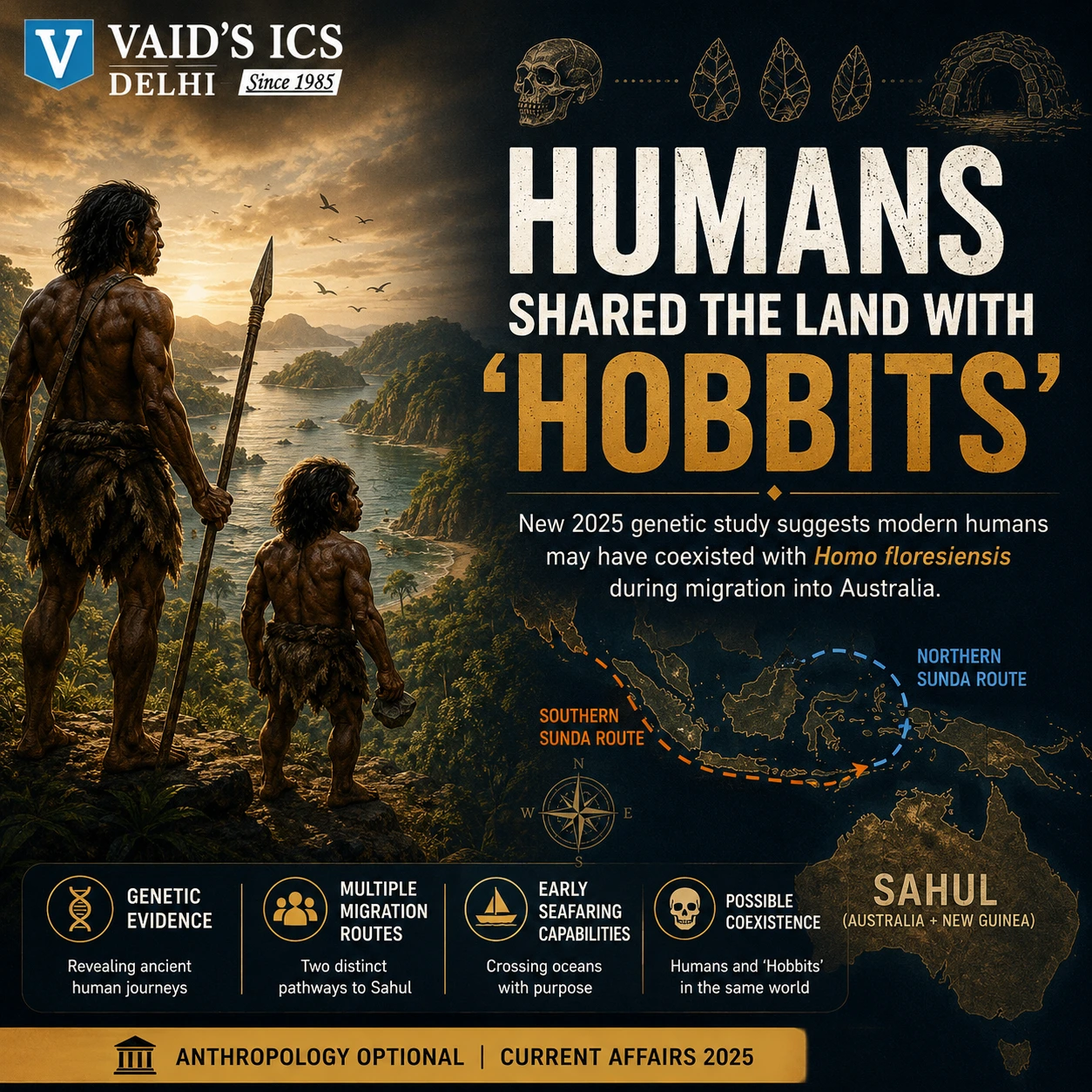
Every few years, a research paper appears that genuinely changes how we think about human evolution. This 2025 study by Francesca Gandini and colleagues is one of them.
For decades, students learned human migration as a relatively clean story: modern humans left Africa, moved through Asia, and eventually reached Australia. But recent genetic research is showing that the process was far more complicated. Different migration routes existed, populations separated and regrouped, and early modern humans may have travelled through regions already occupied by other human species.
That is what makes this study important.
The research suggests that one of the migration routes used by early modern humans passed through the same Indonesian island region where Homo floresiensis — the so-called “Hobbits” — were still living.
The study does not claim direct interaction. But the overlap in geography and chronology is strong enough to raise an important paleoanthropological question:
Were modern humans and Homo floresiensis living in the same broader landscape at roughly the same time?
For Anthropology Optional students, this matters because it connects several themes together in a single case study:
- Human evolution
- Fossil evidence
- Out of Africa migration
- Behavioral modernity
- Human adaptation
- Genetics and paleoanthropology
More importantly, it gives you a contemporary example that can enrich answers beyond standard textbook material.
Who Were Homo Floresiensis?
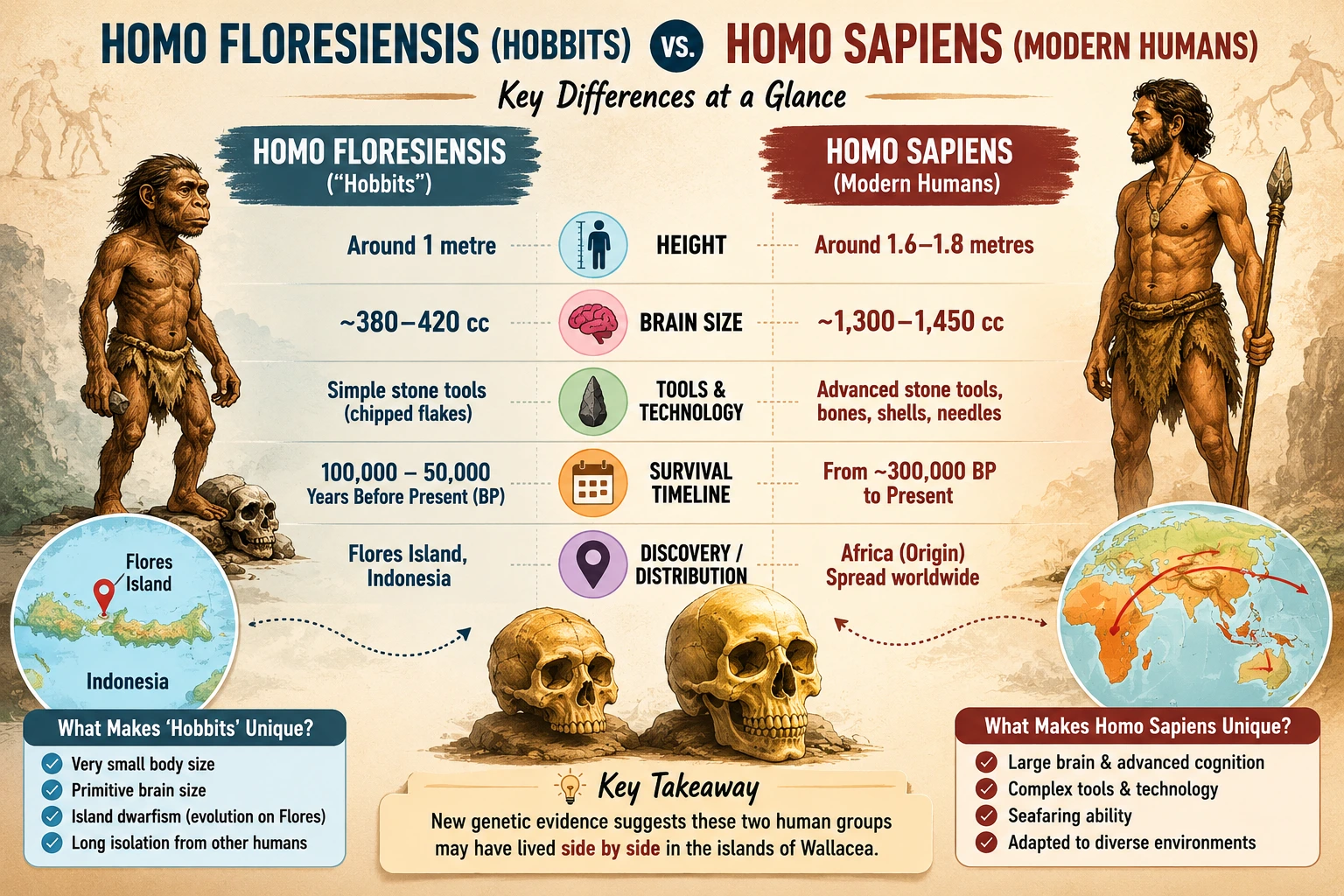
Homo floresiensis was discovered in 2003 in Liang Bua Cave on Flores Island, Indonesia. The discovery immediately attracted global attention because the fossils represented a small-bodied human species that survived surprisingly late in prehistory.
The species stood roughly one metre tall and had a brain size much smaller than modern humans. Yet archaeological evidence showed that they were capable of making and using stone tools.
That combination challenged older assumptions about intelligence and brain size.
Earlier evolutionary models often linked cognitive sophistication directly with larger cranial capacity. Homo floresiensis complicated that idea. Despite their small brains, they appear to have displayed organized behaviour and technological capability.
| Discovery Site | Liang Bua Cave, Flores Island, Indonesia |
| Discovery Year | 2003 |
| Estimated Height | Around 1 metre |
| Brain Size | Approximately 380–420 cc |
| Survival Timeline | Roughly 50,000–60,000 years ago |
| Tool Use | Stone tools present |
| Evolutionary Debate | Possibly descended from Homo erectus |
Why Were They Called “Hobbits”?
The nickname came from popular science reporting after the discovery. Their short stature and unusual appearance reminded researchers and journalists of the fictional Hobbits described by J.R.R. Tolkien.
But in anthropology, the nickname itself is not important.
What matters scientifically is what Homo floresiensis tells us about human diversity during the Late Pleistocene. The species demonstrates that multiple hominin populations existed simultaneously and adapted differently to their environments.
The Idea of Insular Dwarfism
One of the most important concepts linked with Homo floresiensis is insular dwarfism.
This refers to the evolutionary tendency of island-dwelling species to become smaller over long periods due to limited food resources and ecological isolation.
Flores Island provided exactly those conditions.
Many anthropologists consider Homo floresiensis one of the clearest hominin examples of insular dwarfism. The concept is useful not only for Anthropology Optional but also for understanding broader evolutionary adaptation.
What Did the 2025 Study Actually Find?
The Gandini et al. study examined genetic evidence connected with the migration of early modern humans into Sahul — the ancient landmass that once combined Australia, New Guinea, and Tasmania.
During the Late Pleistocene, sea levels were lower than today, exposing large stretches of land. Even then, reaching Sahul still required ocean crossings.
That detail is important.
The migration was not simply accidental drift. It likely involved planning, navigation, and coordinated movement.
The major finding of the study is that early humans appear to have used two different migration pathways while moving toward Sahul.
Route One: Southern Sunda Route
This route passed through parts of Indonesia, including regions associated with Homo floresiensis.
Route Two: Northern Sunda Route
This pathway moved through the Philippines and nearby island systems before turning toward Sahul.
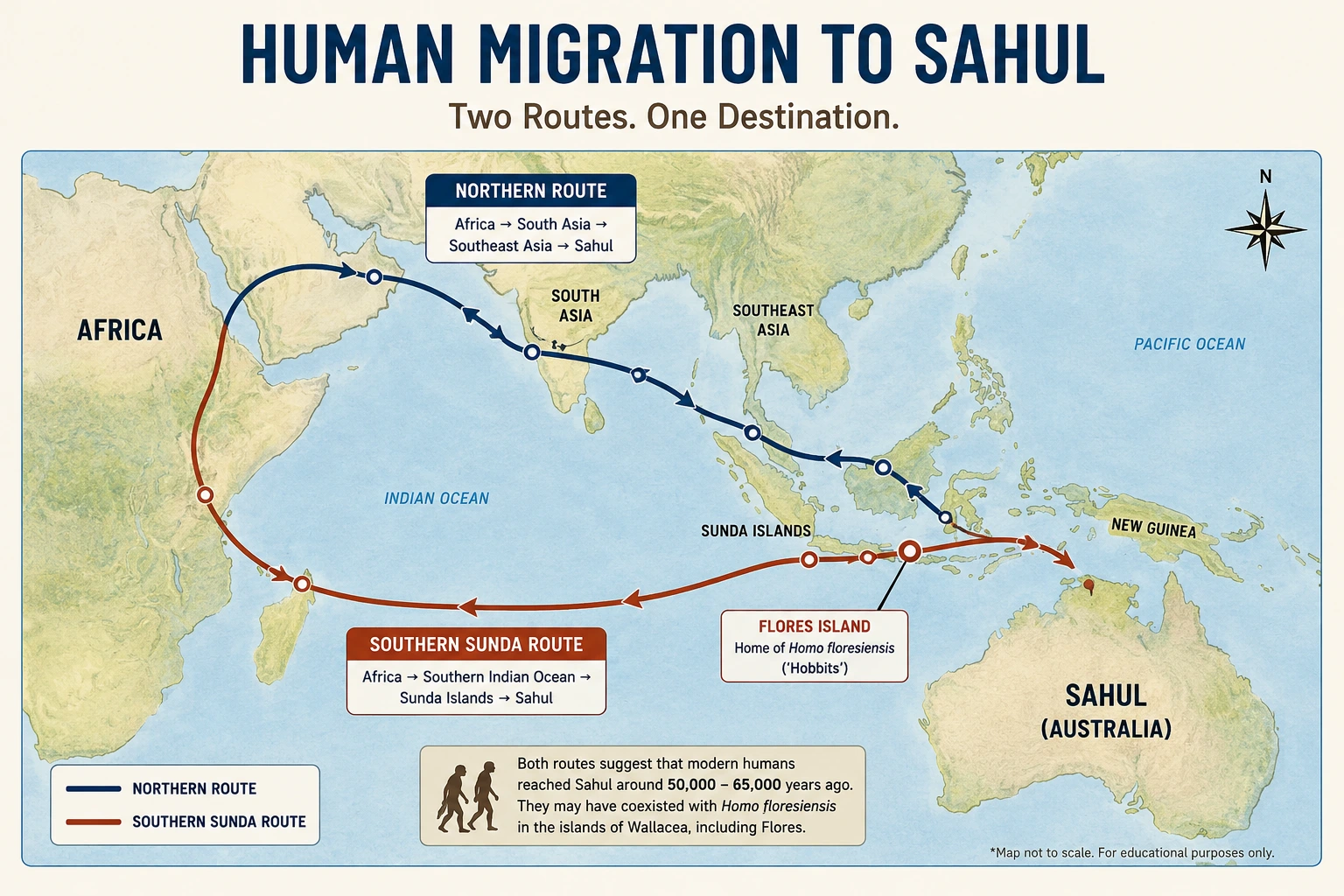
Genetic analysis showed that both groups ultimately shared ancestry from the same African population, supporting the broader Out of Africa framework. However, the migration pattern itself appears more complex than earlier simplified models suggested.
The Most Interesting Question: Did They Coexist?
This is where the study becomes especially fascinating.
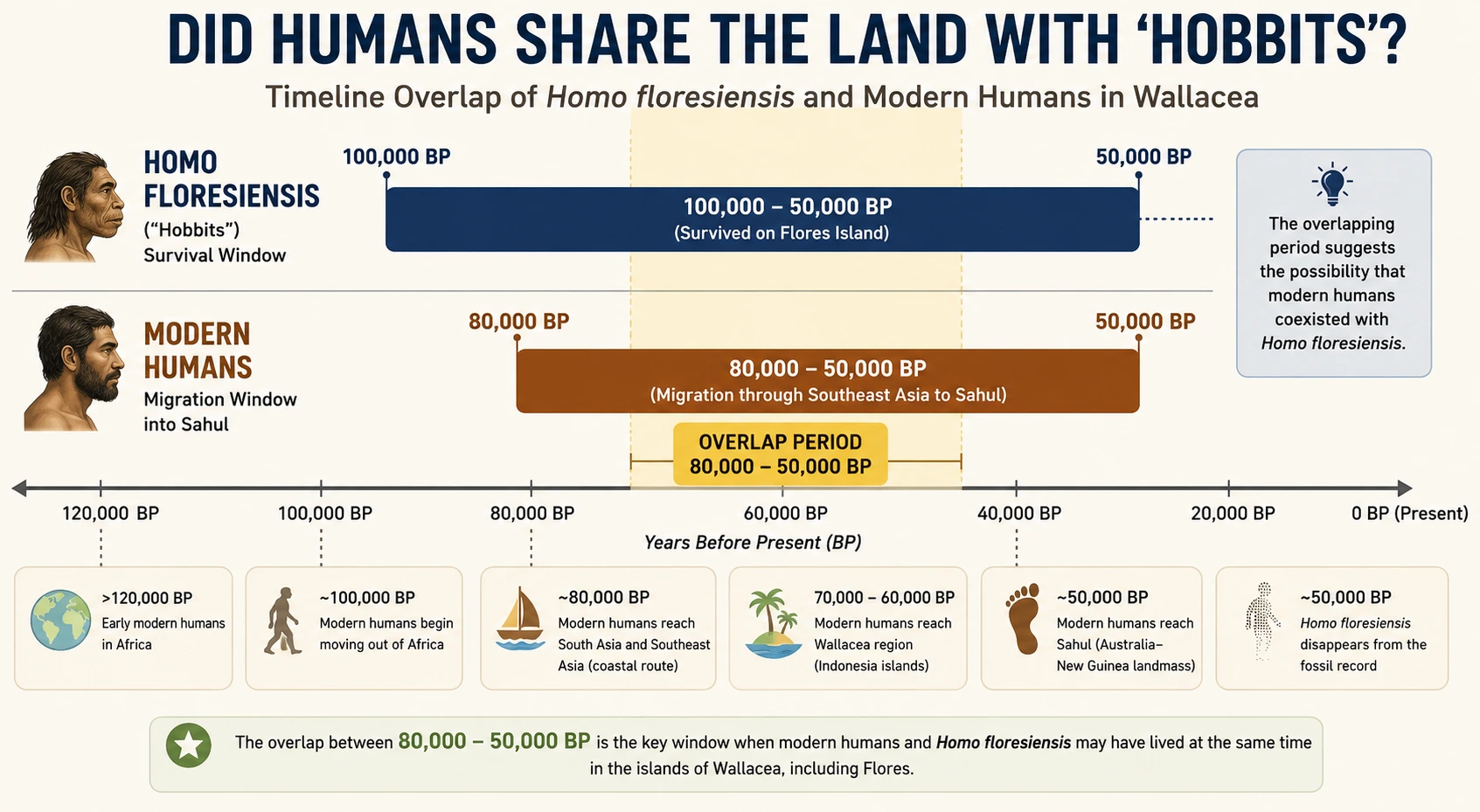
Homo floresiensis survived until approximately 50,000–60,000 years ago. The migration timelines proposed in the new genomic study overlap with that period.
That overlap does not prove direct interaction.
However, many paleoanthropologists now consider coexistence scientifically plausible.
If that interpretation is correct, it means early modern humans were moving through landscapes already occupied by another hominin species.
That changes the way we think about migration.
Instead of imagining a simple human expansion into empty territory, we may need to think in terms of shared ecological spaces, competition for resources, and parallel populations adapting differently to island environments.
Some researchers remain cautious. Chronological overlap alone cannot establish direct contact. Fossil evidence from this period is still incomplete, and archaeology rarely provides perfectly linear narratives.
Still, the possibility itself is significant enough to deserve attention.
Why the Seafaring Angle Matters
One aspect of the study that deserves more attention is maritime capability.
Even with lower sea levels, humans travelling toward Sahul had to cross stretches of open water.
That implies:
- deliberate navigation
- group coordination
- environmental awareness
- planning ability
- adaptation to unfamiliar ecosystems
This pushes sophisticated human mobility further back in time than older theories once assumed.
For Anthropology Optional, this becomes useful while discussing:
- behavioral modernity
- cognitive evolution
- technological adaptation
- prehistoric migration
Where This Fits in Anthropology Optional
This topic connects multiple areas of the syllabus simultaneously.
Paper 1 Relevance
- Fossil Evidence
- Human Evolution
- Human Genetics
- Paleoanthropology
- Out of Africa Theory
- Prehistoric Cultures
Paper 2 Enrichment
- Human Ecology
- Adaptation
- Indigenous Populations
- Migration and cultural interaction
The advantage of such topics is that they improve analytical depth even when UPSC does not ask a direct question.
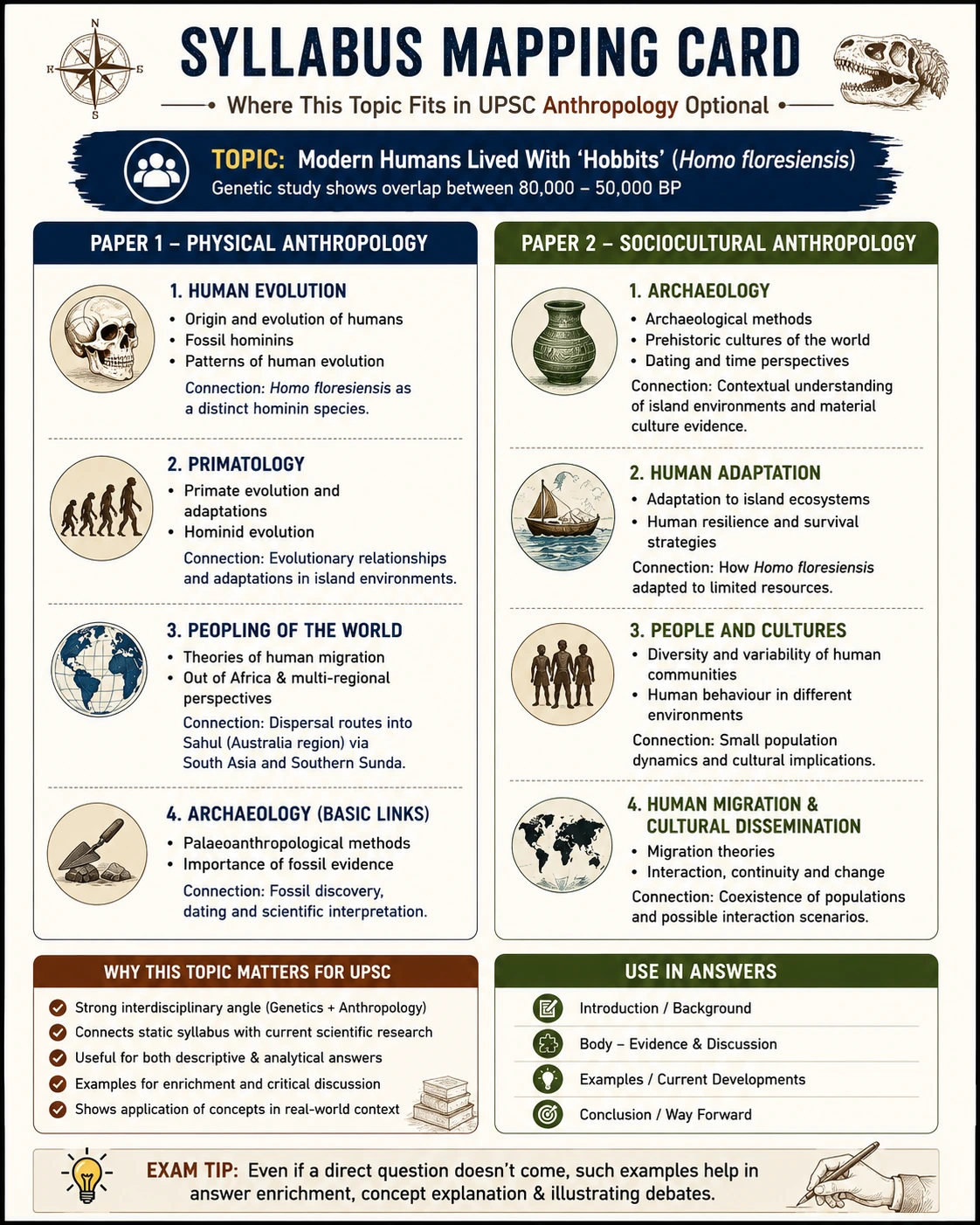
How You Can Use This in Answers
A common mistake among students is treating current affairs as isolated information.
That approach rarely helps.
The better method is to use recent studies as supporting evidence inside static topics.
For example, in a question on the emergence and dispersal of modern humans, this study can be used to:
- support the Out of Africa framework
- show migration complexity
- discuss coexistence with archaic hominins
- explain maritime capability
- connect genetics with paleoanthropology
One properly used contemporary example often creates more impact than several generic points.
A Broader Anthropological Lesson
Older textbooks often presented human evolution as a neat and linear process.
Modern research increasingly shows something different.
Human prehistory was messy, overlapping, adaptive, and geographically diverse. Multiple hominin species existed at the same time. Migration routes changed. Populations adapted differently to isolated environments.
The story of Homo floresiensis fits directly into that larger pattern.
And perhaps that is why the discovery remains so important more than two decades later.
Final Takeaway
Not every current affairs topic deserves long-term attention from Anthropology Optional students.
This one does.
It combines genetics, migration theory, fossil evidence, island adaptation, and behavioral evolution in a single interdisciplinary case study.
More importantly, it reflects the direction in which anthropology itself is moving — toward more integrated explanations using archaeology, genomics, ecology, and evolutionary science together.
That is exactly the kind of perspective UPSC increasingly rewards in high-quality answers.