
Most aspirants who open the Anthropology optional syllabus PDF for the first time make the same mistake. They read through it once, decide it looks manageable, and go looking for notes. A few weeks into preparation, sitting with a stack of handouts and coaching material, they realise they have been studying isolated pieces without any sense of how those pieces fit together. Genetics sits in one corner, kinship sits in another, tribe-caste continuum somewhere else — and the connection between them is unclear.
This is not a failure of effort. It is a failure of orientation. Nobody explained what the syllabus actually contains before preparation began.
This article is that explanation. We are going to walk through both papers — the way a mentor explains a new subject to a student sitting across a desk — in plain language, with honest observations about what each section actually contains and what it asks of you.
One clarification upfront. This article is specifically about understanding what the Anthropology syllabus contains — its architecture, its internal logic, and how Paper 1 and Paper 2 form one unified subject.

If you are looking for a preparation plan, a booklist, or a starting roadmap, those are covered in dedicated companion articles on VAIDS ICS.
| How to Start Anthropology Optional from Zero | Is Anthropology Good Optional for UPSC? |
That clarity about the syllabus, by the way, is not a minor or cosmetic thing. Aspirants who understand the architecture of the subject before they begin preparing study with more focus, write answers with more structural depth, and are far less anxious when a question combines topics they had mentally kept in separate compartments. The subject rewards people who see it whole.
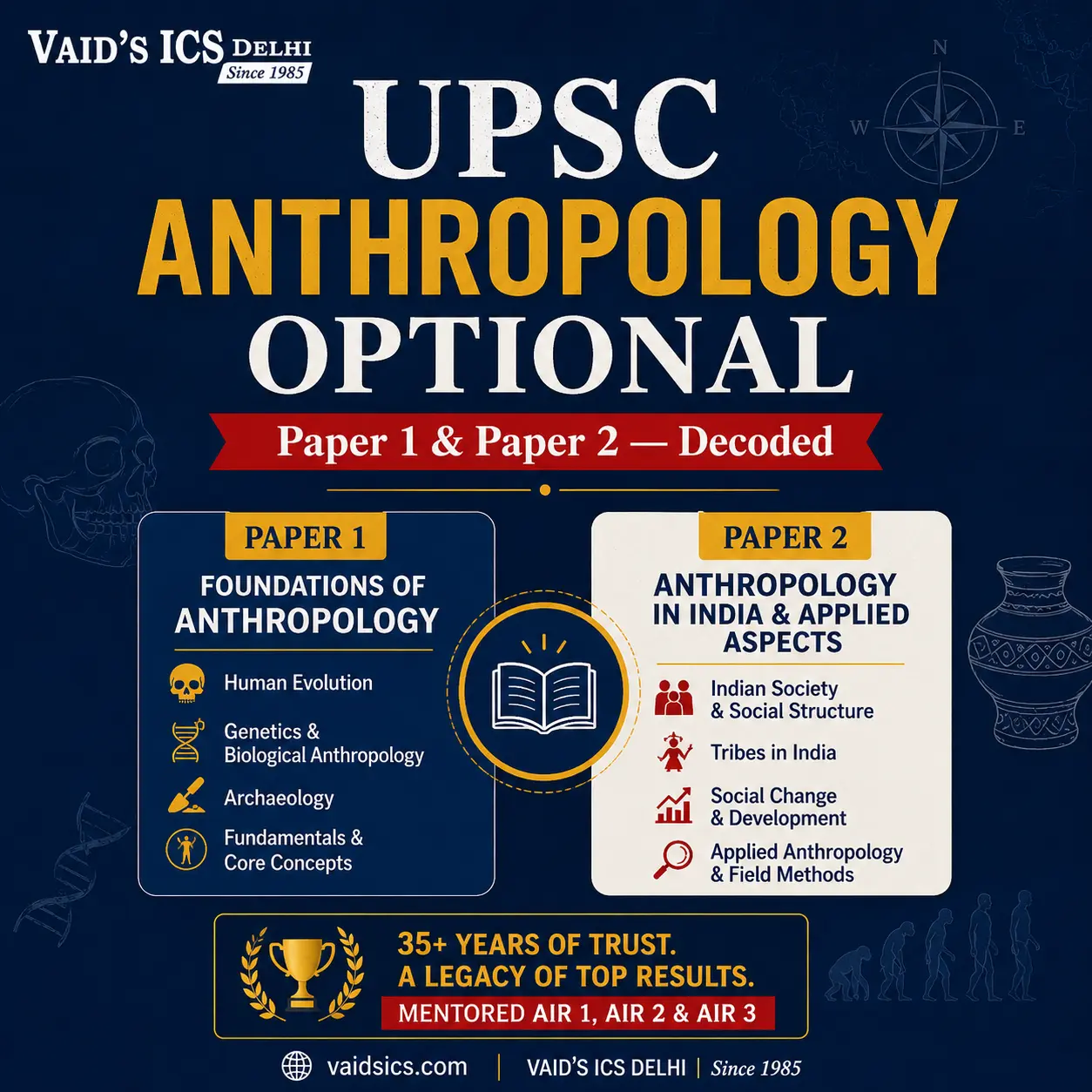
Anthropology optional consists of two papers — 250 marks each, 500 total. But the two papers are not simply two halves of the same content split arbitrarily for length. They represent two different levels of engagement with the same subject.
Paper 1 asks: What is Anthropology as a science of human beings? What concepts does it use? What theories has it developed? What does it know about human evolution, genetics, culture, kinship, economic and political organisation, religion, and prehistoric life? What methods do anthropologists use to study all of this?
Paper 2 asks: How do all of those things — every concept, every theory, every method — help us understand India? Its social structure, its tribal communities, its historical development, its contemporary conflicts, its constitutional choices?
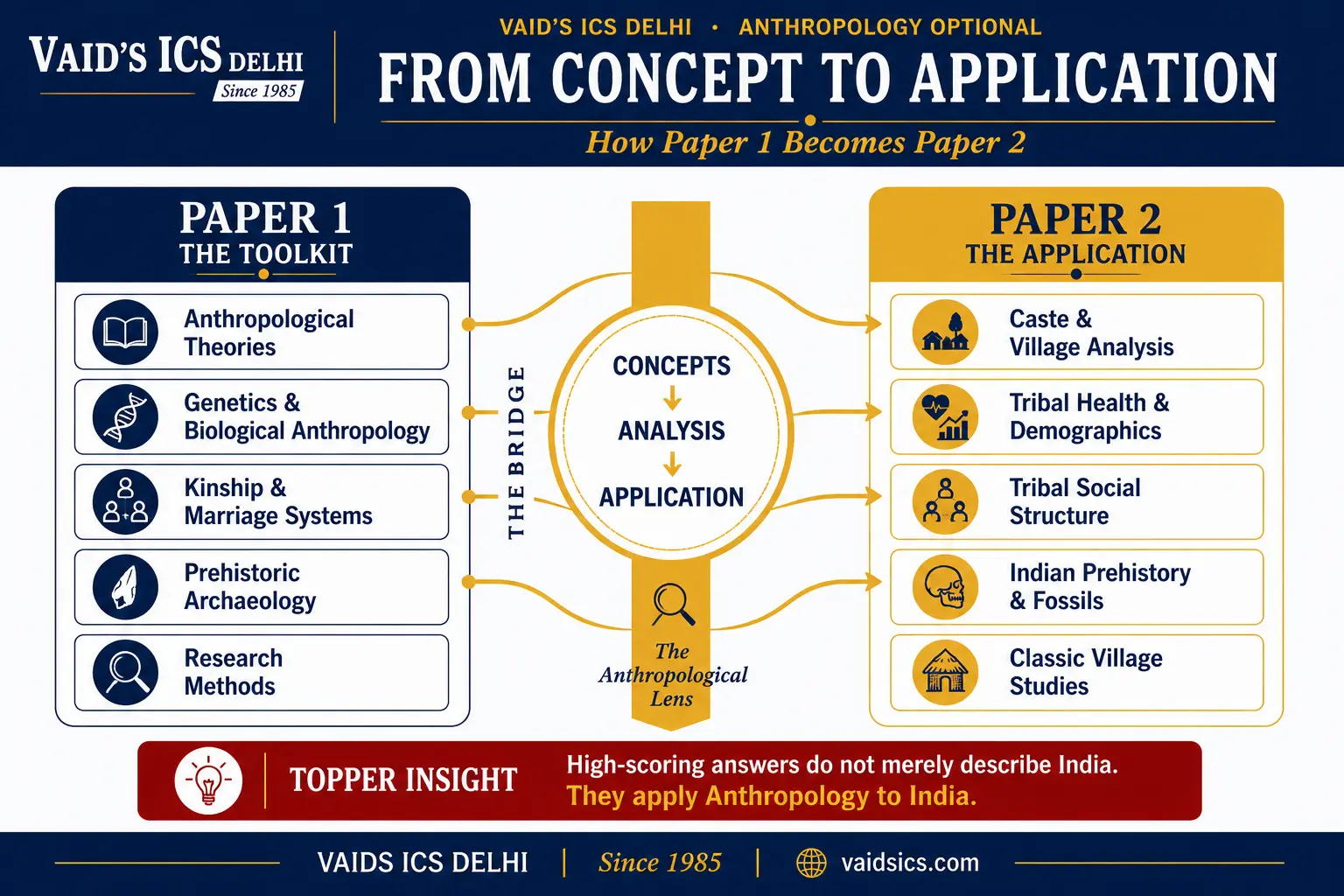
Think of it this way: Paper 1 builds an analytical vocabulary. Paper 2 requires you to use that vocabulary on a specific, familiar, and complex context — Indian society. A student who treats Paper 1 as background reading and focuses preparation on Paper 2’s facts and current affairs will write Paper 2 answers that are descriptive but analytically thin. A student who prepares Paper 1 conceptually will find that Paper 2 questions practically invite the frameworks already built.
This relationship — Paper 1 as toolkit, Paper 2 as the place where tools are used — is the structural insight that changes how you study this optional. Almost every strong Paper 2 answer has roots in Paper 1.
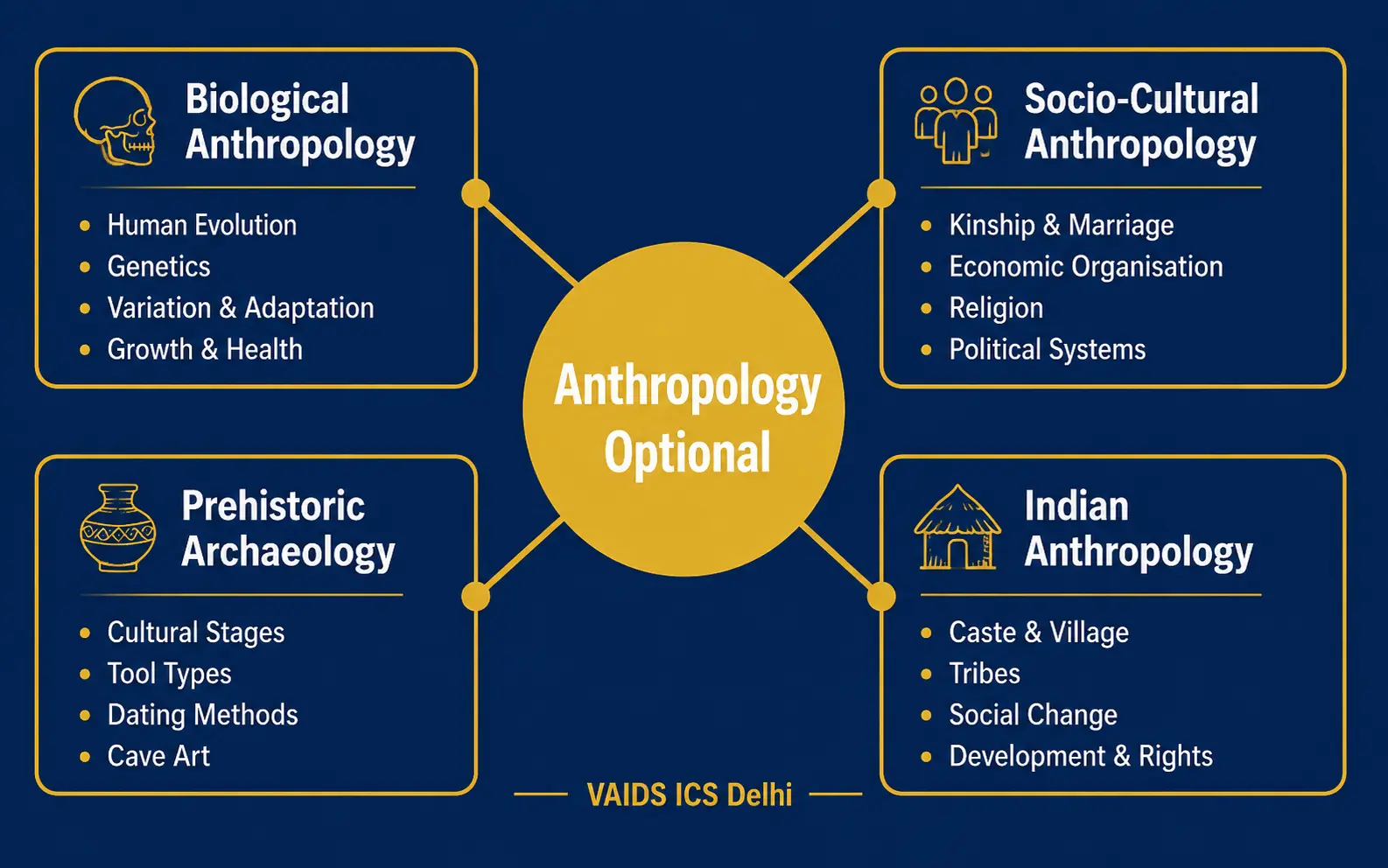
Below all the specific topics, four major intellectual threads run through the entire Anthropology optional. They appear in both papers, intersect with each other, and explain why the syllabus is designed the way it is.
Biological Anthropology — the study of human beings as biological organisms. Our evolutionary history, genetic makeup, bodily variation, adaptation to different environments, growth across the life cycle, and health. Paper 1 covers this as a universal science of the human body. Paper 2 brings it to India’s fossil record, tribal health patterns, and demographic questions.
Socio-Cultural Anthropology — the study of how human beings organise their collective lives. Culture, kinship, marriage, family, economic systems, political structures, religion, language. Paper 1 covers these as phenomena that appear across all human societies. Paper 2 studies their Indian forms — caste, village, tribal community, religious practice, and social change.
Prehistoric Archaeology — the reconstruction of human life before written records, through tools, bones, habitation sites, and art. Paper 1 covers global cultural sequences and the methods used to date and interpret them. Paper 2 brings this to India’s specific prehistoric evidence.
Indian Anthropology — the systematic study of Indian society, culture, tribes, and development through anthropological frameworks. This is primarily Paper 2’s domain, but it draws on all three threads above as its analytical base.
 |
Here is what the official document actually lists, in plain language.
Paper 1 — Six Areas: how Anthropology developed as a discipline; human evolution, genetics, biological variation, growth, and health; prehistoric archaeology from the Stone Age through the Iron Age; socio-cultural life — kinship, marriage, family, economic and political organisation, religion; anthropological theories from evolutionism to postmodernism; and research methods with applied Anthropology.
Paper 2 — Six Areas: Indian prehistoric and civilisational context; the traditional Indian social system — varna, caste, village, Jajmani; India’s tribes and the tribe-caste continuum; social change — Sanskritisation, Westernisation, modernisation; development and constitutional safeguards for SC/ST communities; and contemporary debates around displacement, ethnicity, and identity.
Twelve areas, two papers — not twelve separate subjects, but one subject at two different scales.
Paper 1 vs Paper 2 — The Big Picture
| Intellectual Thread | Paper 1 — Universal Science | Paper 2 — Applied to India | How They Connect |
|---|---|---|---|
| Biological Anthropology | Human evolution, genetics, variation, growth, epidemiology | India’s fossil record (Siwalik, Narmada), tribal health, demographic patterns | Biological concepts from P1 are the framework for India-specific health and genetic realities in P2 |
| Socio-Cultural Anthropology | Culture, kinship, marriage, family, economic and political organisation, religion | Caste, village, Indian tribal kinship, social change processes, folk religion | P1 social concepts appear in their Indian forms in P2 — same vocabulary, specific context |
| Prehistoric Archaeology | Global cultural stages, tool types, dating methods, prehistoric art and burial practices | Indian Palaeolithic, Mesolithic, Neolithic, Harappan civilisation, regional fossil evidence | Paper 2 is the Indian chapter of the global archaeological story told in Paper 1 |
| Anthropological Theories | Evolutionary to postmodern — full range of theoretical frameworks and their debates | Interpretation of caste structure, village organisation, tribal society, social change in India | Every analytical Paper 2 question expects a theoretical lens built in P1 |
| Research Methods & Applied Anthropology | Fieldwork, participant observation, genealogy, case studies; forensics, nutrition, development | Village studies, tribal studies methodology, development planning, policy programme evaluation | The fieldwork methodology of P1 is how classic Indian village and tribal studies were conducted |
Anthropology as a Discipline
Every subject begins by defining itself, and Anthropology is no exception. Here you study what Anthropology is — its scope, its branches, and how it relates to other fields.
Anthropology is distinctive for one reason: it studies human beings as a whole. Not just the body, not just society, not just the distant past. The biological and the cultural together, across time and across the full range of human diversity. This ambition — to understand human beings completely, not just one dimension of them — is what distinguishes it from sociology, biology, history, or linguistics, even when it draws from all of them.
You will also study how Anthropology developed and how it relates to adjacent disciplines. These relationships matter because they explain why the syllabus contains such apparently diverse content — evolution in the same paper as kinship, archaeology alongside research methods. The subject’s range is not accidental. It reflects a genuine intellectual commitment to studying humanity without artificial disciplinary limits.
This section is relatively compact but foundational. It answers the most basic question: what subject did I actually choose?
Biological Anthropology: The Human Story, Biologically Told
This section unsettles more beginners than any other, and almost always for the same reason: they expect it to feel like school biology. It does not. Biological Anthropology is not physiology or biochemistry. It is the biological history of the human species — told as a story that matters because it explains who we are and how we came to be.
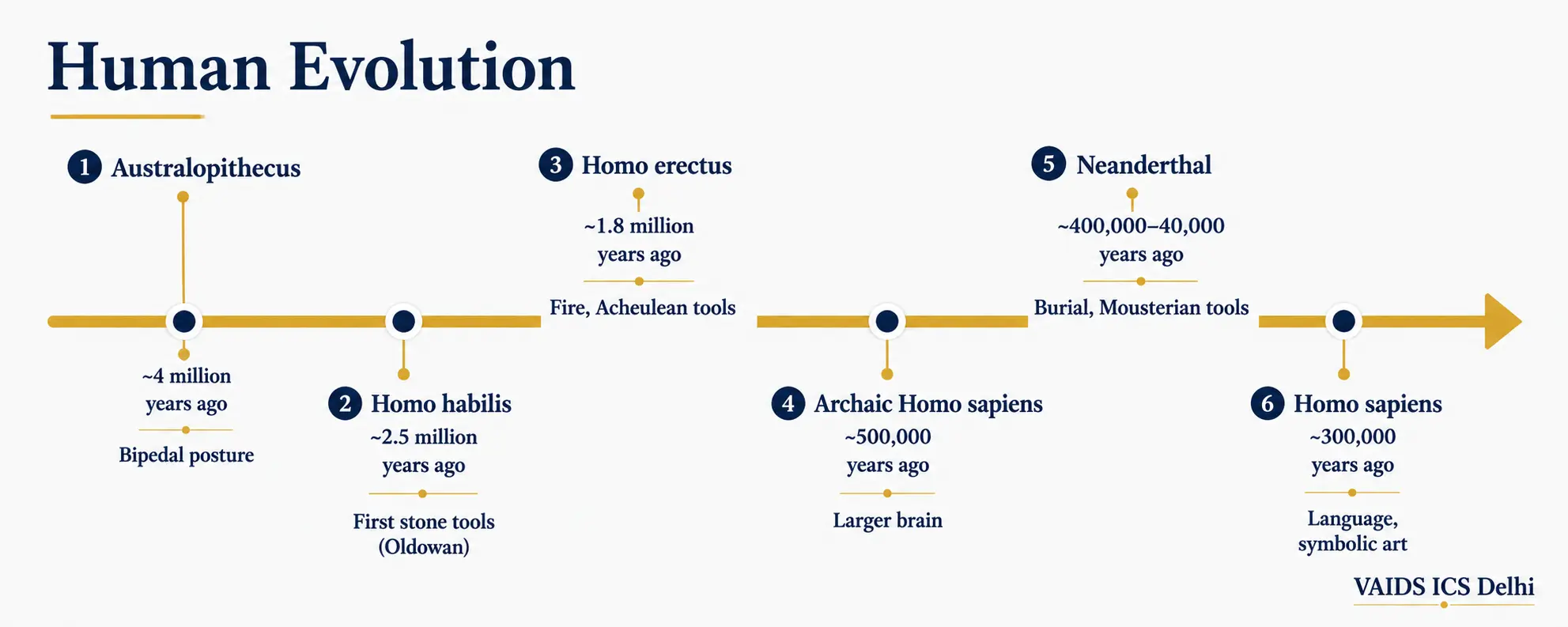
Human evolution is the centrepiece. You follow the evolutionary line from primate ancestors to anatomically modern humans — through Australopithecus, Homo habilis, Homo erectus, archaic Homo sapiens, Neanderthals, and Homo sapiens. But the point is not to memorise a list of names. It is to understand what changed at each stage and what those changes tell us about the emergence of distinctly human capacities: upright posture, freed hands for tool use, enlarged brain, language, symbolic thinking, and complex social life.
 |
Genetics enters here because evolution is driven by genetic processes. You will study chromosomes, genes, mutation, natural selection, genetic drift, gene flow, and the Hardy–Weinberg principle — but always in the context of human populations. Why does a particular genetic disorder cluster in a specific community? Why does population size affect genetic diversity? How has molecular genetics revised our understanding of human migration? These are the questions Anthropology asks of genetics, and they connect directly to Paper 2 discussions of tribal health and demographic patterns.
Human variation and adaptation studies the physical diversity of human populations as the product of ecological pressures. Melanin concentration near the equator, haemoglobin levels at altitude, body proportions in cold versus hot environments — these are biological adaptations, not aesthetic categories. This section connects Anthropology to ecology and gives you the framework to understand how human bodies respond to environments over time.
Human growth and epidemiological Anthropology rounds out this section. Growth here means the entire biological life course from conception to old age, shaped by genetic potential, nutritional status, disease history, and socio-economic conditions. Epidemiological Anthropology studies how health, disease, and mortality distribute across human populations — and why culture, environment, and history are central to that distribution.
Prehistoric Archaeology: The 99 Percent of Human History Without Written Records
Writing is a recent invention. For the overwhelming majority of our existence as a species, human beings lived, adapted, invented, and organised themselves without leaving documents. Prehistoric Archaeology is the discipline that reconstructs that long pre-literate past from physical evidence alone.
You will study the major cultural stages: Palaeolithic (Old Stone Age), Mesolithic, Neolithic, Chalcolithic, Bronze Age, Iron Age. Each stage represents a shift not just in tool types but in subsistence strategy, settlement pattern, and social complexity. A Lower Palaeolithic forager made large bifacial hand axes and lived in mobile bands. A Neolithic person cultivated plants, kept animals, lived in permanent villages, and made pottery. These are different ways of organising human life entirely, not just different objects.
Dating methods — how archaeologists establish the age of sites and artefacts — are part of this section. Stratigraphy, radiocarbon dating, potassium-argon dating, thermoluminescence — understanding these is not about memorising techniques. It is about understanding the evidential basis on which claims about prehistoric life are made.
Burial practices, cave art, and figurines appear here as evidence of symbolic thinking — raising the question of when distinctly human cognitive capacities (language, self-awareness, ritual) emerged and how we can infer them from material remains.
This section rewards visual thinking from day one. A student who draws cultural sequences as timelines and sketches representative tool types will find this section far more coherent than one who reads it only as text.
Socio-Cultural Anthropology: How Human Beings Organise Their Lives Together
This is the largest section in Paper 1 and the one with the most direct connections to every part of Paper 2.
Culture and society — the foundational concepts. Culture as the learned, shared system of meanings, values, and practices through which human beings make sense of the world and organise their behaviour. Two ideas from this section will recur constantly: ethnocentrism — judging another culture by your own standards — and cultural relativism — making the effort to understand a culture on its own terms before evaluating it. These are methodological commitments with real consequences for how fieldworkers observe and what conclusions they draw.
Kinship, marriage, and family — studied together because they are constitutively linked. Kinship is the system of socially recognised relationships based on descent, marriage, and adoption. It determines who is related to whom, what that relationship means for property and inheritance, where newly married couples live, and what mutual obligations flow between kin.
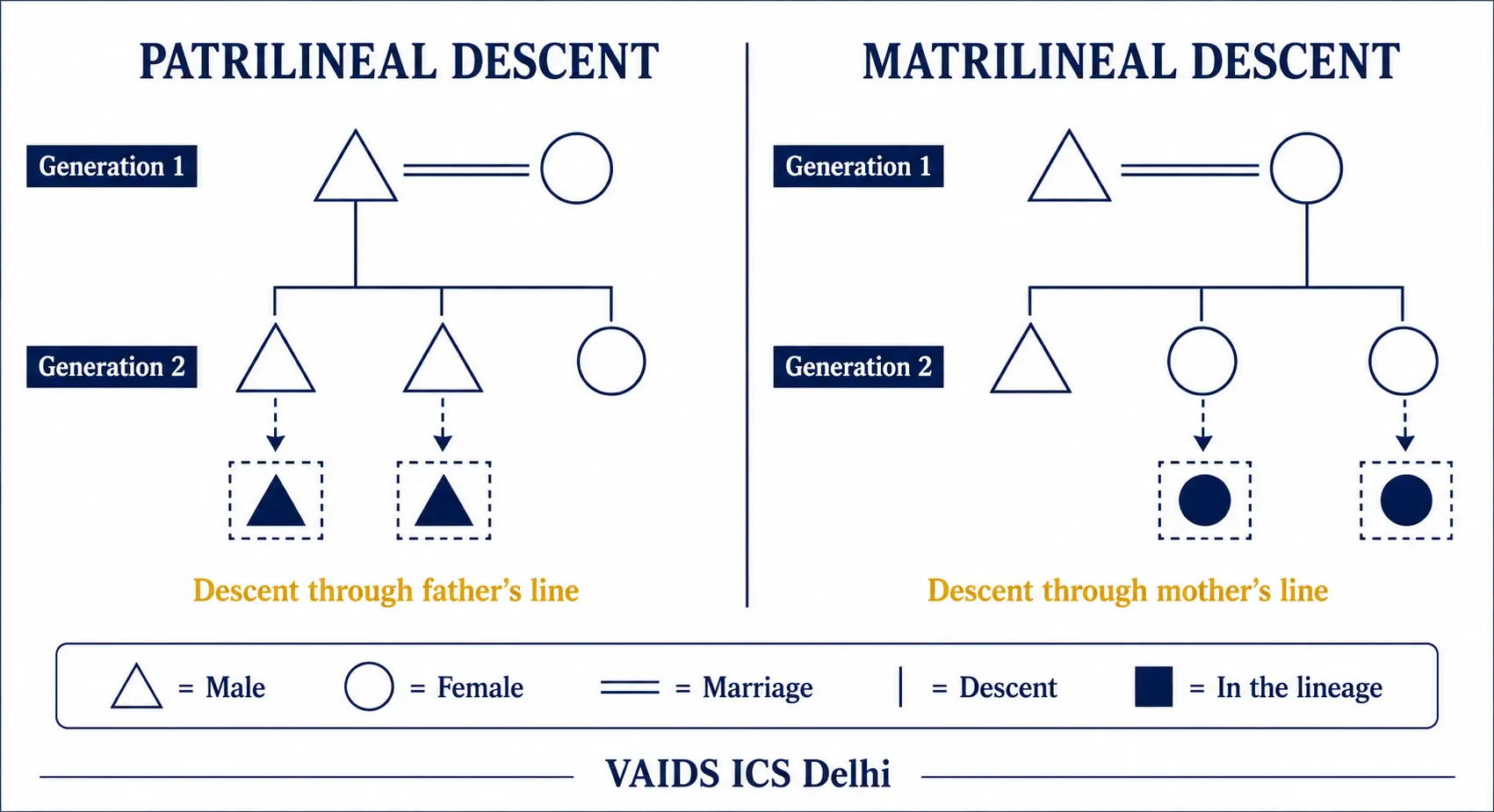
Descent systems — patrilineal (through the father’s line), matrilineal (through the mother’s), bilateral (through both), double descent (both for different purposes) — are the structural backbone of many social systems. Marriage rules determine who may and may not be married, what payments are exchanged, and what different forms marriage can take. When you reach Paper 2 and encounter caste endogamy, the gotra system, tribal cross-cousin marriage rules, and customary inheritance law, these Paper 1 concepts are the tools you will use to think clearly about them.
 |
Economic and political organisation — from hunting-gathering bands to agricultural chiefdoms to modern states, human beings have organised production, distribution, and power in fundamentally different ways. The major forms of economic organisation (foraging, pastoralism, horticulture, agriculture, industrialism) and political organisation (band, tribe, chiefdom, state) are studied comparatively. These are frameworks for understanding what happens when communities organised on one set of principles are absorbed into systems organised on entirely different ones — a question central to Paper 2’s treatment of tribes and development.
Religion and symbolic systems — Anthropology studies what religion does in human communities: how it creates solidarity, how it organises ritual, how it maps the world into meaningful categories, how it justifies social hierarchies or challenges them. You will study animism, totemism, shamanism, magic, and more complex religious systems. The debates between Durkheim (religion as social solidarity), Malinowski (religion as response to anxiety), and Geertz (religion as a system of symbols) give you multiple analytical lenses for the same phenomena. In Paper 2, these lenses help you interpret Indian tribal religion, folk practice, and the complex relationship between caste ideology and religious authority.
Anthropological Theories: Different Lenses, Not a Memory Exercise
This is the section most beginners approach incorrectly, and almost always for the same reason — they treat it as a list of names and dates rather than as a series of genuine intellectual positions about how human society should be understood.
Theories in Anthropology are not arbitrary. They form a conversation across time — each framework developed in response to the limitations of the one before it. Nineteenth-century evolutionism claimed all societies move through the same developmental sequence. Diffusionism challenged this by showing cultural traits travel across societies through contact. Functionalism rejected developmental questions entirely and asked instead how a society works right now — what each institution does for the whole. Structural-functionalism added social structure as the explanatory focus. Culture-and-personality brought in psychological dimensions. Structuralism looked for deep mental patterns underlying cultural surface variation. Cultural materialism put material conditions and technology back at the centre. Symbolic and interpretive anthropology focused on meaning and the insider’s perspective. Postmodern critiques questioned the authority of the ethnographer to represent others at all.
Each of these frameworks was a response to a real question that earlier frameworks could not adequately answer.
For the examination, what matters is not just being able to explain each theory but being able to use it as a lens. “Analyse the caste system from a structural-functionalist perspective.” “How does cultural materialism help us understand tribal economy?” These are the actual question patterns. They require you to move from theoretical statement to Indian application — and that move requires genuine understanding, not surface familiarity with names.
The most effective way to study anthropological theories is to approach each one as an answer to a question someone was genuinely struggling with. Malinowski did not invent functionalism as a set of terms to memorise — he developed it because the question “why do Trobriand Islanders follow customs that seem irrational from the outside?” could not be answered by evolutionary or diffusionist thinking. When you know the question a theory was designed to answer, the theory makes sense. When you know what that theory missed — which is why the next one emerged — you can use it critically rather than just recite it. That critical use is what separates average theoretical answers from genuinely good ones.
Research Methods and Applied Anthropology
Fieldwork — extended, first-hand, participatory research in a living community — is the methodological signature of Anthropology. You will study participant observation, ethnographic interviewing, the genealogical method, life history, case studies, and the logic of qualitative fieldwork. The methodological debates within this section — objectivity versus reflexivity, the observer effect, the ethics of researching vulnerable communities — are substantive and occasionally appear in examination questions.
Applied Anthropology covers how anthropological knowledge is used in practical domains: forensic identification of human remains, nutrition and health programming, sports science, ergonomics, disaster response, and development planning. This section matters both for direct examination questions and because it connects to Paper 2’s extensive treatment of development and tribal policy.
Paper 1 — Difficulty Orientation for Beginners
| Topic Block | Why Beginners Find It Difficult | What It Actually Requires |
|---|---|---|
| Human Evolution | Too many fossil names; feels like rote learning | Understand each stage as a change in lifestyle and capacity, not just anatomy — see it as a story |
| Genetics | Technical terms feel like school chemistry or biology | Focus on population genetics as human context — disease, variation, migration — not formulas |
| Prehistoric Archaeology | Cultural stages feel similar; tool names seem arbitrary | Group by cultural stage; use timelines and simple tool sketches to make sequences visual |
| Anthropological Theories | Many theorists, many debates — volume is overwhelming | Learn each theory as a response to a specific intellectual problem, not as vocabulary to memorise |
| Socio-Cultural Anthropology | Appears accessible but has layers of conceptual depth | Go beyond definitions; actively connect each concept to Indian examples before moving on |
| Research Methods | Often treated as peripheral and deprioritised | Understand the methodological debates; connect methods to classic Indian village and tribal fieldwork |
Paper 2 is India as the subject of anthropological inquiry. Everything built in Paper 1 now meets its application. The content is specific to India, but the analytical vocabulary is entirely from Paper 1.
Indian Prehistoric and Civilisational Context
Paper 2 begins where Paper 1’s archaeology section ends — but now the stage is specifically India. You will study the Palaeolithic record (the Soan Valley, Acheulean tool traditions of the Deccan and Central India, south Indian prehistoric sequences), Mesolithic art (Bhimbetka), Neolithic cultures, Chalcolithic settlements, and the Bronze Age Indus Valley Civilisation.
India’s hominid fossil evidence gets specific attention: the Siwalik fauna of the Himalayan foothills, the Narmada skull and what it tells us about early human presence in the subcontinent. These are not disconnected facts — they are the Indian chapter of the evolutionary and archaeological story from Paper 1.
The Indus Valley Civilisation is studied in anthropological terms: as a complex urban society with specific patterns of economy, craft specialisation, urban planning, trade networks, and still-undeciphered symbolic systems. The question of cultural continuity from Harappa to later Indian traditions is an active scholarly debate and an occasional examination topic.
The Traditional Indian Social System: Varna, Caste, and Village
This is the conceptual heart of Paper 2, and it receives sustained attention across multiple sections of the syllabus.
The ideological framework of traditional Indian society — the varnashrama model, the principles of karma and dharma, ritual purity and pollution — is studied not as a belief system to endorse or condemn, but as a system that organised social life for centuries and continues to shape everyday realities. The approach is analytical, not evaluative.
The caste system is studied across several dimensions: its internal structure, the debates about its origins (religious ideology, economic specialisation, colonial administration, or a combination), and its contemporary dynamics. Key conceptual tools include M.N. Srinivas’s concept of dominant caste, the idea of caste mobility, the sacred complex (Robert Redfield and McKim Marriott), and the tribe-caste continuum (F.G. Bailey). These are not names to collect but frameworks to think with.
The Indian village is studied as a social universe — not just a settlement but a microcosm of the wider social order, organised around caste hierarchy, the Jajmani system of functional interdependence, sacred geography, and local political dynamics. Village studies as a methodology — from M.N. Srinivas’s work in Rampura to S.C. Dube’s study of Shamirpet to McKim Marriott’s work in Kishangarhi — are part of the section.
India’s Tribes: Not Primitives, Citizens with Specific Histories
The tribal section is one of the richest parts of the syllabus intellectually, and consistently one of the most tested.
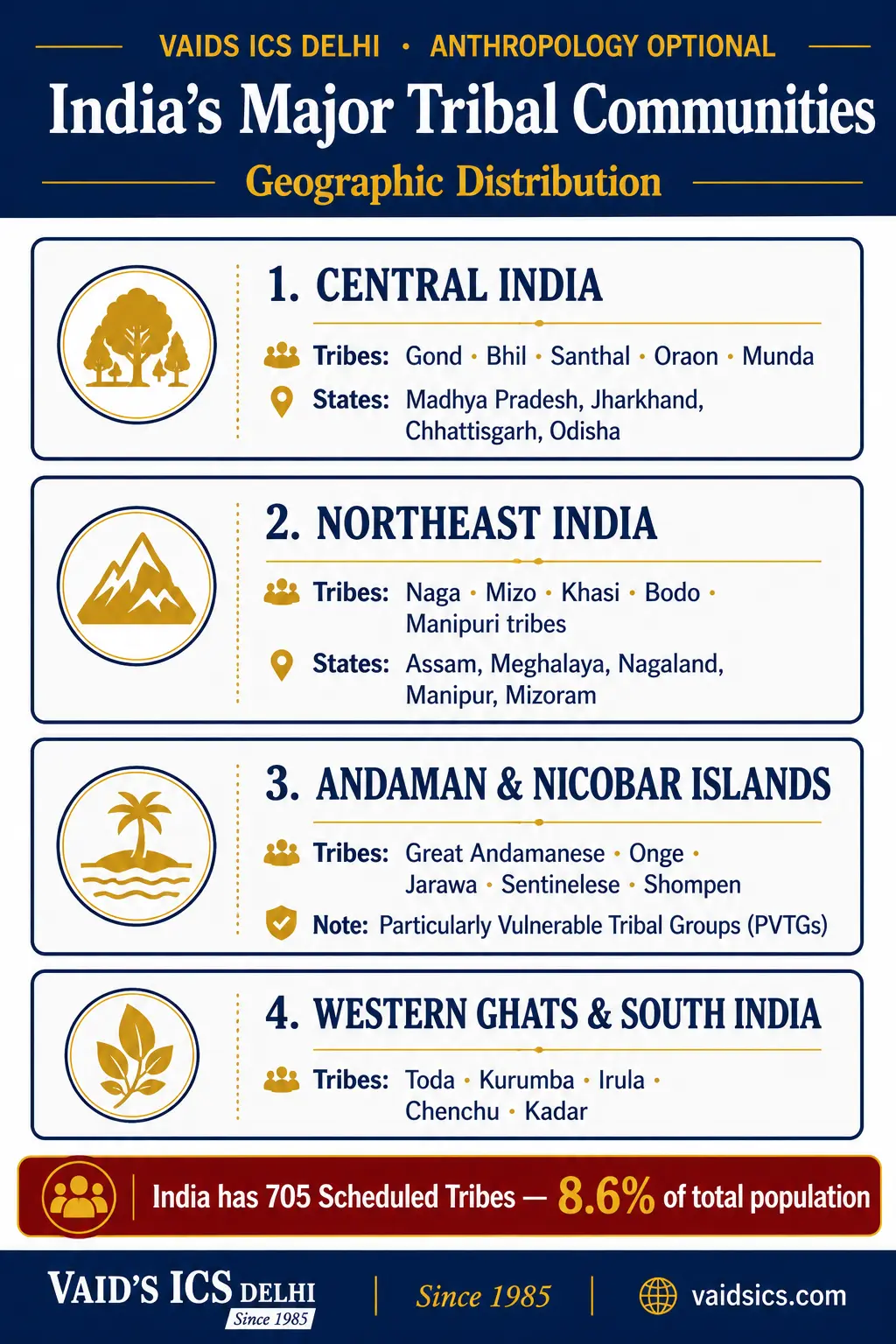
You will study India’s tribal communities in terms of their demographic spread, linguistic diversity, and geographic distribution — from Central India’s Gond, Bhil, and Santhal communities to the Northeast’s complex ethnic landscape to the Andaman Islanders. But the more important analytical work involves understanding what a “tribe” actually is — and is not — in the anthropological sense.
The tribe-caste continuum is one of the most productive conceptual frameworks here. Tribal and caste communities are not rigidly separate social types. Many communities occupy positions along a continuum between fully tribal and fully caste-integrated social organisation, and that positioning is itself the result of historical processes — trade, migration, conquest, religious conversion, and state incorporation.
The tribal situation — the specific vulnerabilities tribal communities face in contemporary India — includes land alienation, indebtedness, displacement by development projects, health and nutritional deficits, marginalisation from formal education, and underrepresentation in economic and political institutions. These are not problems to list. They are structural patterns to analyse.
 |
Social Change, Development, and Constitutional Safeguards
India is not a static society, and this section studies the processes through which it changes and has changed.
Sanskritisation (M.N. Srinivas’s concept of lower castes adopting upper-caste ritual practices and cultural markers to claim upward social mobility), Westernisation, modernisation, secularisation, and the interplay between Little Traditions and Great Traditions (Robert Redfield’s framework) are the major frameworks for understanding directional change. Each addresses a different dimension of how Indian society absorbs, resists, and adapts to pressures from within and outside.
Constitutional safeguards for Scheduled Castes and Scheduled Tribes are studied in terms of their rationale — what historical injury they are responding to, what the logic of protective discrimination is — and in terms of what their implementation has and has not achieved. This is not a legal topic here; it is an analytical one.
Development programmes — tribal sub-plans, Particularly Vulnerable Tribal Groups (PVTG) schemes, forest rights legislation, Fifth and Sixth Schedule governance frameworks — are studied in terms of design logic and on-ground outcomes, not as lists to memorise.
Contemporary Debates: Ethnicity, Displacement, and Identity
This is where the syllabus connects most directly to ongoing realities in India, and where questions increasingly expect engagement with current events and unresolved tensions.
Ethnicity — the social organisation of cultural difference, the assertion of cultural identity as a basis for political claims — is a major theme. Northeast India’s ethnic politics, the politics of tribal identity, SC community mobilisations, and regional autonomy movements are the Indian forms in which ethnicity theory becomes concrete.
Tribal displacement by infrastructure projects, mining operations, and wildlife conservation initiatives is one of the most contested policy areas in Indian public life. The syllabus expects you to engage with this analytically, understanding the positions of the state, the tribal community, environmental advocates, and development economists.
Religious change among tribal communities — conversion movements, syncretic practices, revivalist movements — raises questions about identity, cultural continuity, and the relationship between tribal communities and the Indian nation-state that go well beyond the religious question itself.
A common preparation mistake in Paper 2 is treating it like a current affairs accumulation exercise — track the schemes, memorise the Acts, list the tribal problems. That approach produces average marks. The questions that carry real weight ask you to think: Why does land alienation persist despite protective legislation? What does forced displacement do to a tribal community’s kinship structure and sense of cultural continuity? How should we evaluate the effectiveness of PVTG programmes when “vulnerability” itself is contested? Paper 2 rewards the student who can think through a problem — who brings analytical vocabulary to specific Indian realities — not the one who can list the most items about it.
The Bridge: How Paper 1 Lives Inside Paper 2 Questions
 |
This section matters more than any other, and it is the one most often read too quickly.
Paper 2 questions are not asking for descriptions of Indian society. They are asking for anthropological analysis of Indian society. That analysis requires the concepts, theories, and frameworks built in Paper 1. The bridge between the two papers is not symbolic — it is structural. It is how the examination actually works.
A question on the persistence of caste hierarchy is not answered well by describing caste features. It is answered better by a student who brings structural-functional analysis (caste as a system where each part serves the whole), M.N. Srinivas’s concept of dominant caste (power operates through land and numbers, not just ritual rank), and a critical note on functionalism’s tendency to justify existing inequalities — all drawn from Paper 1.
A question on tribal health deficits connects to genetics and population isolation (Paper 1), ecological stress and dietary adaptation (Paper 1), disrupted economic systems and subsistence change (Paper 1 economic anthropology), and specific policy failures (Paper 2 development). A student who has only the second thread writes a surface answer.
A question on tribal displacement connects to ecological anthropology (the relationship between a community and its resource environment), economic anthropology (disruption of subsistence systems), ethnicity theory (displacement as identity crisis and political flashpoint), and development theory (trade-offs between national development and local rights). These connections are all available in Paper 1, waiting to be applied.
Topic Interconnection — Paper 1 Concepts in Paper 2 Questions
| Paper 1 Concept | Paper 2 Application | Nature of the Connection |
|---|---|---|
| Structural-functionalism | Jajmani system, caste hierarchy as functional division of labour, village studies | Theoretical lens applied to interpret traditional Indian social organisation |
| Population genetics and genetic drift | Tribal consanguinity, genetic disorders in geographically isolated communities, tribal demography | Biological concept from P1 applied to India-specific health and demographic context |
| Prehistoric cultural stages and tool typology | Indian Palaeolithic, Mesolithic, Neolithic, Harappan sequences | Global archaeological framework applied to Indian prehistoric evidence |
| Kinship and descent systems | Caste endogamy and the gotra system, tribal cross-cousin marriage rules, matrilineal communities of Northeast India | Social organisation concepts applied to Indian caste and tribal marriage and property rules |
| Ethnicity theory | Northeast India autonomy movements, tribal identity politics, SC political mobilisation | Social theory from P1 applied to contemporary Indian political realities |
| Ecological anthropology | Tribal communities and forest resource dependence, displacement and livelihood loss | Adaptation concept from P1 applied to Indian tribal displacement debates |
| Research methods / village study methodology | Srinivas in Rampura, Dube in Shamirpet, Marriott in Kishangarhi | The fieldwork methodology from P1 is how India’s canonical village studies were conducted |
| Culture change theory (Sanskritisation, etc.) | Social mobility in Indian caste system, tribe-caste continuum, direction of tribal social change | Frameworks developed from Indian data in P1 applied back to contemporary Indian transformations |
| Epidemiological anthropology | Tribal nutritional deficits, maternal and child health in tribal communities, health disparities | Health and disease framework from P1 applied to India’s tribal and marginalised populations |
The High-Value Zones: Where the Syllabus Clusters
Some areas of the Anthropology syllabus are deeply interconnected — one concept opens into three or four others, and questions from these zones demand that you draw on multiple threads simultaneously. Understanding where these clusters are helps you prioritise which areas need conceptual depth rather than surface familiarity.
The social change cluster — Sanskritisation, Westernisation, modernisation, secularisation, and the Little-Great tradition framework form an interconnected set of ideas about how Indian society changes direction. A question on any one of these will typically reward a student who can bring in the others comparatively.
The biology-India bridge — genetics, human variation, tribal health, consanguinity, demographic patterns. This cluster connects the technical biological content of Paper 1 to genuinely contemporary Indian questions. This is where the subject’s apparent boundary between science and social science collapses most usefully.
The theory-application cluster — every major theoretical framework in Paper 1 has at least one clear Indian application in Paper 2. Functionalism and caste. Structuralism and kinship. Cultural materialism and tribal economy. Symbolic anthropology and Indian religious practice. Learning to move fluently between theoretical statement and Indian example is the core intellectual skill this optional is designed to build.
The tribes-rights-development cluster — tribal situation, constitutional safeguards, displacement, PVTG programmes, ethnicity, and regional autonomy movements converge in this zone. It is where static conceptual knowledge meets dynamic current events, and where the ability to think analytically rather than accumulate information makes the decisive difference in marks.
Looking at the pattern of questions across UPSC Anthropology examinations, certain thematic areas attract consistent attention.
Caste — its structure, dynamics, contemporary forms, and ongoing debates — appears regularly across both papers. No serious preparation of Paper 2 can treat caste as a peripheral topic.
Tribal issues — land alienation, displacement, health, development programming, constitutional provisions — are consistently tested, and the nature of these questions has shifted perceptibly toward analytical and evaluative formats rather than descriptive ones.
Theoretical frameworks and their application to Indian society is a recurring pattern. Questions ask you to use a theory, critique it, or compare theoretical perspectives on a specific Indian institution.
The genetics-India bridge appears with enough regularity across both papers that students who consider biological anthropology “the less important half” typically underperform in ways they did not anticipate.
Prehistoric archaeology and Indian fossil evidence appear with moderate frequency. When they do appear, a student who can produce a clean, labelled diagram has a visible advantage over one who can only describe in prose.
Coming Soon: Anthropology PYQ Analysis — Year-by-Year Breakdown
The Anthropology syllabus is largely static — the theories, the fossils, the kinship concepts, and the cultural stages do not change from year to year. But the questions are dynamic. UPSC takes the same permanent knowledge base and connects it to contemporary debates, recent government reports, evolving policy frameworks, and current social conflicts. This means serious preparation has two inseparable layers: deep conceptual understanding of the core content, and active awareness of how that content connects to what is happening now in India. The student who has only the static layer writes accurate but thin answers. The student who brings current examples to deep concepts writes the kind of answers that actually score well.
“Anthropology is mostly biology with some culture chapters on the side.”
This follows from seeing “Biological Anthropology” in the syllabus and concluding the paper is science-heavy. In reality, the biological and socio-cultural threads carry comparable weight across the two papers taken together, and the optional is consistently more demanding on the socio-cultural and analytical side than beginners expect. Treating it as science-plus-humanities means underpreparing one half. It is one integrated subject where both sides inform each other.
“The syllabus is compact, so I can cover it quickly and move to practice.”
The syllabus is compact in breadth — fewer individual topics than many other optionals. But compact does not mean shallow. Each major area carries real depth expectations: theories require critical understanding, not definition-familiarity; caste requires engaging with a literature, not just a concept; biological anthropology requires enough clarity to draw and explain accurately; tribal issues require structural analysis, not symptomatic description. Breadth is limited. Depth is not.
“Paper 2 is factual — learn the tribes, the Acts, and the current government schemes.”
This is probably the most damaging misconception. The questions in Paper 2 that carry the most marks are analytical: Why do certain problems persist despite decades of policy? What structural forces produce land alienation? How should we evaluate protective discrimination when its outcomes are contested? A student who prepares Paper 2 as a facts-and-schemes exercise will be consistently outscored by one who brings Paper 1’s analytical vocabulary to the same questions.
This is a point about the nature of the subject, not about preparation technique.
Biological Anthropology and prehistoric archaeology are visual disciplines. Skull morphology comparisons across hominid stages, primate dental formulae, chromosomal patterns, growth curves, tool types, cultural sequence timelines — these are not communicated as effectively in prose as they are in a clear, accurately labelled diagram. Kinship charts show relationship systems that would take several paragraphs to describe in words. An evolutionary timeline makes visible what a sentence makes confusing.
When you study these sections, you are learning content that has a natural visual form. A student who approaches the entire syllabus as text-only material is accessing only part of what these sections actually contain and only part of what they can offer in an examination answer. The capacity to draw and explain a diagram is not an add-on skill. For significant portions of this subject, it is the most direct form of expression available.
The confusion that builds up in the early months of Anthropology preparation — topics that feel disconnected, questions that seem to come from nowhere, answers that feel thin despite genuine effort — usually traces back to a syllabus that was never properly decoded at the start. That decoding is what this article has attempted. What comes after it is a different conversation, and each stage has its own dedicated guide in this series.
Do I need a science background to handle Biological Anthropology in Paper 1?
No. Biological Anthropology in the Anthropology optional is framed in humanistic and social context — evolution as a human story, genetics as population-level patterns, variation as ecological adaptation. It is not organic chemistry or cell biology. Students from humanities and social science backgrounds study this section with full effectiveness once they understand that the approach is contextual and comparative rather than mathematical or laboratory-based.
Is Paper 2 more scoring than Paper 1?
Both papers carry equal marks and both have real scoring potential. Paper 2 tends to feel more intuitive for students already familiar with Indian society, history, and current affairs. Paper 1 is where conceptual depth is built — and that depth shows up in Paper 2 answers in ways that determine whether a response is analytical or merely descriptive. The more useful question is not which paper is more scoring, but how deeply the two papers reinforce each other.
How much current affairs does this syllabus actually require?
More than it appears. The content base is largely permanent — theories, fossils, kinship concepts, cultural stages do not change from year to year. But the questions increasingly connect that permanent base to current realities: displacement by new infrastructure projects, recent government reports on tribal development, evolving constitutional debates, new genetic research on Indian populations. Current awareness, always anchored in conceptual understanding, is a genuine necessity.
Which part of the syllabus tends to appear most consistently in UPSC questions?
Caste and social change, tribal issues and development, theoretical frameworks and their application to Indian society, and the biology-India bridge (genetics, health, demography) appear with the most regularity. Prehistoric archaeology and Indian fossils appear with moderate frequency. No area of the syllabus can be safely ignored — UPSC covers the full range, just with different concentrations across years.
Can I skip Biological Anthropology if I genuinely struggle with it?
Skipping it entirely is a strategic risk rather than a strategy. Biological Anthropology forms a meaningful part of Paper 1, and its connections to Paper 2 (tribal health, demographics, Indian fossil evidence) mean that gaps in this section appear across both papers. The difficulty is real but manageable — it responds well to a specific approach: think in human and social context rather than technical formula, and use diagrams actively. For guidance on how to approach this in preparation, see the VAIDS ICS guide to starting Anthropology from Zero.
Is there meaningful overlap between Anthropology optional and GS papers?
Yes — and it is one of the practical advantages of the optional. Social change in India, tribal issues, constitutional provisions for SC/ST communities, development debates, demographic patterns, environmental conflicts over forest and land rights — these topics appear in both Anthropology optional and in GS Paper 1 and GS Paper 2. Anthropology preparation builds the analytical vocabulary that deepens GS answers, and current affairs tracked for GS often provides exactly the contemporary examples Anthropology answers need. The overlap works in both directions.
Should I study Paper 1 completely before starting Paper 2?
Paper 1 does not have a finish line — waiting until it feels “complete” before opening Paper 2 is how aspirants lose months. A more practical approach is thematic: once you have a working understanding of a Paper 1 area, read the corresponding Paper 2 content alongside it. Paper 2 examples sharpen Paper 1 concepts, and Paper 1 frameworks make Paper 2 analytical rather than descriptive. Study the two papers in dialogue, not in sequence.
Is Anthropology optional easier than Sociology optional?
They have different difficulty profiles rather than a clear ranking. Sociology has a broader syllabus and a heavier theoretical reading list — the volume can feel overwhelming. Anthropology is more compact but adds biological content, diagrams, and a Paper 2 that rewards analytical application of theory over topical breadth. Humanities aspirants often find Sociology more familiar in the first few weeks; Anthropology has a steeper entry curve — the biological section, particularly — but the total coverage arc is shorter. Which feels “easier” depends on your background and whether you favour analytical depth or breadth of content. See our full comparison in Is Anthropology Good Optional for UPSC?
How do diagrams actually help in answers, and how many is the right number?
A diagram helps when it clarifies something that prose makes complicated. In evolution questions, a timeline with labelled hominid stages and key traits communicates more cleanly than three paragraphs of description. In kinship questions, a descent chart makes visible what would take many sentences to express. In archaeology, a tool sketch with accurate proportions shows command over the material. The number of diagrams matters less than their relevance — one well-drawn, accurately labelled diagram placed at the right point in an answer serves better than several hurried ones scattered through the response.
Should I understand the syllabus architecture before starting serious preparation?
It is not just the right instinct; it is the approach that makes everything else more efficient. Understanding the logic of the syllabus — what each section contains, how the parts connect, what Paper 1 does for Paper 2 — is the orientation that organised preparation depends on. This article is that first step. For what comes next in terms of actually building preparation, the VAIDS ICS guide on starting Anthropology from zero walks through the sequence in detail. How to Start Anthropology Optional from Zero →