
Kinship — Complete Study Guide
How to Use This Document
For complete beginners — Read the Beginner’s Glossary first. Every technical term is explained there in plain English before it appears in the main text.

For students who have some background:
- Use the Table of Contents to jump to weak areas
- Focus on the Vaid Sir Exam Tips — these are the highest-yield points
- Prioritise the diagrams for Crow-Omaha, Descent Tree, and Lineage Hierarchy — these are frequently misunderstood
- Read all model answers — each demonstrates a different structure and length
1. Beginner’s Glossary
Kinship
The system of relationships that connects people through blood and marriage — the social map of who is related to whom.
Consanguinity
Being related by blood — having a common biological ancestor.
Affinity
Being related by marriage — connected through a spouse.
Descent
The rule that decides which family group you belong to — traced through either your father’s or mother’s side.
Unilineal
Tracing family membership through only ONE line — either the father’s side or the mother’s side.
Patrilineal
Family membership and property passes through the FATHER’s line.
Matrilineal
Family membership and property passes through the MOTHER’s line.
Lineage
A family group where everyone can actually NAME and TRACE every ancestor back to the founding person.
Clan
A larger family group where members BELIEVE they share a common ancestor but cannot prove the exact connection.
Exogamy
The rule that you must MARRY OUTSIDE your own family/clan group.
Endogamy
The rule that you must MARRY WITHIN a specific group.
Totemism
The practice of a group identifying with a natural object, animal, or plant as their symbolic ancestor or protector.
Moiety
When a society is divided into exactly TWO halves for marriage and ceremonies.
Phratry
A grouping of two or more clans that recognise some shared identity.
Affinal
Related through marriage (not blood).
Filiation
The direct, personal relationship between a PARENT and their CHILD — not about group membership.
Complementary Filiation
In a patrilineal society, the personal tie you have with your MOTHER’s side of the family (who are not in your descent group).
Corporate Group
A group that acts as a single legal/social unit — owns property, makes decisions, continues after members die.
Avunculate
The special relationship between a man and his mother’s brother (maternal uncle) — particularly important in matrilineal societies.
Levirate
The custom where a widow marries her deceased husband’s BROTHER.
Sororate
The custom where a widower marries his deceased wife’s SISTER.
Ego
In kinship diagrams, ‘Ego’ = YOU — the reference person from whose perspective all relationships are mapped.
Cross-Cousins
Children of a BROTHER and SISTER — your father’s sister’s children, or your mother’s brother’s children.
Parallel Cousins
Children of TWO BROTHERS or TWO SISTERS — your father’s brother’s children or your mother’s sister’s children.
Putative Descent
Believed but not proven ancestry — you CLAIM a common ancestor but cannot trace the exact genealogy.
Prescriptive Marriage
A marriage rule where you MUST marry a specific category of person.
Preferential Marriage
A marriage rule where you are ENCOURAGED (but not required) to marry a certain category.
2. What is Kinship?
Imagine you are standing in the middle of your family. All around you are people connected to you — your parents, siblings, grandparents, cousins, and in-laws. Now imagine that this web of relationships does not just tell you who to invite to a wedding — it also tells you who inherits your land, who you can marry, who fights alongside you in a dispute, who performs your last rites, and who you owe money to.
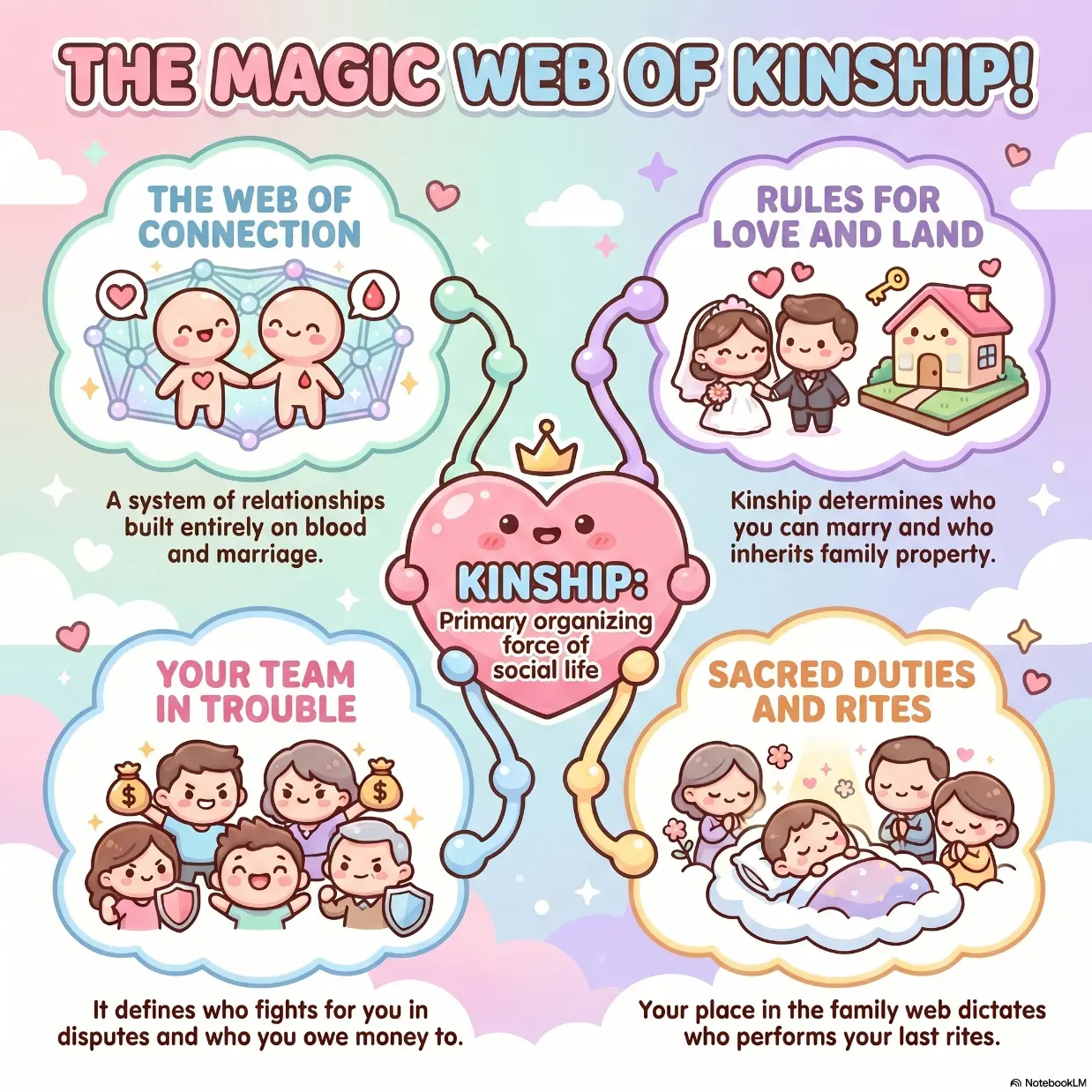
This entire system of relationships — based on blood and marriage — is what anthropologists call KINSHIP. In tribal and pre-industrial societies, it is the most important organising force in social life. Everything runs through it.
“Kinship refers to the complex system of social relationships based on consanguinity (common ancestry or descent) and affinity (marriage), which establishes rights and obligations between individuals and groups.”
“Kinship designates relationships established through blood and marriage ties, and the cultural rules governing behaviour between those so related.”
“Kinship systems are the totality of relationships based on real, putative, or fictive ties of blood and marriage, which in most societies constitute the primary framework of social organization.”
Open every kinship answer with a sourced definition. Citing Haviland or Beals & Hoijer by name and year signals to the examiner that your answer is grounded in standard literature. This alone adds 1–2 marks over a student who writes a definition from memory without attribution.
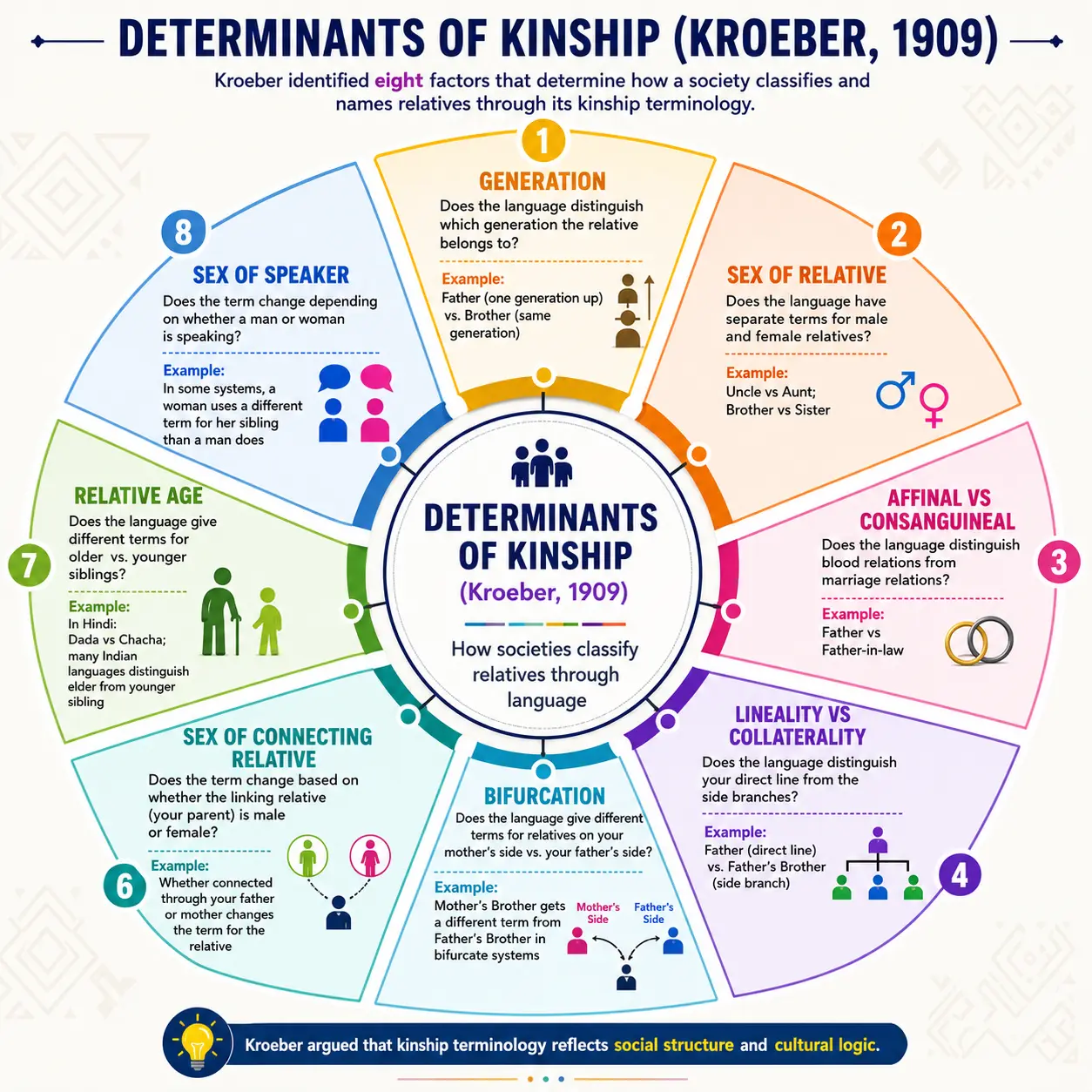
3. Kroeber’s 8 Determinants of Kinship
Generation
Does the language distinguish which generation the relative belongs to?
Example: Father (one generation up) vs. Brother (same generation)
Sex of Relative
Does the language have separate terms for male and female relatives?
Example: Uncle vs. Aunt; Brother vs. Sister
Affinal vs. Consanguineal
Does the language distinguish blood relations from marriage relations?
Example: Father vs. Father-in-law
Lineality vs. Collaterality
Does the language distinguish your direct line from the side branches?
Example: Father (direct line) vs. Father’s Brother (side branch)
Bifurcation
Does the language give different terms for relatives on your mother’s side vs. your father’s side?
Example: Mother’s Brother gets a different term from Father’s Brother in bifurcate systems
Sex of Connecting Relative
Does the term change based on whether the linking relative (your parent) is male or female?
Example: Whether you are connected through your father or mother changes the term for the relative
Relative Age
Does the language give different terms for older vs. younger siblings?
Example: In Hindi — Dada vs. Chacha; many Indian languages distinguish elder from younger sibling
Sex of Speaker
Does the term change depending on whether a man or woman is speaking?
Example: In some systems, a woman uses a different term for her sibling than a man does
In Kinship related answers always do 5 things:
- Define the Concept
- Cite the theorist who coined the term
- Give an Indian Example
- Give reasons for each phenomenon, with reference
- Support with suitable examples
This combination takes a 10/20 answer to a 14/20 answer
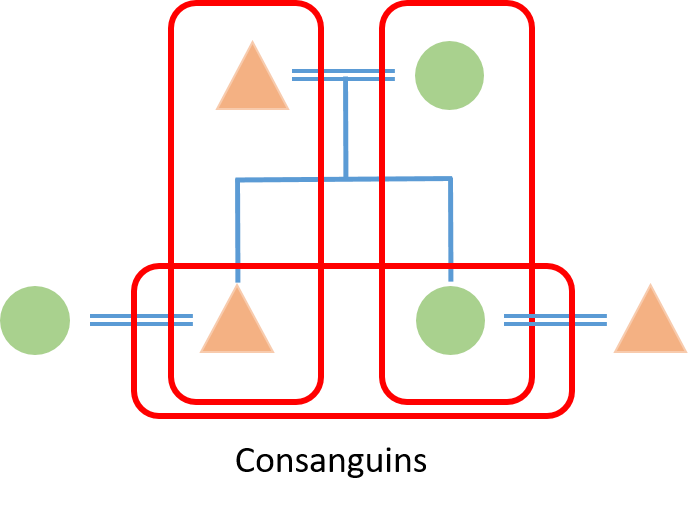
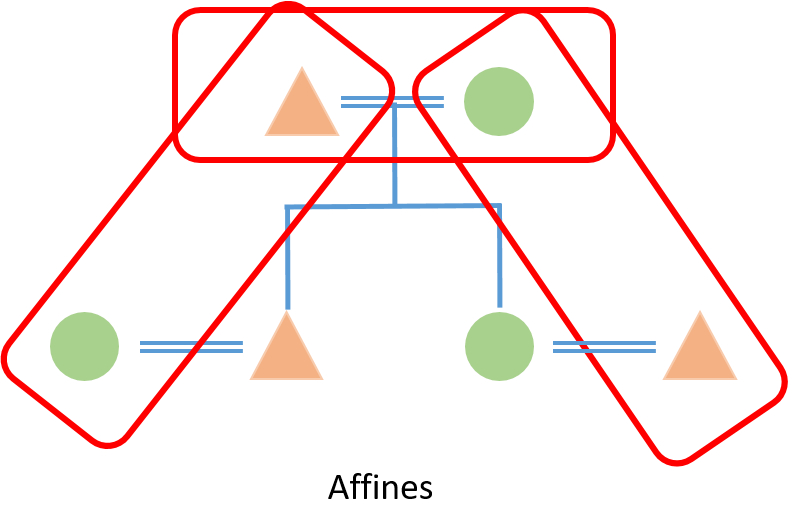
4. Consanguinity and Affinity
“Consanguinity denotes relationship by descent from a common ancestor. Affinity denotes relationship by or through marriage.”
“Consanguineal kin are people related by birth; affinal kin are people related by marriage.”
An important distinction: anthropologists separate biological consanguinity (actual genetic relationship) from reckoned consanguinity (the social recognition of kinship, which may differ from biology). Adopted children are often treated as full consanguineal kin — demonstrating that kinship is as much a social fact as a biological one.
“In all human societies, social kinship — the culturally recognised network of relationships — is more significant than biological kinship in determining rights, obligations, and identity.”
 |
 |
5. Principles of Descent
“Descent is the cultural principle by which an individual is assigned to a specific kinship group through demonstrated or stipulated genealogical connection to an ancestor.”
“The principle of descent establishes group membership and governs the transmission of property, rank, titles, and group membership from one generation to the next.”
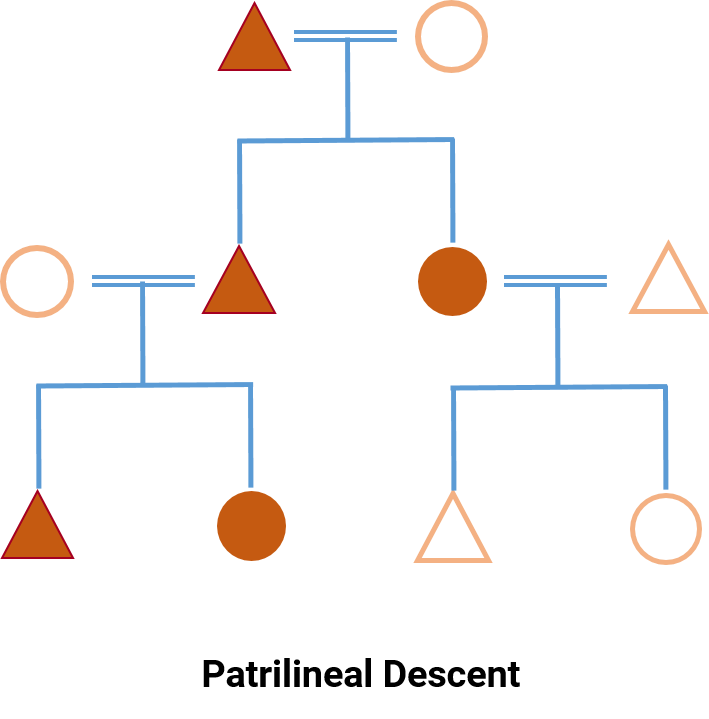
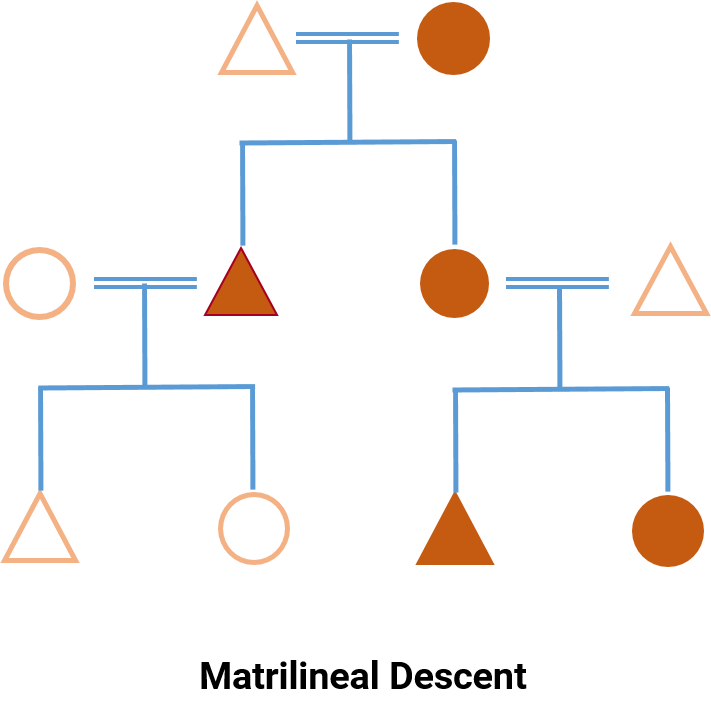
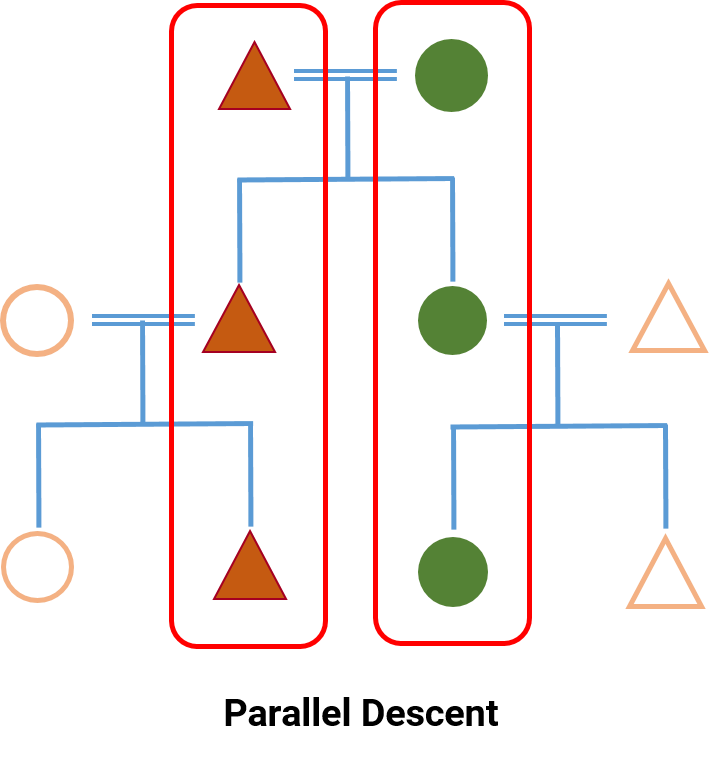
Patrilineal (Agnatic)
You belong to your FATHER’s group. Property, name, and membership pass through men.
Indian Examples: Gonds, Bhils, most North Indian tribes, Hindu gotra system
Reference: Murdock, Social Structure, 1949
Matrilineal (Uterine)
You belong to your MOTHER’s group. Property and membership pass through women.
Indian Examples: Khasi (Meghalaya), Garo, Nayars of Kerala
Reference: Haviland, Cultural Anthropology, 2001
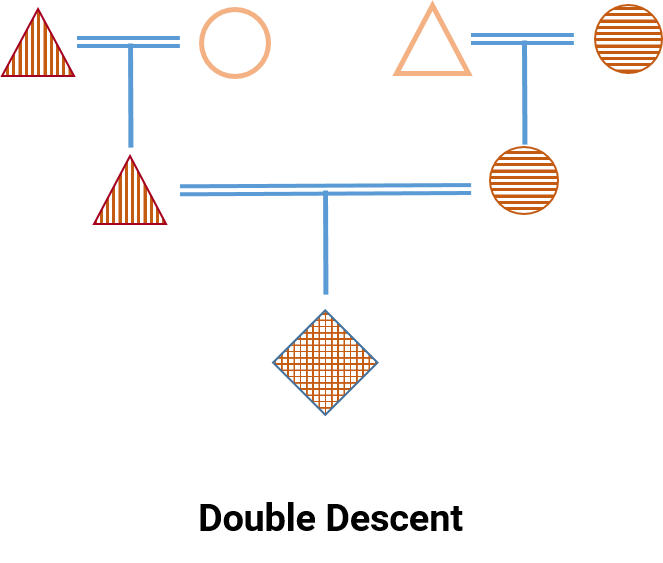
Double (Bilineal)
TWO systems operate at the same time — one for some purposes (like property) and one for others (like ritual).
Indian Example: Toda of Nilgiris — patrilineal for cattle/property, matrilineal for dairy ritual
Reference: Murdock, Social Structure, 1949
Bilateral
You recognise BOTH parents’ families equally. No permanent group formed — just a personal network.
Examples: Urban India; some NE hill tribes; modern nuclear families
Reference: Beals & Hoijer, Intro to Anthropology, 1953
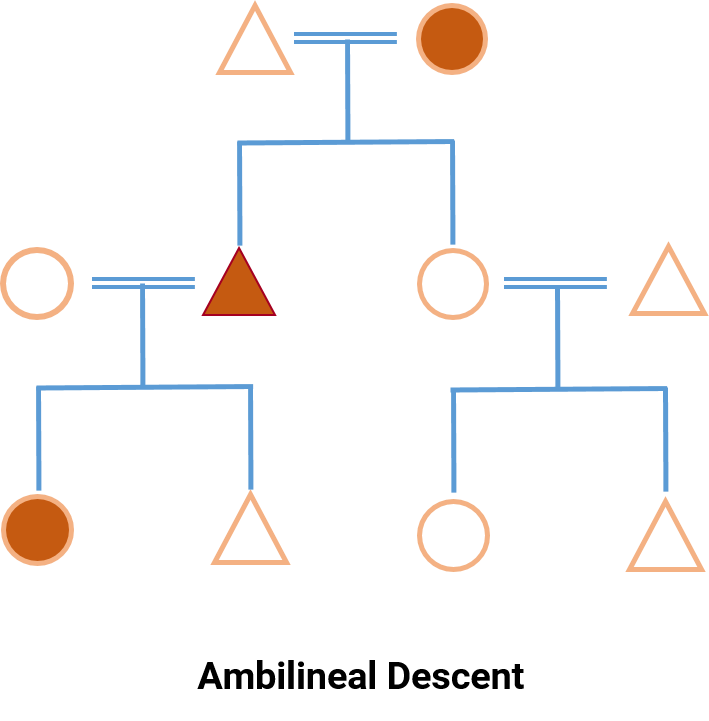
Ambilineal
You can CHOOSE which parent’s group to join — flexible affiliation based on circumstances.
Examples: Some Polynesian societies; flexible NE India groups
Reference: Barfield, Dictionary of Anthropology, 1993
Cognatic
Descent is traced through all lineal ancestors — 2 parents, 4 grandparents, 8 great-grandparents, and so on.
For double descent, always use the example of pastoral societies. They have patrilineal polyclans for property and cattle ownership AND matrilineal clans for dairy ritual — simultaneously. This is the most exam-ready Indian example for double descent. Cite Murdock, Social Structure, 1949.
6. Descent Groups — From Lineage to Moiety
“A descent group is any publicly recognised social group the members of which are recruited on a basis of a descent rule.”
Lineage
A group where everyone can TRACE and NAME every ancestor back to the founder. Like a complete family tree.
Key Feature: Traced genealogy — every ancestor nameable | Size: 20–200 members
Reference: Radcliffe-Brown, Structure & Function in Primitive Society, 1952
Clan
A group that BELIEVES in a common ancestor but cannot prove the connection — often the ancestor is mythical or totemic.
Key Feature: Putative descent — ancestor believed, not traced | Size: Hundreds to thousands
Reference: Murdock, Social Structure, 1949
Phratry
Two or more clans grouped together because they recognise some shared identity or origin story.
Key Feature: Inter-clan grouping; ritual significance
Reference: Haviland, Cultural Anthropology, 2001
Moiety
The entire society divided into exactly TWO halves. Everyone belongs to one half; must marry from the other.
Key Feature: Binary division — universal membership in one of two sides
Reference: Beals & Hoijer, 1953
Kindred
Your PERSONAL network of relatives — everyone you recognise as kin. Unlike a lineage, it changes with each person.
Key Feature: Ego-centred — not a corporate group; varies by individual
Reference: Fox, Kinship and Marriage, 1967
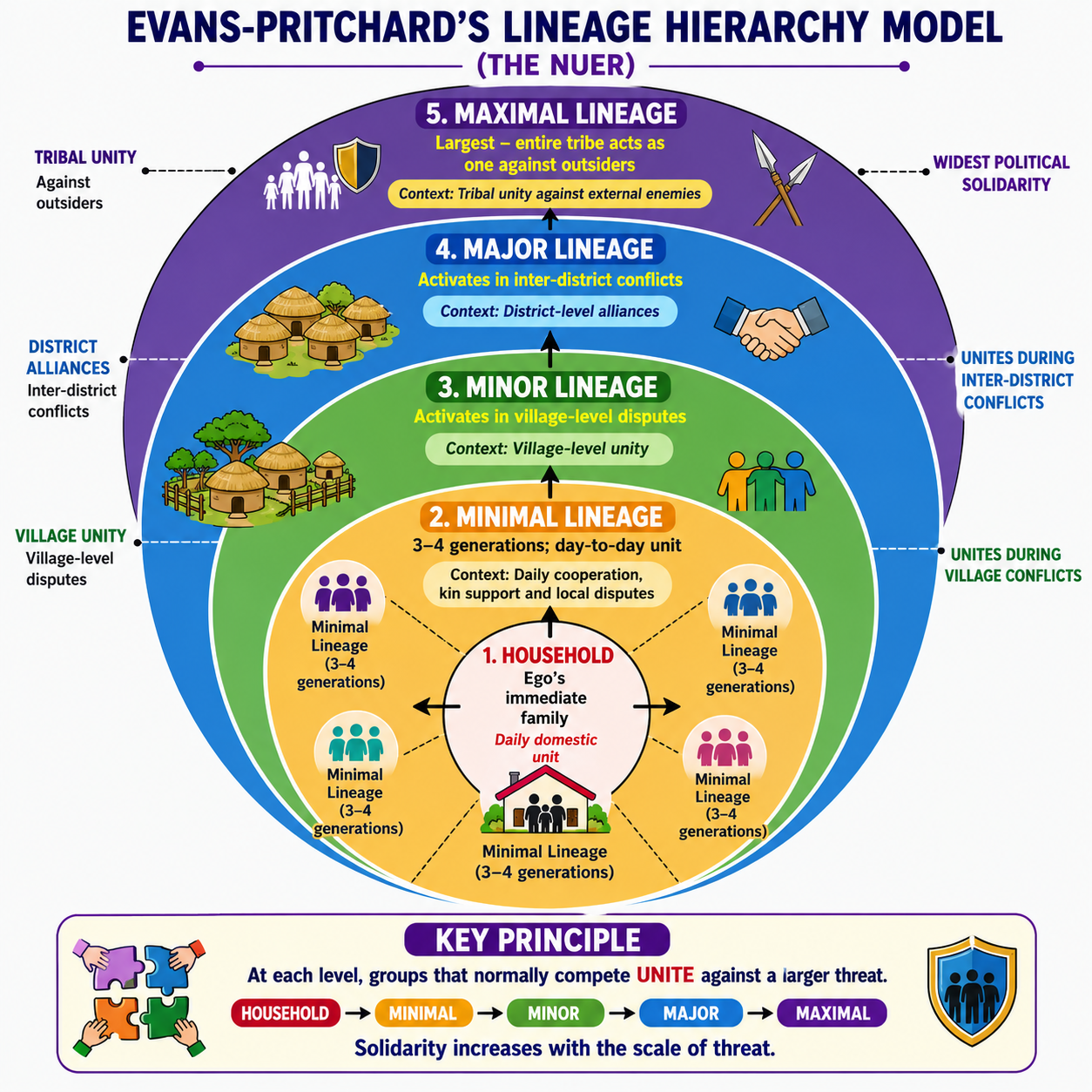
As Fox summarises in Kinship and Marriage (1967): “The lineage knows its genealogy; the clan believes its mythology.”
| Parameter | Lineage | Clan |
|---|---|---|
| Ancestor | Known, real, named | Mythical or putative (believed) |
| Genealogy | Demonstrated — can be traced | Asserted — cannot be traced |
| Size | Small (20–200 members) | Large (hundreds to thousands) |
| Totemism | Rare | Common |
| Territory | Strongly localised | Often dispersed across villages |
| Indian Example | Gond sib, Brahmin gotra | Khasi kur, Munda khunti |
| Global Example | Nuer (Evans-Pritchard, 1940) | Iroquois (Morgan, 1877) |
7. Rules of Residence
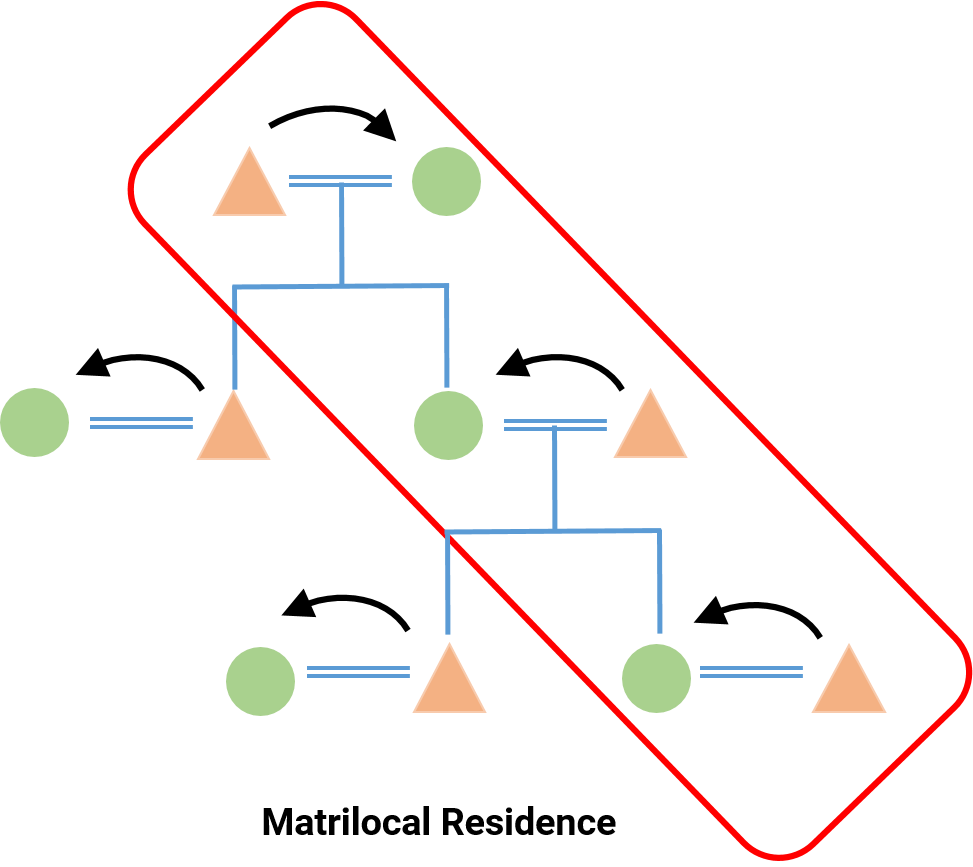
“Rules of residence determine with which kin group a newly married couple will take up their place of abode, thereby shaping the composition of domestic groups and influencing patterns of descent and inheritance.”
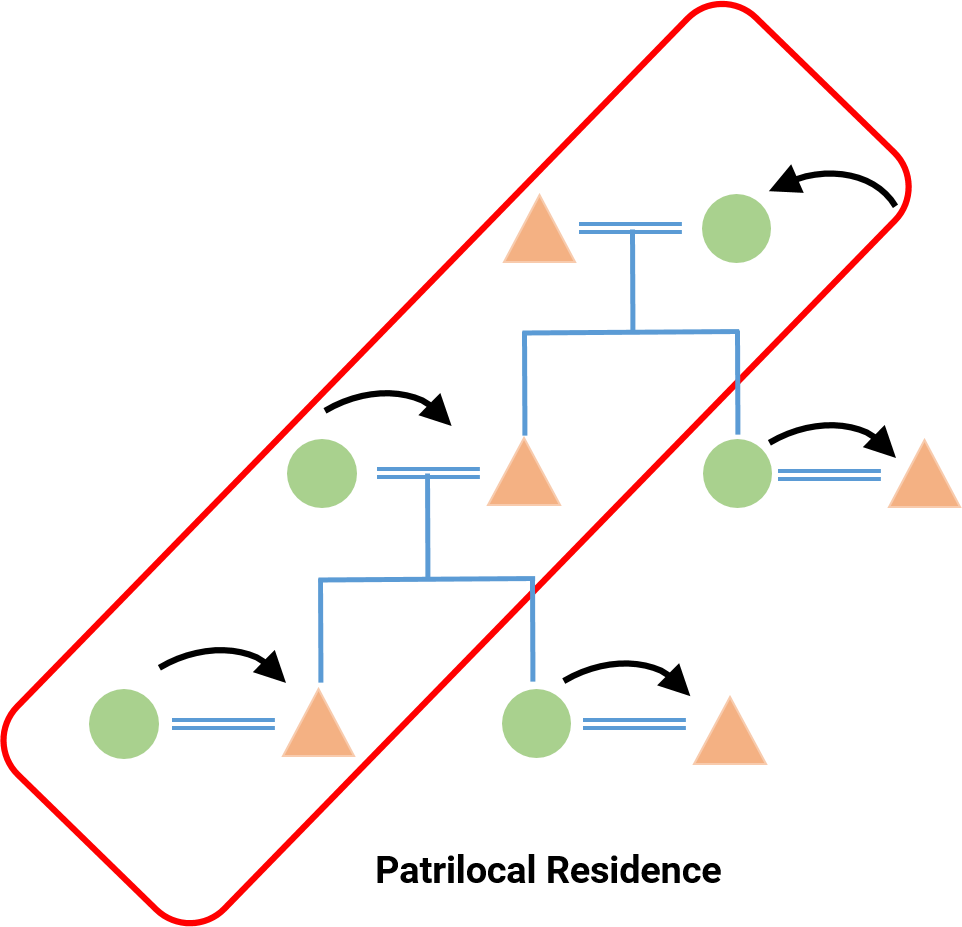
Patrilocal (Virilocal)
Couple lives with/near husband’s father’s family.
Examples: Gonds, Bhils, most North Indian Hindu and tribal communities
Reference: Murdock, Social Structure, 1949
Matrilocal (Uxorilocal)
Couple lives with/near wife’s mother’s family.
Examples: Khasi of Meghalaya, Garo, Nayars of Kerala
Reference: Haviland, Cultural Anthropology, 2001
Bilocal (Ambilocal)
Couple may choose either family’s home depending on circumstances.
Examples: Some NE Indian tribal communities; flexible pastoral groups
Reference: Beals & Hoijer, 1953
Neolocal
Couple sets up an independent home separate from both families.
Examples: Urban India; educated middle class; increasing with industrialisation
Reference: Murdock, Social Structure, 1949
Avunculocal
Couple lives with/near husband’s mother’s brother (maternal uncle).
Examples: Nayars of Kerala (historically); some matrilineal NE India tribes
Reference: Fox, Kinship and Marriage, 1967
Duolocal (Natalocal)
Husband and wife maintain SEPARATE residences with their own kin groups.
Example: Nayar sambandham union — husband visited but did not co-reside
Reference: Barfield, Dictionary, 1998
The Nayar case is the richest single example for residence rules — it demonstrates duolocal residence (sambandham), avunculocal organisation (taravad), AND matrilineal descent simultaneously. Three concepts, one example. Use it whenever a question touches residence rules, matriliny, or unusual family forms.
8. Kinship Terminology
“Kinship terminology is the set of words used to designate kin; it both reflects and reinforces the social structure of a society by defining who is equivalent to whom, and thereby who has the same rights and obligations.”
“Kinship systems of nomenclature reflect not the forms of social organization but categories of the mind — psychological groupings determined by the eight determinants of kinship.”
Lewis Henry Morgan first identified these two types in Systems of Consanguinity and Affinity of the Human Family (1871):
Descriptive:
Each relative gets a unique, specific term. English is largely descriptive — ‘father,’ ‘father’s brother,’ and ‘mother’s brother’ are all different terms. No merging.
Classificatory:
Some relatives are merged under the same term. In many tribal systems, your ‘father’ and your ‘father’s brother’ are both called ‘father’ — because in a patrilineal society, they hold the same social position relative to you.
| Abbreviation | Meaning | Abbreviation | Meaning |
|---|---|---|---|
| Mo | Mother | MoBr | Mother’s Brother |
| Fa | Father | FaSi | Father’s Sister |
| Br | Brother | MoSi | Mother’s Sister |
| Si | Sister | FaBr | Father’s Brother |
| So | Son | MoBrSo / MoBrDa | Cross-Cousins (maternal) |
| Da | Daughter | FaSiSo / FaSiDa | Cross-Cousins (paternal) |
| Hu | Husband | MoSiSo / FaBrSo | Parallel Cousins |
| Wi | Wife |
| Kin Type | Significance |
|---|---|
| Mother’s Brother MoBr | In patrilineal systems: unique term. The ‘male mother’ — Radcliffe-Brown’s avunculate. In matrilineal systems holds authority over Ego. |
| Father’s Sister FaSi | In matrilineal systems: unique term. The ‘female father’ — holds ritual authority in some patrilineal societies (Tallensi). |
| Father’s Brother FaBr | In patrilineal systems: merged with Fa — both called ‘father.’ FaBr belongs to the same patrilineage — merging reflects agnatic solidarity. |
| Mother’s Sister MoSi | In matrilineal systems: merged with Mo — both called ‘mother.’ MoSi belongs to the same matrilineage — merging reflects uterine solidarity. |
| Cross-Cousins | Distinguished from parallel cousins. Preferred or prescribed marriage partners in many systems. Lévi-Strauss: cross-cousin marriage creates alliances between different lineages. |
| Parallel Cousins | Merged with siblings in most unilineal systems — treated as brothers and sisters. Marriage treated as incestuous. Exception: Arab patrilineal FaBrDa marriage. |
| FaSiSo | Omaha system: equated with Mo or MoBr — skewed across generations. Reflects patrilineal emphasis. |
| MoBrSo | Crow system: equated with Fa or FaBr — skewed across generations. Reflects matrilineal emphasis. |
Murdock, G.P., Social Structure (1949)
| System | Core Principle | Social Structure | Indian / Exam Example |
|---|---|---|---|
| Hawaiian | Most classificatory. All relatives of same generation called by same term — everyone is ‘brother’ or ‘sister’ | Bilateral / ambilineal; no strong lineage groups | Simplest system; rarely used as UPSC example |
| Eskimo | Nuclear family terms are unique; all other collaterals merged as ‘cousin’ or ‘uncle’ | Bilateral; nuclear family emphasis | English is closest to Eskimo type |
| Iroquois | Parallel cousins merged with siblings; cross-cousins get a separate distinct term | Unilineal (patrilineal or matrilineal); classic tribal structure | Most common in tribal India — Mundas, Santhals, many Adivasi groups |
| Crow | Matrilineal emphasis. Father’s matrilineal kin equated across generations — generational skewing | Matrilineal descent systems | Khasi of Meghalaya; some NE Indian tribes |
| Omaha | Patrilineal emphasis. Mother’s patrilineal kin equated across generations — generational skewing | Patrilineal descent systems | Gonds and most North Indian patrilineal tribes |
| Sudanese | Most descriptive. Every single relative has a unique term — no merging at all | Complex stratified societies; Arab societies | Arab societies; reflects need to distinguish exact relationship for property and rank |
Crow = matrilineal. Omaha = patrilineal. They are structural mirror images of each other. Cite Murdock, Social Structure for both. The Crow-Omaha contrast appears in almost every second UPSC paper. Know this cold.
9. Descent vs. Alliance
Descent is the principle of corporate group membership. Filiation is the personal dyadic parent-child tie. Complementary filiation is the tie to the non-descent parent’s kin — in a patrilineal society, your mother’s brother (MoBr) has obligations to you even though he is outside your lineage.
Alliance theorists (Lévi-Strauss) say: Kinship is about CONNECTIONS BETWEEN groups — specifically, the alliances created when one family gives a daughter in marriage to another family.
Think of it this way: Descent theory looks INWARD at the group. Alliance theory looks OUTWARD at how groups connect through marriage.
Prescriptive Marriage
A person MUST marry a specific category of kin (e.g., MoBrDa)
Preferential Marriage
A person is ENCOURAGED but not obliged to marry within a category
Lévi-Strauss’s alliance theory is built on prescriptive cross-cousin marriage systems.
10. Previous Year Questions (2013–2024)
| Year | Question | Marks |
|---|---|---|
| 2024 | Critically examine the alliance theory of kinship with special reference to Lévi-Strauss. How does it differ from the descent theory? | 20 |
| 2023 | Discuss the concept of complementary filiation as given by Fortes. Illustrate with examples from Indian tribal societies. | 15 |
| 2022 | Distinguish between lineage and clan. Explain with the help of examples from Indian tribes. | 15 |
| 2021 | Explain the principle of the unity of the sibling group as propounded by Radcliffe-Brown. How is it relevant to tribal India? | 20 |
| 2020 | Write a note on Crow and Omaha kinship terminologies and their sociological significance. | 10 |
| 2019 | Discuss the nature and significance of double descent with appropriate examples. | 15 |
| 2013 | Write short notes on Classificatory kinship terminology. | 10 |
11. Model Answer Content & Structure
Model Answer 1 — Role of Kinship in Regulating Marriage
Introduction
Marriage in every human society is not merely a personal union but a socially regulated institution governed by kinship rules. As Haviland states in Cultural Anthropology (p. 222):
“Kinship systems regulate marriage by specifying who is an eligible spouse and who is not, through rules of exogamy, endogamy, and preferential mate selection.”
1. Exogamy
Exogamy requires marriage outside one’s kinship group. As Beals and Hoijer define it in An Introduction to Anthropology (p. 460):
“Exogamy prohibits marriage between members of the same descent group, compelling individuals to seek spouses from other groups and thereby creating inter-group alliances.”
Among the Gonds of Central India, clan exogamy is strictly observed — members of the same gotra may not marry.
2. Endogamy
Endogamy requires marriage within a specified group. As Murdock notes in Social Structure (p. 31):
“Endogamy keeps property, status, and social identity within the defined group.”
Caste endogamy in India is the most prominent example. Among the Toda of Nilgiris, clan exogamy and moiety endogamy operate simultaneously — demonstrating how both rules can coexist.
3. Preferential and Prescriptive Marriage Rules
Lévi-Strauss in The Elementary Structures of Kinship distinguished between prescriptive systems (must marry a specific category) and preferential systems (should ideally marry a certain category). Among Dravidian-speaking tribes of South India, MBD (mother’s brother’s daughter) marriage is prescriptive — a man is obligated to marry his MoBrDa.
4. The Incest Taboo
The incest taboo is the most universal kinship-based marriage rule. Lévi-Strauss in The Elementary Structures of Kinship (p. 24) argued:
“The prohibition of incest is less a rule prohibiting marriage with the mother, sister or daughter than a rule obliging the giving of the mother, sister or daughter to another man.”
The taboo simultaneously prohibits (certain unions) and prescribes (alliance creation).
5. Levirate and Sororate
The levirate (widow marries deceased husband’s brother) and the sororate (widower marries deceased wife’s sister) are kinship-governed rules of remarriage. As Barfield notes in The Dictionary of Anthropology (p. 280):
“Both customs reflect kinship obligations — the levirate ensures the dead man’s lineage retains rights over the widow.”
Both practices are found among the Bhils and Mundas of Central India.
Conclusion
As Fox argues in Kinship and Marriage (p. 54):
“Marriage is not merely a domestic arrangement; it is the mechanism by which kinship groups reproduce their alliances, maintain their boundaries, and transmit their resources.”
Model Answer 2 — Rules of Descent in India
Introduction
Descent rules determine group membership, property transmission, and social identity across generations. As Murdock defines in Social Structure (p. 15):
“A descent rule is the cultural principle by which an individual is affiliated with a group of consanguineal relatives for purposes of forming kin groups and regulating succession and inheritance.”
India presents one of the world’s richest laboratories for studying the full range of descent principles.
1. Patrilineal Descent
The most widespread form in India. As Beals and Hoijer note in An Introduction to Anthropology (p. 447):
“In patrilineal systems, descent, property, and group membership pass through the male line.”
Among the Gonds of MP and Chhattisgarh, all members of a sib trace descent from a common male ancestor. Hindu joint family law similarly follows patrilineal principles.
2. Matrilineal Descent
Robust in Northeast India and Kerala. Haviland in Cultural Anthropology (p. 231):
“In matrilineal systems, group membership and property pass through the female line.”
The Khasi of Meghalaya are India’s most studied matrilineal community — property is inherited by the youngest daughter (khatduh), and children belong to the mother’s clan (kur).
3. Double (Bilineal) Descent
Two unilineal systems operate simultaneously for different purposes. Murdock in Social Structure (p. 43) identifies the Toda of Nilgiris as the classic Indian case — patrilineal polyclans govern property and cattle; matrilineal clans govern dairy ritual. A Toda individual simultaneously belongs to both systems.
4. Bilateral Descent
As Barfield notes in The Dictionary of Anthropology (p. 44):
“Bilateral systems generate kindreds rather than lineages.”
Increasingly common in urban India and among educated communities.
Conclusion
India’s descent systems form a spectrum — from strict patrilineality (dominant in North and Central India) to matrilineality (Northeast and Kerala) to the rare double descent (Toda). This diversity makes India uniquely significant for comparative kinship studies.
Model Answer 3 — Importance of Kinship in Anthropology
Introduction
Kinship has historically occupied a central position in social anthropology. As Robin Fox states in Kinship and Marriage (p. 10):
“Kinship is to anthropology what logic is to philosophy or the nude is to art: it is the basic discipline of the subject.”
1. Foundation of Social Organisation
As Radcliffe-Brown argued in Structure and Function in Primitive Society (p. 1):
“The whole social structure of a simple society can be described in terms of kinship.”
Among the Mundas, Santhals, and Gonds — kinship groups are simultaneously the economic, political, and ritual unit.
2. Regulation of Marriage and Reproduction
As Haviland notes in Cultural Anthropology (p. 220):
“Through rules of exogamy and endogamy, kinship systems determine the boundaries within which alliances can be formed.”
Lévi-Strauss in The Elementary Structures of Kinship went further — kinship systems are fundamentally systems of communication, with women exchanged as the medium of social alliance.
3. Transmission of Property and Status
As Murdock demonstrated in Social Structure (p. 20):
“Rules of descent and the kinship groups they create are the primary mechanism by which property — land, cattle, ritual knowledge, political office — is transmitted across generations.”
The matrilineal taravad inheritance among Nayars and patrilineal gotra-based inheritance among Brahmins illustrate this.
4. Identity and Belonging
As Beals and Hoijer state in An Introduction to Anthropology (p. 441):
“Kinship membership defines who one is, who one’s allies are, and who one’s rivals are.”
In India, jati (caste) and gotra (exogamous lineage) together constitute the individual’s core social identity.
5. Political and Juridical Functions
As Barfield notes in The Dictionary of Anthropology (p. 275):
“In acephalous (leaderless) societies, kinship groups perform the functions that states perform in complex societies.”
Evans-Pritchard’s segmentary lineage model among the Nuer — applicable to India’s central tribal belt — demonstrates this.
6. Contemporary Relevance and Critique
Schneider in A Critique of the Study of Kinship (1984) challenged the entire field by arguing kinship as a biological category is a Western cultural imposition. Nevertheless, kinship analysis remains indispensable — extended now to fictive kinship, transnational families, and reproductive technology.
Conclusion
As Fox concludes in Kinship and Marriage (p. 265):
“No other single institution encapsulates the totality of human social existence as completely as kinship.”
For UPSC Anthropology, a command of kinship theory is the foundation on which all other topics rest.
12. Case Studies & Recent Researches
These items can be used to enrich answers in both Paper 1 and Paper 2.
SC Ruling on Daughters’ Coparcenary Rights in Hindu Joint Family
The Supreme Court reaffirmed (2020, Vineeta Sharma v. Rakesh Sharma) that daughters have equal coparcenary rights in ancestral property under the Hindu Succession (Amendment) Act 2005 — retroactively, even if the father died before 2005.
This directly challenges traditional patrilineal descent norms in Hindu society. Property in a Hindu joint family was historically transmitted through the agnatic (patrilineal) line only — daughters were excluded. The SC ruling legally dismantles this descent-based exclusion. Connects to Murdock’s observation that patrilineal residence generates patrilineal property transmission.
Paper 1 — Principles of Descent (patrilineal); Descent Groups; Descent Theory. Paper 2 — Family and kinship change in India; women’s issues.
Khasi Community Debate on Matrilineal Succession Reform
A section of the Khasi community in Meghalaya has been debating whether the exclusive inheritance rights of the youngest daughter (khatduh) should be reformed to allow more equal distribution among siblings — challenging the traditional matrilineal norm.
Classic example of matrilineal descent under modernisation pressure. The khatduh system is the structural core of Khasi matriliny — the youngest daughter inherits the iing (ancestral home) and kur (clan) property. Reform would restructure the descent group itself. Connects to Fortes’s complementary filiation and Leach’s argument that kinship serves political ends.
Paper 1 — Matrilineal descent; descent groups; complementary filiation. Paper 2 — Khasi tribe; matrilineal communities in India; social change.
Shompen Tribe and Great Nicobar Island Development Project
The Great Nicobar Island development project (2022–ongoing) threatens the Shompen, a Particularly Vulnerable Tribal Group (PVTG) with a population of approximately 300, who practice strict clan-based endogamy and territorial kinship organisation.
The Shompen’s social organisation is built on clan-based kinship — their territory is divided along clan lines, and marriage is strictly regulated by clan membership. Infrastructure development disrupts the territorial basis of clan organisation — when land is lost, the clan’s social and ritual functions collapse. This demonstrates that kinship groups are not abstract — they are embedded in ecology.
Paper 1 — Clan; descent groups; ecological anthropology. Paper 2 — PVTGs; tribal displacement; applied anthropology.
Uniform Civil Code Debate and Kinship Pluralism in India
The UCC debate (intensified 2022–2023, Uttarakhand UCC 2024) raises the question of whether India’s plural personal law systems should be replaced by a single uniform code.
India’s personal law systems are essentially codified kinship systems — the Hindu Succession Act, Muslim Personal Law (Shariat), Christian Marriage Act, and tribal customary law all encode different descent, inheritance, and marriage rules. The UCC debate is fundamentally an anthropological debate: should the state impose uniform kinship rules, or respect the kinship pluralism that defines India’s social diversity? Connects to Leach’s argument that kinship is always political.
Paper 1 — Marriage regulation; descent and inheritance. Paper 2 — Social change in India; secularism; tribal customary law.
Manipur Ethnic Conflict and Clan-Based Tribal Identity (2023–2024)
The Manipur ethnic conflict (2023–ongoing) between the Meitei and Kuki-Zo communities has deep roots in kinship-based territorial identity — both communities organise social and political life around clan-based descent groups with specific territorial claims.
The conflict illustrates how kinship groups (clans) function as political units in contexts of resource competition — precisely Leach’s argument in Political Systems of Highland Burma about the Kachin. Evans-Pritchard’s complementary opposition model (groups unite against external threats) is visible in how sub-clans within each community consolidate against the other.
Paper 1 — Clan; descent groups as political units; kinship and conflict. Paper 2 — Tribal communities of NE India; applied anthropology; conflict and kinship.
Supreme Court Rejects Same-Sex Marriage Petition (2023)
The Supreme Court of India (October 2023) declined to legalise same-sex marriage, ruling it was a matter for Parliament, while acknowledging that LGBTQ+ couples constitute de facto families.
The SC judgment is anthropologically significant for two reasons: (1) the Court acknowledged that ‘family’ exists beyond marriage — de facto kinship without legal marriage; (2) the dissenting judgment argued that denying marriage to same-sex couples denies them the kinship rights (inheritance, adoption, next-of-kin hospital access) that flow from marriage. Schneider’s critique — that kinship as a category is culturally constructed — is directly relevant.
Paper 1 — Marriage as a social institution; kinship and law. Paper 2 — Social change; new family forms; applied anthropology.
Surrogacy Regulation Act 2021 — Fictive Kinship and the State
The Surrogacy (Regulation) Act 2021 banned commercial surrogacy in India and permitted only altruistic surrogacy by a close relative — transforming India’s position as the world’s leading commercial surrogacy destination.
Surrogacy creates kinship through technology rather than biology or marriage — the child’s social parents may have no biological connection to the child. This is fictive kinship (as Barfield defines it — kinship based on social recognition rather than biology or marriage). The Act’s restriction of surrogacy to ‘close relatives’ reveals the state’s discomfort with kinship that cannot be classified under traditional descent or alliance categories.
Paper 1 — Kinship (fictive/chosen); marriage and reproduction. Paper 2 — Applied anthropology; women’s issues; reproductive rights.
NFHS-5 Data — Declining Household Size and Changing Family Structure (2021)
The National Family Health Survey 5 (2019–21) showed average household size has declined from 4.8 (2015–16) to 4.0 (2019–21). Nuclear family formation is accelerating, particularly in urban areas and Southern states.
NFHS-5 provides the most current empirical evidence for the transformation of the Indian family. The decline in household size reflects nucleation — joint families splitting into nuclear units. However, as Shah demonstrated in The Family in India: Critical Essays, nucleation of residence does not mean severance of kinship obligations. Economic interdependence persists through remittances, property sharing, and ritual obligations — demonstrating that kinship is not merely residential.
Paper 1 — Family types; nuclear vs. joint family. Paper 2 — Changing family in India; social change; urbanisation and kinship.
PVTGs and Clan-Based Displacement
Multiple Particularly Vulnerable Tribal Groups (PVTGs) — including the Birhor of Jharkhand, Hill Korwa of Chhattisgarh, and Chenchu of Andhra Pradesh — face displacement from forest lands that are also the territorial basis of their clan organisation (2022–2024).
For PVTGs, the clan is not merely a social category — it is a territorial unit. Each clan has specific rights over particular forest areas for hunting, gathering, and ritual. When forest rights are denied or land is acquired, the clan loses its functional basis. The Forest Rights Act 2006 recognition of community forest rights is essentially a legal recognition of clan-based territorial claims.
Paper 1 — Clan; descent groups; ecological anthropology. Paper 2 — PVTGs; tribal land rights; applied anthropology; Forest Rights Act.
Gond Scheduled Tribe Recognition — Lineage-Based Identity Claims
The ongoing controversy over including certain Gond sub-groups in the Scheduled Tribe list has foregrounded lineage and clan identity as the basis of tribal recognition — who belongs to the Gond community is determined by patrilineal descent and clan membership.
ST recognition in India is fundamentally a kinship question — it is determined by demonstrating descent from recognised tribal ancestors. The Gond case shows that lineage (traceable genealogical connection) determines eligibility for constitutional protections. This is a contemporary application of the lineage principle (Murdock’s definition) in a legal-administrative context.
Paper 1 — Lineage; descent groups; patrilineal descent. Paper 2 — Scheduled Tribes; tribal identity; applied anthropology.