VAID'S ICS – Best UPSC Anthropology Coaching in Delhi Since 1985

Anthropology PYQ Analysis: What UPSC Keeps Asking in Anthropology Optional

VAIDS ICS · Anthropology Content Hub ~16 min read UPSC Anthropology Optional On this page Why PYQsRepeatsThemesPaper 1Paper 2InsightsStrategyFAQ Somewhere in the third or fourth month of preparation, most serious Anthropology students do the same thing. They download ten or twelve years of UPSC Anthropology papers, print them, sit down with a highlighter — and start hunting for repeats. They scan year after year for the same question asked twice, because somewhere they absorbed the idea that past papers are for spotting repeats and predicting the exam. When the clean repetitions don’t appear, they feel cheated, and they quietly demote the papers from “critical resource” to “nice to have” — going back to reading textbooks cover to cover, hoping volume will carry them. That whole approach is built on a misunderstanding. A proper Anthropology PYQ analysis reads past papers the way experienced teachers and exam-setters do: not as a prediction engine, but as a window into the themes, frameworks, and analytical patterns UPSC keeps returning to. If you’re reading this, you’ve likely already crossed the beginner stage — you’ve seen the Anthropology Optional syllabus and started your first pass through the standard texts. Good. This is the point where understanding how the exam thinks matters more than covering one more topic. Wrong vs Right Use of PYQs Why Most Students Use PYQs Incorrectly “Use PYQs properly” helps nobody, so let me be specific about the four mistakes I see most. The first is treating the paper like a lottery ticket — checking your numbers against the draw, hoping the same ones come again. Since Anthropology almost never lifts a question verbatim, this reader concludes the papers aren’t useful and walks away. The second is timing. Most students open their PYQs only after “the syllabus is done,” as a final quiz. Used that way, a paper can only test you; it cannot shape how you study. Read kinship first and discover only later how UPSC frames it, and you’ve lost the chance to read that chapter with the examiner’s concerns in mind. Read the questions first, and the same chapter reads differently — the debates and fault-lines stop blurring into the text. The third is counting instead of interpreting. Marking how often caste or tribe “appeared” and declaring them important is a start, but shallow. The question that changes your preparation is why the examiner keeps returning to a theme — what tension or framework makes it endlessly examinable. Without that, you know only that something recurs, not how it will be asked next. The fourth is ignoring the directive word. Many students register only the noun — kinship, caste, evolution — and skip the verb. In Anthropology, the verb is half the question. “Describe the functionalist approach” and “critically examine the continued relevance of functionalism” demand completely different answers, though functionalism sits in both. Vaid Sir’s Observation When a student tells me, “Sir, I’ve done ten years of PYQs,” I ask one thing back: “Then tell me three things the setter seems obsessed with.” If they can’t, they’ve counted the papers, not studied them. Counting is not studying — a child can count. Do Questions Repeat in Anthropology Optional? No — not in the way students hope. You will very rarely see a question lifted word-for-word from an earlier year. That’s by design; repeating questions would turn the exam into a memory test rather than a test of understanding. But something more useful does repeat. While the wording changes, UPSC keeps walking the same terrain — the same core debates, conceptual tensions, and theoretical frameworks. Each year the examiner approaches the same hill from a different side, with a different contemporary hook or Indian example. To the repeat-hunter these look like all-new questions. To the reader who knows the terrain, they’re the same hill in new light. Take the tribe–caste relationship. One year it surfaces as a direct question on the tribe–caste continuum; another year it’s folded into social change; another year it sits inside a question on tribal identity and development policy. Three questions, one underlying concern. So “do questions repeat?” is the wrong question. The right one is: what parts of the syllabus does UPSC keep returning to, and in what forms? One Theme, Many Questions What Actually Repeats: Themes, Not Questions To use PYQs seriously, separate the question from the theme. A question is specific — one year, one wording, one demand. A theme is the underlying concept, debate, or framework being tested, and themes are revisited precisely because they sit at the heart of the discipline. What recurs falls into four buckets. Concepts are the foundational bricks — culture, kinship, marriage, family, caste, tribe, ethnicity, social change. Debates are the unsettled arguments anthropology loves: formalist versus substantivist in economic anthropology, descent versus alliance in kinship, whether the family is a human universal, isolation versus assimilation versus integration in tribal policy, whether “race” carries any biological meaning. Frameworks are the theoretical schools — evolutionism through postmodernism — asked not as “write short notes” but as lenses: examine X using Y, compare how two schools would read Z. Dimensions are the recurring angles: “critically examine the relevance today,” “compare and contrast,” “trace the evolution of this concept,” “discuss with Indian examples.” Here’s the payoff. Prepare a question and you’re ready only when that exact question comes. Prepare a theme — concept plus core debate plus relevant frameworks plus the usual dimensions — and you’re ready for every variant UPSC can generate from it, including the ones not yet written. Vaid Sir’s Observation I ask students to keep two notebooks. One lists topics the way the syllabus does. The other — the one that wins marks — lists debates and dimensions. Not “kinship,” but “descent vs alliance, and where I stand.” Not “tribes,” but “isolation vs assimilation vs integration, and what the evidence suggests.” When you can argue a theme instead of reciting a topic, you stop fearing new questions. Table 1: Theme Frequency Matrix (Qualitative) The recurrence … Read more

Anthropology Optional Syllabus Explained: Paper 1 & Paper 2 Roadmap for UPSC CSE 2027

Anthropology Optional Syllabus Explained for UPSC CSE 2027

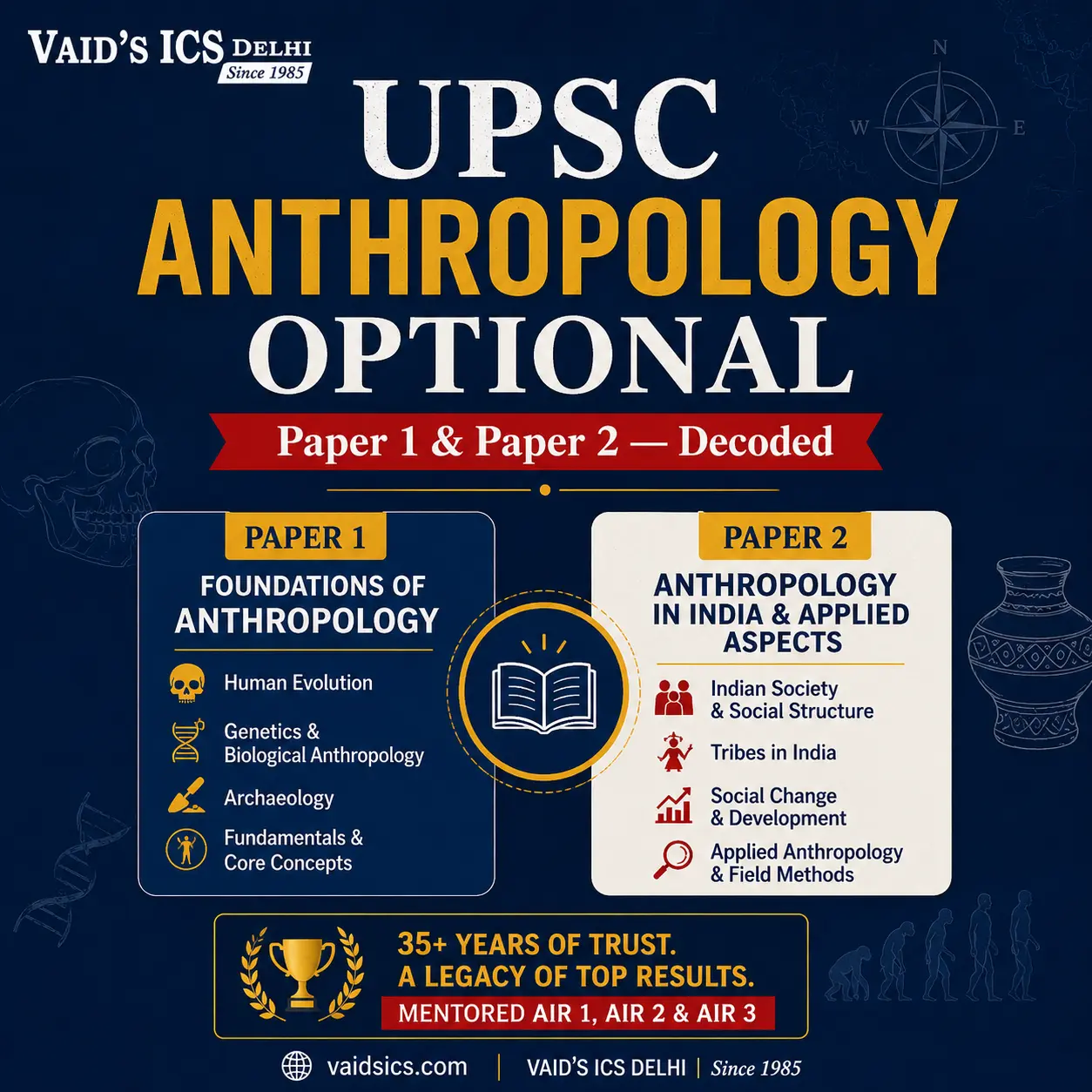
Vaid Sir · 18 min read · Updated June 2026 · VAIDS ICS Delhi Most aspirants who open the Anthropology optional syllabus PDF for the first time make the same mistake. They read through it once, decide it looks manageable, and go looking for notes. A few weeks into preparation, sitting with a stack of handouts and coaching material, they realise they have been studying isolated pieces without any sense of how those pieces fit together. Genetics sits in one corner, kinship sits in another, tribe-caste continuum somewhere else — and the connection between them is unclear. This is not a failure of effort. It is a failure of orientation. Nobody explained what the syllabus actually contains before preparation began. This article is that explanation. We are going to walk through both papers — the way a mentor explains a new subject to a student sitting across a desk — in plain language, with honest observations about what each section actually contains and what it asks of you. One clarification upfront. This article is specifically about understanding what the Anthropology syllabus contains — its architecture, its internal logic, and how Paper 1 and Paper 2 form one unified subject. If you are looking for a preparation plan, a booklist, or a starting roadmap, those are covered in dedicated companion articles on VAIDS ICS. How to Start Anthropology Optional from Zero Is Anthropology Good Optional for UPSC? That clarity about the syllabus, by the way, is not a minor or cosmetic thing. Aspirants who understand the architecture of the subject before they begin preparing study with more focus, write answers with more structural depth, and are far less anxious when a question combines topics they had mentally kept in separate compartments. The subject rewards people who see it whole. The Design of Anthropology Optional: Two Papers, One Unified Subject Anthropology optional consists of two papers — 250 marks each, 500 total. But the two papers are not simply two halves of the same content split arbitrarily for length. They represent two different levels of engagement with the same subject. Paper 1 asks: What is Anthropology as a science of human beings? What concepts does it use? What theories has it developed? What does it know about human evolution, genetics, culture, kinship, economic and political organisation, religion, and prehistoric life? What methods do anthropologists use to study all of this? Paper 2 asks: How do all of those things — every concept, every theory, every method — help us understand India? Its social structure, its tribal communities, its historical development, its contemporary conflicts, its constitutional choices? Think of it this way: Paper 1 builds an analytical vocabulary. Paper 2 requires you to use that vocabulary on a specific, familiar, and complex context — Indian society. A student who treats Paper 1 as background reading and focuses preparation on Paper 2’s facts and current affairs will write Paper 2 answers that are descriptive but analytically thin. A student who prepares Paper 1 conceptually will find that Paper 2 questions practically invite the frameworks already built. This relationship — Paper 1 as toolkit, Paper 2 as the place where tools are used — is the structural insight that changes how you study this optional. Almost every strong Paper 2 answer has roots in Paper 1. The Four Threads Running Through Both Papers Below all the specific topics, four major intellectual threads run through the entire Anthropology optional. They appear in both papers, intersect with each other, and explain why the syllabus is designed the way it is. Biological Anthropology — the study of human beings as biological organisms. Our evolutionary history, genetic makeup, bodily variation, adaptation to different environments, growth across the life cycle, and health. Paper 1 covers this as a universal science of the human body. Paper 2 brings it to India’s fossil record, tribal health patterns, and demographic questions. Socio-Cultural Anthropology — the study of how human beings organise their collective lives. Culture, kinship, marriage, family, economic systems, political structures, religion, language. Paper 1 covers these as phenomena that appear across all human societies. Paper 2 studies their Indian forms — caste, village, tribal community, religious practice, and social change. Prehistoric Archaeology — the reconstruction of human life before written records, through tools, bones, habitation sites, and art. Paper 1 covers global cultural sequences and the methods used to date and interpret them. Paper 2 brings this to India’s specific prehistoric evidence. Indian Anthropology — the systematic study of Indian society, culture, tribes, and development through anthropological frameworks. This is primarily Paper 2’s domain, but it draws on all three threads above as its analytical base. The four intellectual pillars of UPSC Anthropology Optional and their key sub-topics UPSC Anthropology Syllabus at a Glance Here is what the official document actually lists, in plain language. Paper 1 — Six Areas: how Anthropology developed as a discipline; human evolution, genetics, biological variation, growth, and health; prehistoric archaeology from the Stone Age through the Iron Age; socio-cultural life — kinship, marriage, family, economic and political organisation, religion; anthropological theories from evolutionism to postmodernism; and research methods with applied Anthropology. Paper 2 — Six Areas: Indian prehistoric and civilisational context; the traditional Indian social system — varna, caste, village, Jajmani; India’s tribes and the tribe-caste continuum; social change — Sanskritisation, Westernisation, modernisation; development and constitutional safeguards for SC/ST communities; and contemporary debates around displacement, ethnicity, and identity. Twelve areas, two papers — not twelve separate subjects, but one subject at two different scales. Paper 1 vs Paper 2 — The Big Picture Intellectual Thread Paper 1 — Universal Science Paper 2 — Applied to India How They Connect Biological Anthropology Human evolution, genetics, variation, growth, epidemiology India’s fossil record (Siwalik, Narmada), tribal health, demographic patterns Biological concepts from P1 are the framework for India-specific health and genetic realities in P2 Socio-Cultural Anthropology Culture, kinship, marriage, family, economic and political organisation, religion Caste, village, Indian tribal kinship, social change processes, folk religion P1 social … Read more

How to Start Anthropology Optional from Zero: A Beginner’s Roadmap for UPSC CSE 2027

How to Start Anthropology Optional from Zero — a beginner's roadmap for UPSC CSE 2027 by VAID's ICS

The most common pattern among first-time Anthropology aspirants is this: they spend their opening weeks collecting books, watching overview videos, and comparing notes formats — without ever reading the actual syllabus. Most beginners go through this phase. When you are new to a subject, gathering materials feels productive. It gives the impression that preparation has begun. But Anthropology at the UPSC level is a subject that punishes aimless accumulation and rewards structured thinking. The aspirants who struggle most in the first few months are rarely those who studied less — they are those who studied without knowing what they were preparing for. Anthropology is not a difficult subject. What makes it feel difficult is beginning without a clear sense of direction. This article is written for aspirants who have already made the decision — “I am taking Anthropology optional” — and now want to know exactly how to begin. Can a Beginner with No Anthropology Background Choose This Subject? Yes. And this is not reassurance for the sake of it — it is simply accurate. Most candidates who perform well in Anthropology optional did not study the subject in their undergraduate programmes. This is worth understanding clearly, because the anxiety around “I have no Anthropology background” is one of the most common things beginners carry into their first few weeks — and it is largely unnecessary. Consider what the UPSC Anthropology syllabus actually contains. Paper 1 covers evolution, genetics, and physical anthropology — areas where science and engineering graduates are often already comfortable. It covers cultural anthropology and major theoretical frameworks — areas where humanities graduates tend to have natural affinity. Paper 2 covers Indian society, tribal communities, social change, and development — areas that any informed Indian citizen has encountered through general reading, current affairs, and everyday observation. The syllabus is not designed for specialists. It is designed to test whether a candidate can understand, analyse, and apply anthropological ideas — regardless of where they studied. Why Your Background Doesn’t Hold You Back An engineering graduate who is patient with conceptual work and comfortable drawing diagrams will find Anthropology’s structure logical. A medical graduate who has studied human biology will find Physical Anthropology familiar. A humanities graduate will find that kinship theory, social change, and cultural anthropology sit close to what they already know. A commerce graduate — who may feel most uncertain — will discover that Anthropology requires no prior technical knowledge at all, and that a fresh mind approaching the subject systematically is often an advantage. Key Takeaway Your graduation background is not a limiting factor. What matters is how systematically you approach the syllabus. 👉 If you are still evaluating whether Anthropology is the right optional for you, read: Is Anthropology a Good Optional for UPSC? — an analysis of Anthropology’s scoring patterns and suitability across different candidate profiles. Understand the Anthropology Syllabus Before Buying Any Book This is the single most important instruction in this article, and it is the one most beginners skip. The instinct, when starting a new subject, is to find “the best book” and begin reading. But in Anthropology, this approach almost always leads to a specific kind of confusion: you read broadly, you cover many pages, and yet you cannot tell what is exam-relevant and what is not. You are unable to judge whether you are making progress. You cannot connect what you are reading to what UPSC actually asks. Two days spent reading the syllabus carefully — before touching any book — will change how you study everything that follows. Anthropology has two papers with distinctly different characters. Understanding this distinction early shapes everything that follows — what you read, in what sequence, and how you frame your answers. Paper 1 is fundamentally theoretical and conceptual. It asks you to understand how human beings evolved biologically, how physical variation developed across populations, what the major archaeological findings tell us about human prehistory, how genetics explains heredity and adaptation, and what the principal schools of anthropological thought have argued about culture, society, and human behaviour. This paper requires you to build a conceptual vocabulary — an understanding of terms, frameworks, and arguments that will inform everything you write. Paper 2 is application-based and India-specific. It asks you to understand the structure of Indian society, the situation of tribal communities in India, the processes of social change, and how anthropological methods and perspectives apply to development questions in the Indian context. This paper feels closer to general studies for many aspirants, which is partly why its demands are underestimated. Paper 1 vs Paper 2   The sequencing point that most beginners get wrong: Paper 2 should not be studied before Paper 1. Paper 2 feels easier at first glance. Indian tribes, social change, rural development — these topics seem familiar. Many aspirants begin with Paper 2 for this reason, treating it as a confidence-building exercise before tackling the “harder” Paper 1. In practice, this has real consequences for answer quality. The concepts you build in Paper 1 — theories of social structure, kinship systems, evolutionary frameworks, the anthropological understanding of culture — are precisely the tools you need to write analytical Paper 2 answers. An answer on tribal development that draws on evolutionary theory, or an answer on social change that engages with anthropological theories of culture, is a fundamentally stronger answer than one written purely from descriptive knowledge. Paper 1 gives you the vocabulary. Paper 2 is where you apply it. Study Paper 1 first. The initial discomfort of unfamiliar concepts is the investment that pays off when you reach Paper 2. 👉 For a complete chapter-wise breakdown with topic weightage: Anthropology Syllabus Explained What Should Be Your First Book? Most beginners approach this question the wrong way. They ask: “Which is the best book for Anthropology?” The better question is: “What should I read, and in what order?” These are different questions with different answers. The first leads you toward a ranked list of titles. The second leads … Read more

Is Anthropology Good Optional for UPSC? Complete Guide, Strategy, Pros & Challenges (2027)

A concise and practical guide to whether anthropology is a good optional for UPSC — its advantages, challenges, preparation strategy, comparison with other optionals, and who it actually suits. By Bharat Bhushan Asthana · Appeared, UPSC CSE Interview · Reviewed by VAIDS ICS Anthropology faculty · Updated June 2026 Why Choosing the Right Optional Matters in UPSC Choosing an optional subject is one of the most stressful parts of UPSC preparation. Many aspirants spend months confused, scared of choosing the wrong subject and wasting an entire attempt. Since the optional carries 500 marks in UPSC Mains, it can completely change your final rank. That is exactly why is anthropology good optional for UPSC is one of the most searched questions before serious preparation begins. In recent years, anthropology has become popular because of its short syllabus, easy revision, and good scoring potential. Many beginners, engineers, and working professionals prefer it because it feels more manageable than lengthy subjects like history or geography. But no optional is perfect for everyone. Before choosing anthropology, weigh your interest, learning style, and consistency — not trends, toppers, or social media opinion. What is Anthropology Optional in UPSC? Meaning of Anthropology: Anthropology is the scientific study of humans — their evolution, culture, society, and biological development. It combines elements of science and humanities, which makes it a genuinely interdisciplinary subject. Paper Structure: The anthropology optional consists of two papers. Paper I focuses on physical anthropology and socio-cultural anthropology, while Paper II deals with Indian society, tribes, caste, religion, and applied anthropology. (See Anthropology Syllabus Decoded for the full topic-wise breakdown.) Scientific + Social Blend: Part of the subject’s appeal is the balance it strikes between scientific concepts and social understanding. That blend is what makes it workable for students from very different academic backgrounds. Compact Nature: Compared to history or geography, anthropology has a shorter syllabus. With proper planning, many aspirants complete the core syllabus within 4–6 months. Answer Writing Style: Anthropology answers reward diagrams, flowcharts, tribal case studies, and clear conceptual explanations. Good presentation lifts marks noticeably. Why Anthropology Became Popular Among UPSC Aspirants A fair question before you commit: is the popularity earned, or is it just hype? Mostly the former, with a few caveats worth knowing. Topper Influence: Several UPSC toppers from engineering and medical backgrounds have cleared with anthropology, and those results pushed the subject into the mainstream. The most cited example is Shubham Kumar, AIR 1 in CSE 2020. An IIT Bombay engineer, he scored 170 in Paper I and 150 in Paper II — 320 out of 500 — within a total of 1054/2025. Worth noting how he got there: he used civil engineering as his optional in his first attempt, moved to anthropology from the second, and has said that his closer focus on the optional in his final attempt is what lifted his score. For many top rankers, the optional is where the decisive marks are made, not the GS papers. Closer to home, the pattern repeats. In CSE 2025, five classroom students at VAIDS ICS crossed 290 in the anthropology optional, the highest at 303/500. The individual scores and ranks are listed on the Toppers Talk page if you want to verify them for yourself. Short Syllabus Advantage: A major reason behind its popularity is the concise syllabus. Aspirants juggling Prelims and GS at the same time find anthropology easier to revise repeatedly. Scoring Potential: Many candidates believe anthropology delivers stable marks when prepared properly — which is precisely why it keeps surfacing on the shortlist of aspirants hunting for a scoring subject. Diagram-Based Answers: The subject rewards visual presentation. Simple diagrams of skulls, evolution, tribes, kinship, and genetics make answers sharper and more analytical. Balanced Difficulty Level: Anthropology is neither excessively theoretical nor extremely technical. That balance draws aspirants from both science and humanities streams. Major Advantages of Anthropology Optional So what makes aspirants pick it over more established optionals? Five things stand out. Revision Friendly: The compact syllabus allows multiple revisions before the exam, and repeated revision improves both retention and answer quality. Suitable for Beginners: Even students with no prior anthropology background can build command with proper guidance — one reason first-time aspirants are so often drawn to it. Interdisciplinary Nature: Anthropology overlaps with sociology, ethics, essay, tribal governance, and social justice topics across the General Studies papers, so your optional preparation does double duty. Faster Completion: Where some optionals demand 1–2 years, anthropology can usually be covered faster with focused effort. Good Return on Investment: For the time it asks of you, anthropology gives back well — a strong balance of preparation time and scoring opportunity. Comparison Table: Anthropology vs Other Popular Optionals Hidden Challenges in Anthropology Optional No optional is all upside, and an honest mentor will tell you where this one bites. Go in knowing these. Technical Terminology: Evolution, genetics, skull classification, tribal terms — these are precise and must be reproduced precisely. That takes repeated revision. Need for Diagrams: Aspirants uncomfortable with diagrams may struggle early, because anthropology rewards presentation heavily. The good news: this is a trainable skill, not a talent. Dynamic Tribal Issues: Indian tribal issues, displacement, government schemes, and cultural change need regular updates from current affairs. Paper II is never “finished” in one sitting. Limited Standard Sources: Unlike polity or history, anthropology has fewer universally accepted books. The discipline here is to avoid excessive resource collection, not chase it. Answer Writing Practice: Reading anthropology is not enough. The real test is writing structured, analytical answers within the time limit — and this is the part most aspirants quietly underestimate. Who Can Benefit the Most from Anthropology Optional? The honest answer to “should I take it?” depends less on the subject and more on how your mind works. You are likely to do well if you fit one of these profiles. Students with an Analytical Mindset: Those who enjoy logical thinking, structured concepts, and scientific reasoning tend to find anthropology comfortable. Students from Science and … Read more

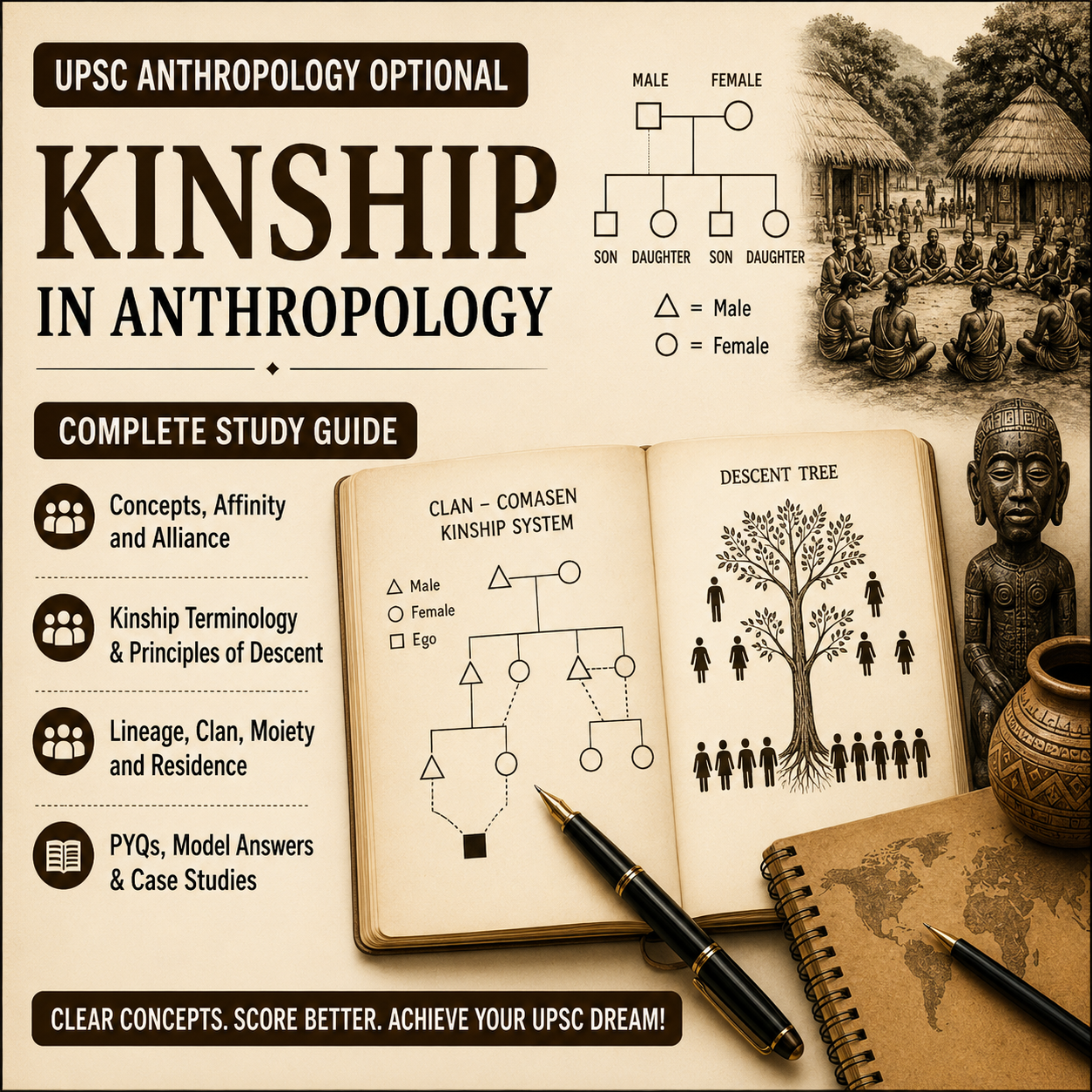
Kinship in Anthropology: Complete UPSC Anthropology Study Guide

Sarvagya · Anthropology Content Hub · vaidsics.com Kinship — Complete Study Guide UPSC Anthropology Optional · Paper 1 & Paper 2 Created by Antim N. Vaid  |  Affiliated by Vaid Sir  |  27th May 2026 How to Use This Document For complete beginners — Read the Beginner’s Glossary first. Every technical term is explained there in plain English before it appears in the main text. For students who have some background: Use the Table of Contents to jump to weak areas Focus on the Vaid Sir Exam Tips — these are the highest-yield points Prioritise the diagrams for Crow-Omaha, Descent Tree, and Lineage Hierarchy — these are frequently misunderstood Read all model answers — each demonstrates a different structure and length Table of Contents 1 Beginner’s Glossary 2 What is Kinship? 3 Kroeber’s 8 Determinants 4 Consanguinity and Affinity 5 Principles of Descent 6 Descent Groups — Lineage to Moiety 7 Rules of Residence 8 Kinship Terminology 9 Descent vs. Alliance 10 Previous Year Questions (2013–2024) 11 Model Answer Content & Structure 12 Case Studies & Recent Researches 1. Beginner’s Glossary Before you read anything else, read this glossary. Every technical word used in this document is explained here in plain English. The first time a term appears in the main text, its plain English meaning is also given in brackets. Kinship The system of relationships that connects people through blood and marriage — the social map of who is related to whom. Example: Your family tree — parents, siblings, cousins, in-laws. Consanguinity Being related by blood — having a common biological ancestor. Example: You and your brother are consanguineal kin. Affinity Being related by marriage — connected through a spouse. Example: Your wife’s parents are your affinal kin (in-laws). Descent The rule that decides which family group you belong to — traced through either your father’s or mother’s side. Example: In most of North India, you belong to your father’s gotra — that is patrilineal descent. Unilineal Tracing family membership through only ONE line — either the father’s side or the mother’s side. Example: The Gonds trace only through the father; the Khasi trace only through the mother. Patrilineal Family membership and property passes through the FATHER’s line. Example: Your father’s surname, gotra, and ancestral land — this is patrilineal. Matrilineal Family membership and property passes through the MOTHER’s line. Example: Among the Khasi of Meghalaya, children belong to the mother’s clan. Lineage A family group where everyone can actually NAME and TRACE every ancestor back to the founding person. Example: A Brahmin family that can recite their gotra ancestry back to a specific rishi. Clan A larger family group where members BELIEVE they share a common ancestor but cannot prove the exact connection. Example: Millions of people share the same clan name but cannot trace exactly how they are related. Exogamy The rule that you must MARRY OUTSIDE your own family/clan group. Example: You cannot marry someone from the same gotra — this is exogamy. Endogamy The rule that you must MARRY WITHIN a specific group. Example: Caste endogamy — you must marry within your own caste. Totemism The practice of a group identifying with a natural object, animal, or plant as their symbolic ancestor or protector. Example: A clan that considers the tiger as their founding ancestor and does not hunt or eat tigers. Moiety When a society is divided into exactly TWO halves for marriage and ceremonies. Example: Village A and Village B — everyone in A must marry someone from B and vice versa. Phratry A grouping of two or more clans that recognise some shared identity. Example: Three clans that all believe they came from the same original ancestor group. Affinal Related through marriage (not blood). Example: Your mother-in-law is an affinal relative. Filiation The direct, personal relationship between a PARENT and their CHILD — not about group membership. Example: The bond between you and your father, regardless of which lineage you belong to. Complementary Filiation In a patrilineal society, the personal tie you have with your MOTHER’s side of the family (who are not in your descent group). Example: Your mother’s brother (MoBr) is not in your patrilineal group but still has special obligations to you. Corporate Group A group that acts as a single legal/social unit — owns property, makes decisions, continues after members die. Example: A lineage that collectively owns ancestral land. Avunculate The special relationship between a man and his mother’s brother (maternal uncle) — particularly important in matrilineal societies. Example: In some tribes, the maternal uncle (MoBr) has more authority over you than your own father. Levirate The custom where a widow marries her deceased husband’s BROTHER. Example: After her husband dies, she marries his younger brother — this keeps her within the same family group. Sororate The custom where a widower marries his deceased wife’s SISTER. Example: After his wife dies, he marries her younger sister — this maintains the alliance between the two families. Ego In kinship diagrams, ‘Ego’ = YOU — the reference person from whose perspective all relationships are mapped. Example: All kinship terms are defined relative to Ego’s position. Cross-Cousins Children of a BROTHER and SISTER — your father’s sister’s children, or your mother’s brother’s children. Example: Your FaSiDa (father’s sister’s daughter) is your cross-cousin. Parallel Cousins Children of TWO BROTHERS or TWO SISTERS — your father’s brother’s children or your mother’s sister’s children. Example: Your FaBrSo (father’s brother’s son) is your parallel cousin — treated like a sibling in most tribal societies. Putative Descent Believed but not proven ancestry — you CLAIM a common ancestor but cannot trace the exact genealogy. Example: Clan members claim descent from a common ancestor but cannot name every person in between. Prescriptive Marriage A marriage rule where you MUST marry a specific category of person. Example: In some South Indian tribes, a man MUST marry his MoBrDa (mother’s brother’s daughter). Preferential Marriage A marriage rule where you are ENCOURAGED (but not required) to marry a certain … Read more

Why UPSC Aspirants Are Choosing Anthropology Optional in 2026 & 2027 | Vaid’s ICS

Why Serious UPSC Aspirants Are Choosing Anthropology Optional in 2026 & 2027 And What Most Beginners Realise Too Late Reviewed by Vaid Sir | Anthropology Mentor Since 1985 Before Anything Else, Let’s Talk About the Real Problem When aspirants look back at their UPSC preparation journey, many regret things like choosing the wrong sources, delaying answer writing, ignoring revision, or spending too much time on current affairs. But among Anthropology Optional rankers, one observation appears repeatedly: “I should have started earlier.” Not necessarily because the subject was impossible. Not because the syllabus was too vast. But because they spent months hesitating before making a clear optional decision. And that hesitation matters more than most aspirants realise. In UPSC preparation, confusion is expensive. A delayed optional decision often leads to fragmented preparation, weak answer writing, inconsistent revision, and rushed Mains preparation later. This article is not an attempt to convince every aspirant to choose Anthropology Optional. Different optionals work for different people. The goal here is simpler: to explain honestly where Anthropology Optional performs strongly, where aspirants misunderstand it, and who should seriously evaluate it for UPSC 2026 and 2027. The Optional Selection Advice Most Aspirants Receive Is Too Generic Most optional-selection advice sounds predictable: “Choose what interests you.” “Pick something overlapping with GS.” “Take the subject you enjoy reading.” None of these are completely wrong. But none of them are sufficient either. Optional selection is one of the highest-impact decisions in your UPSC preparation. A poor optional fit does not only affect marks. It affects: motivation consistency answer-writing quality revision efficiency interview confidence overall preparation energy That is why optional selection should not be based only on hearsay, trend, fear, or someone else’s experience. The Three Criteria That Actually Matter 1. Scoring Consistency The important question is not: “Can someone score 340?” Almost every optional has produced exceptional scores occasionally. The better question is: “Can disciplined aspirants consistently score in a competitive range?” Anthropology Optional has shown relatively stable scoring across multiple UPSC cycles, especially among aspirants who: complete the syllabus properly practice answer writing consistently use diagrams effectively revise regularly integrate examples and case studies in answers This is one reason why many serious aspirants evaluate Anthropology Optional with greater attention. 2. Cross-Paper Utility Anthropology Optional performs strongly because it does not remain limited to the optional papers alone. It has meaningful overlap with: GS Paper 1 Essay Social issues Tribal development topics Interview preparation Topics such as tribal communities, caste, kinship, culture, social change, identity, women and society, development, and tradition regularly help aspirants develop a more mature understanding of society. 3. Competition Density Anthropology Optional usually operates with a comparatively manageable syllabus and clearer answer-quality expectations. Unlike some subjects where the reading list can become endless, Anthropology has a more structured syllabus. With the right preparation plan, aspirants can build strong command over the subject in a disciplined manner. What Makes Anthropology Optional Different? The Syllabus Is Surprisingly Finite Anthropology Optional may look intimidating at first because terms like genetics, fossil evidence, primatology, kinship, and paleoanthropology appear unfamiliar. But once the syllabus is understood properly, most aspirants realise something important: The subject is highly structured. Paper 1 has conceptual and scientific foundations. Paper 2 connects those concepts with Indian society, tribes, caste, development, and constitutional issues. Once the structure becomes clear, the subject becomes far more approachable. You Do Not Need an Anthropology Background One of the biggest misconceptions is that Anthropology Optional is only for students from biology, science, or anthropology backgrounds. That is not true. The majority of successful Anthropology Optional candidates did not study anthropology academically before UPSC. Anthropology for UPSC is not university anthropology. It is an exam-oriented, structured version of the discipline. If an aspirant can understand basic concepts, revise consistently, and present answers clearly, the subject can be approached even without prior academic exposure. Physical Anthropology Is Not as Difficult as It Looks Many beginners get nervous when they see topics related to human evolution, genetics, fossils, race, and primates. But UPSC does not expect medical-level biology knowledge. What the exam actually rewards is: conceptual clarity structured explanation diagram usage relevant examples good answer presentation With proper guidance and repeated revision, Physical Anthropology becomes one of the most scoring areas for many aspirants. The GS and Essay Overlap Is Real Anthropology Optional helps aspirants develop a strong understanding of society, culture, identity, and human development. This becomes useful in GS and Essay topics related to: tribal communities caste and social change women and society development and displacement social reform identity and tradition Indian society Many Anthropology students find that their optional preparation improves their ability to write mature, balanced, and example-rich answers in GS and Essay as well. The Interview Advantage Is Often Ignored Optional subject knowledge does not end with Mains. Anthropology students are often more comfortable handling discussions involving: tribal policy identity culture and tradition social change constitutional provisions development conflicts These areas are highly relevant to civil services because administrators regularly deal with society, communities, welfare, development, and conflict resolution. That is why Anthropology can also contribute to better personality-test preparedness. Who Should Seriously Consider Anthropology Optional? Anthropology Optional is usually a strong fit for: beginners who have not finalised their optional aspirants preparing for UPSC 2026 or 2027 working professionals looking for a finite syllabus repeaters considering a practical optional switch aspirants who want overlap with GS, Essay, and Interview students who prefer structured and diagram-based answers However, Anthropology Optional still requires discipline. It is not a shortcut. It rewards aspirants who prepare systematically. The Biggest Mistake Beginners Make Most beginners start preparation by immediately collecting books, PDFs, notes, and topper copies. But a better beginning looks like this: Week 1: Understand the syllabus completely. Week 2: Study previous year questions carefully. Week 3: Begin with Human Evolution and Fossil Evidence. Week 4: Study quality answers before writing your own. This approach helps aspirants avoid confusion and build the subject step by step. The goal should … Read more

Humans Shared the Land with ‘Hobbits’ | Anthropology Current Affairs for UPSC

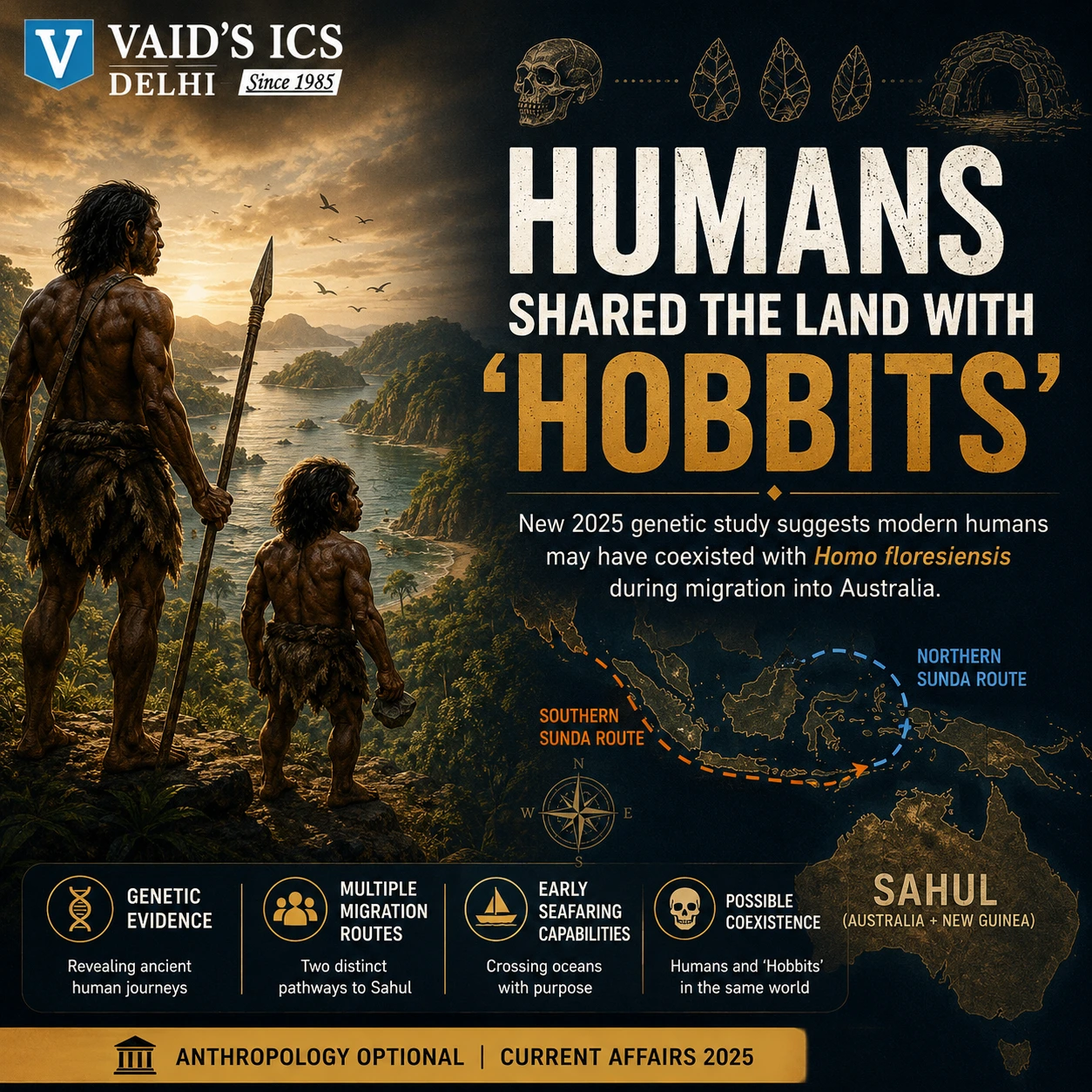
  Anthropology Optional • Current Affairs • 2025 Humans Shared the Land with ‘Hobbits’ Fossil Evidence, Human Migration & What the 2025 Research Really Means Reviewed by Vaid Sir Anthropology Mentor · Since 1985 Source: Science Advances, November 2025 Why This Study Matters Every few years, a research paper appears that genuinely changes how we think about human evolution. This 2025 study by Francesca Gandini and colleagues is one of them. For decades, students learned human migration as a relatively clean story: modern humans left Africa, moved through Asia, and eventually reached Australia. But recent genetic research is showing that the process was far more complicated. Different migration routes existed, populations separated and regrouped, and early modern humans may have travelled through regions already occupied by other human species. That is what makes this study important. The research suggests that one of the migration routes used by early modern humans passed through the same Indonesian island region where Homo floresiensis — the so-called “Hobbits” — were still living. The study does not claim direct interaction. But the overlap in geography and chronology is strong enough to raise an important paleoanthropological question: Were modern humans and Homo floresiensis living in the same broader landscape at roughly the same time? For Anthropology Optional students, this matters because it connects several themes together in a single case study: Human evolution Fossil evidence Out of Africa migration Behavioral modernity Human adaptation Genetics and paleoanthropology More importantly, it gives you a contemporary example that can enrich answers beyond standard textbook material. Who Were Homo Floresiensis? Homo floresiensis was discovered in 2003 in Liang Bua Cave on Flores Island, Indonesia. The discovery immediately attracted global attention because the fossils represented a small-bodied human species that survived surprisingly late in prehistory. The species stood roughly one metre tall and had a brain size much smaller than modern humans. Yet archaeological evidence showed that they were capable of making and using stone tools. That combination challenged older assumptions about intelligence and brain size. Earlier evolutionary models often linked cognitive sophistication directly with larger cranial capacity. Homo floresiensis complicated that idea. Despite their small brains, they appear to have displayed organized behaviour and technological capability. Key Facts Discovery Site Liang Bua Cave, Flores Island, Indonesia Discovery Year 2003 Estimated Height Around 1 metre Brain Size Approximately 380–420 cc Survival Timeline Roughly 50,000–60,000 years ago Tool Use Stone tools present Evolutionary Debate Possibly descended from Homo erectus   Figure 1. Side-by-side comparison of Homo floresiensis and modern humans, with new genetic evidence suggesting overlap in the islands of Wallacea. Why Were They Called “Hobbits”? The nickname came from popular science reporting after the discovery. Their short stature and unusual appearance reminded researchers and journalists of the fictional Hobbits described by J.R.R. Tolkien. But in anthropology, the nickname itself is not important. What matters scientifically is what Homo floresiensis tells us about human diversity during the Late Pleistocene. The species demonstrates that multiple hominin populations existed simultaneously and adapted differently to their environments. The Idea of Insular Dwarfism One of the most important concepts linked with Homo floresiensis is insular dwarfism. This refers to the evolutionary tendency of island-dwelling species to become smaller over long periods due to limited food resources and ecological isolation. Flores Island provided exactly those conditions. Many anthropologists consider Homo floresiensis one of the clearest hominin examples of insular dwarfism. The concept is useful not only for Anthropology Optional but also for understanding broader evolutionary adaptation. What Did the 2025 Study Actually Find? The Gandini et al. study examined genetic evidence connected with the migration of early modern humans into Sahul — the ancient landmass that once combined Australia, New Guinea, and Tasmania. During the Late Pleistocene, sea levels were lower than today, exposing large stretches of land. Even then, reaching Sahul still required ocean crossings. That detail is important. The migration was not simply accidental drift. It likely involved planning, navigation, and coordinated movement. The major finding of the study is that early humans appear to have used two different migration pathways while moving toward Sahul. Route One: Southern Sunda Route This route passed through parts of Indonesia, including regions associated with Homo floresiensis. Route Two: Northern Sunda Route This pathway moved through the Philippines and nearby island systems before turning toward Sahul. Figure 2. Two distinct migration pathways from Africa to Sahul. The Southern Sunda Route passes directly through the islands where Homo floresiensis survived. Genetic analysis showed that both groups ultimately shared ancestry from the same African population, supporting the broader Out of Africa framework. However, the migration pattern itself appears more complex than earlier simplified models suggested. The Most Interesting Question: Did They Coexist? This is where the study becomes especially fascinating. Homo floresiensis survived until approximately 50,000–60,000 years ago. The migration timelines proposed in the new genomic study overlap with that period. That overlap does not prove direct interaction. However, many paleoanthropologists now consider coexistence scientifically plausible. If that interpretation is correct, it means early modern humans were moving through landscapes already occupied by another hominin species. That changes the way we think about migration. Instead of imagining a simple human expansion into empty territory, we may need to think in terms of shared ecological spaces, competition for resources, and parallel populations adapting differently to island environments. Figure 3. The overlap between 80,000 and 50,000 years before present is the critical window in which both populations may have shared the islands of Wallacea. Some researchers remain cautious. Chronological overlap alone cannot establish direct contact. Fossil evidence from this period is still incomplete, and archaeology rarely provides perfectly linear narratives. Still, the possibility itself is significant enough to deserve attention. Why the Seafaring Angle Matters One aspect of the study that deserves more attention is maritime capability. Even with lower sea levels, humans travelling toward Sahul had to cross stretches of open water. That implies: deliberate navigation group coordination environmental awareness planning ability adaptation to unfamiliar ecosystems This pushes sophisticated human mobility … Read more