
VAID'S ICS – Best UPSC Anthropology Coaching in Delhi Since 1985

Anthropology Optional Syllabus Explained: Paper 1 & Paper 2 Roadmap for UPSC CSE 2027
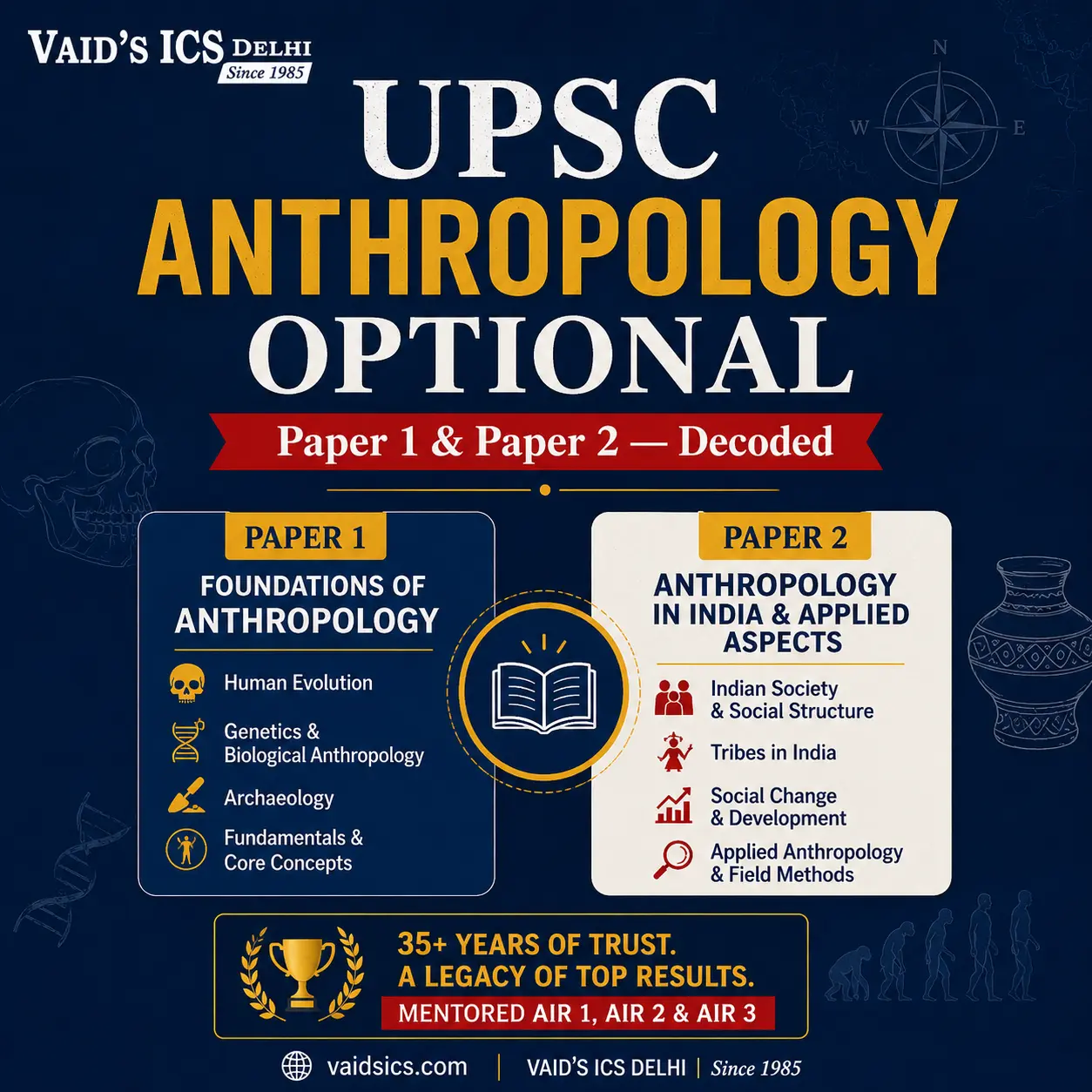
Anthropology Optional Syllabus Explained for UPSC CSE 2027

Vaid Sir · 18 min read · Updated June 2026 · VAIDS ICS Delhi Most aspirants who open the Anthropology optional syllabus PDF for the first time make the same mistake. They read through it once, decide it looks manageable, and go looking for notes. A few weeks into preparation, sitting with a stack of handouts and coaching material, they realise they have been studying isolated pieces without any sense of how those pieces fit together. Genetics sits in one corner, kinship sits in another, tribe-caste continuum somewhere else — and the connection between them is unclear. This is not a failure of effort. It is a failure of orientation. Nobody explained what the syllabus actually contains before preparation began. This article is that explanation. We are going to walk through both papers — the way a mentor explains a new subject to a student sitting across a desk — in plain language, with honest observations about what each section actually contains and what it asks of you. One clarification upfront. This article is specifically about understanding what the Anthropology syllabus contains — its architecture, its internal logic, and how Paper 1 and Paper 2 form one unified subject. If you are looking for a preparation plan, a booklist, or a starting roadmap, those are covered in dedicated companion articles on VAIDS ICS. How to Start Anthropology Optional from Zero Is Anthropology Good Optional for UPSC? That clarity about the syllabus, by the way, is not a minor or cosmetic thing. Aspirants who understand the architecture of the subject before they begin preparing study with more focus, write answers with more structural depth, and are far less anxious when a question combines topics they had mentally kept in separate compartments. The subject rewards people who see it whole. The Design of Anthropology Optional: Two Papers, One Unified Subject Anthropology optional consists of two papers — 250 marks each, 500 total. But the two papers are not simply two halves of the same content split arbitrarily for length. They represent two different levels of engagement with the same subject. Paper 1 asks: What is Anthropology as a science of human beings? What concepts does it use? What theories has it developed? What does it know about human evolution, genetics, culture, kinship, economic and political organisation, religion, and prehistoric life? What methods do anthropologists use to study all of this? Paper 2 asks: How do all of those things — every concept, every theory, every method — help us understand India? Its social structure, its tribal communities, its historical development, its contemporary conflicts, its constitutional choices? Think of it this way: Paper 1 builds an analytical vocabulary. Paper 2 requires you to use that vocabulary on a specific, familiar, and complex context — Indian society. A student who treats Paper 1 as background reading and focuses preparation on Paper 2’s facts and current affairs will write Paper 2 answers that are descriptive but analytically thin. A student who prepares Paper 1 conceptually will find that Paper 2 questions practically invite the frameworks already built. This relationship — Paper 1 as toolkit, Paper 2 as the place where tools are used — is the structural insight that changes how you study this optional. Almost every strong Paper 2 answer has roots in Paper 1. The Four Threads Running Through Both Papers Below all the specific topics, four major intellectual threads run through the entire Anthropology optional. They appear in both papers, intersect with each other, and explain why the syllabus is designed the way it is. Biological Anthropology — the study of human beings as biological organisms. Our evolutionary history, genetic makeup, bodily variation, adaptation to different environments, growth across the life cycle, and health. Paper 1 covers this as a universal science of the human body. Paper 2 brings it to India’s fossil record, tribal health patterns, and demographic questions. Socio-Cultural Anthropology — the study of how human beings organise their collective lives. Culture, kinship, marriage, family, economic systems, political structures, religion, language. Paper 1 covers these as phenomena that appear across all human societies. Paper 2 studies their Indian forms — caste, village, tribal community, religious practice, and social change. Prehistoric Archaeology — the reconstruction of human life before written records, through tools, bones, habitation sites, and art. Paper 1 covers global cultural sequences and the methods used to date and interpret them. Paper 2 brings this to India’s specific prehistoric evidence. Indian Anthropology — the systematic study of Indian society, culture, tribes, and development through anthropological frameworks. This is primarily Paper 2’s domain, but it draws on all three threads above as its analytical base. The four intellectual pillars of UPSC Anthropology Optional and their key sub-topics UPSC Anthropology Syllabus at a Glance Here is what the official document actually lists, in plain language. Paper 1 — Six Areas: how Anthropology developed as a discipline; human evolution, genetics, biological variation, growth, and health; prehistoric archaeology from the Stone Age through the Iron Age; socio-cultural life — kinship, marriage, family, economic and political organisation, religion; anthropological theories from evolutionism to postmodernism; and research methods with applied Anthropology. Paper 2 — Six Areas: Indian prehistoric and civilisational context; the traditional Indian social system — varna, caste, village, Jajmani; India’s tribes and the tribe-caste continuum; social change — Sanskritisation, Westernisation, modernisation; development and constitutional safeguards for SC/ST communities; and contemporary debates around displacement, ethnicity, and identity. Twelve areas, two papers — not twelve separate subjects, but one subject at two different scales. Paper 1 vs Paper 2 — The Big Picture Intellectual Thread Paper 1 — Universal Science Paper 2 — Applied to India How They Connect Biological Anthropology Human evolution, genetics, variation, growth, epidemiology India’s fossil record (Siwalik, Narmada), tribal health, demographic patterns Biological concepts from P1 are the framework for India-specific health and genetic realities in P2 Socio-Cultural Anthropology Culture, kinship, marriage, family, economic and political organisation, religion Caste, village, Indian tribal kinship, social change processes, folk religion P1 social … Read more
How to Start Anthropology Optional from Zero: A Beginner’s Roadmap for UPSC CSE 2027

How to Start Anthropology Optional from Zero — a beginner's roadmap for UPSC CSE 2027 by VAID's ICS

The most common pattern among first-time Anthropology aspirants is this: they spend their opening weeks collecting books, watching overview videos, and comparing notes formats — without ever reading the actual syllabus. Most beginners go through this phase. When you are new to a subject, gathering materials feels productive. It gives the impression that preparation has begun. But Anthropology at the UPSC level is a subject that punishes aimless accumulation and rewards structured thinking. The aspirants who struggle most in the first few months are rarely those who studied less — they are those who studied without knowing what they were preparing for. Anthropology is not a difficult subject. What makes it feel difficult is beginning without a clear sense of direction. This article is written for aspirants who have already made the decision — “I am taking Anthropology optional” — and now want to know exactly how to begin. Can a Beginner with No Anthropology Background Choose This Subject? Yes. And this is not reassurance for the sake of it — it is simply accurate. Most candidates who perform well in Anthropology optional did not study the subject in their undergraduate programmes. This is worth understanding clearly, because the anxiety around “I have no Anthropology background” is one of the most common things beginners carry into their first few weeks — and it is largely unnecessary. Consider what the UPSC Anthropology syllabus actually contains. Paper 1 covers evolution, genetics, and physical anthropology — areas where science and engineering graduates are often already comfortable. It covers cultural anthropology and major theoretical frameworks — areas where humanities graduates tend to have natural affinity. Paper 2 covers Indian society, tribal communities, social change, and development — areas that any informed Indian citizen has encountered through general reading, current affairs, and everyday observation. The syllabus is not designed for specialists. It is designed to test whether a candidate can understand, analyse, and apply anthropological ideas — regardless of where they studied. Why Your Background Doesn’t Hold You Back An engineering graduate who is patient with conceptual work and comfortable drawing diagrams will find Anthropology’s structure logical. A medical graduate who has studied human biology will find Physical Anthropology familiar. A humanities graduate will find that kinship theory, social change, and cultural anthropology sit close to what they already know. A commerce graduate — who may feel most uncertain — will discover that Anthropology requires no prior technical knowledge at all, and that a fresh mind approaching the subject systematically is often an advantage. Key Takeaway Your graduation background is not a limiting factor. What matters is how systematically you approach the syllabus. 👉 If you are still evaluating whether Anthropology is the right optional for you, read: Is Anthropology a Good Optional for UPSC? — an analysis of Anthropology’s scoring patterns and suitability across different candidate profiles. Understand the Anthropology Syllabus Before Buying Any Book This is the single most important instruction in this article, and it is the one most beginners skip. The instinct, when starting a new subject, is to find “the best book” and begin reading. But in Anthropology, this approach almost always leads to a specific kind of confusion: you read broadly, you cover many pages, and yet you cannot tell what is exam-relevant and what is not. You are unable to judge whether you are making progress. You cannot connect what you are reading to what UPSC actually asks. Two days spent reading the syllabus carefully — before touching any book — will change how you study everything that follows. Anthropology has two papers with distinctly different characters. Understanding this distinction early shapes everything that follows — what you read, in what sequence, and how you frame your answers. Paper 1 is fundamentally theoretical and conceptual. It asks you to understand how human beings evolved biologically, how physical variation developed across populations, what the major archaeological findings tell us about human prehistory, how genetics explains heredity and adaptation, and what the principal schools of anthropological thought have argued about culture, society, and human behaviour. This paper requires you to build a conceptual vocabulary — an understanding of terms, frameworks, and arguments that will inform everything you write. Paper 2 is application-based and India-specific. It asks you to understand the structure of Indian society, the situation of tribal communities in India, the processes of social change, and how anthropological methods and perspectives apply to development questions in the Indian context. This paper feels closer to general studies for many aspirants, which is partly why its demands are underestimated. Paper 1 vs Paper 2   The sequencing point that most beginners get wrong: Paper 2 should not be studied before Paper 1. Paper 2 feels easier at first glance. Indian tribes, social change, rural development — these topics seem familiar. Many aspirants begin with Paper 2 for this reason, treating it as a confidence-building exercise before tackling the “harder” Paper 1. In practice, this has real consequences for answer quality. The concepts you build in Paper 1 — theories of social structure, kinship systems, evolutionary frameworks, the anthropological understanding of culture — are precisely the tools you need to write analytical Paper 2 answers. An answer on tribal development that draws on evolutionary theory, or an answer on social change that engages with anthropological theories of culture, is a fundamentally stronger answer than one written purely from descriptive knowledge. Paper 1 gives you the vocabulary. Paper 2 is where you apply it. Study Paper 1 first. The initial discomfort of unfamiliar concepts is the investment that pays off when you reach Paper 2. 👉 For a complete chapter-wise breakdown with topic weightage: Anthropology Syllabus Explained What Should Be Your First Book? Most beginners approach this question the wrong way. They ask: “Which is the best book for Anthropology?” The better question is: “What should I read, and in what order?” These are different questions with different answers. The first leads you toward a ranked list of titles. The second leads … Read more

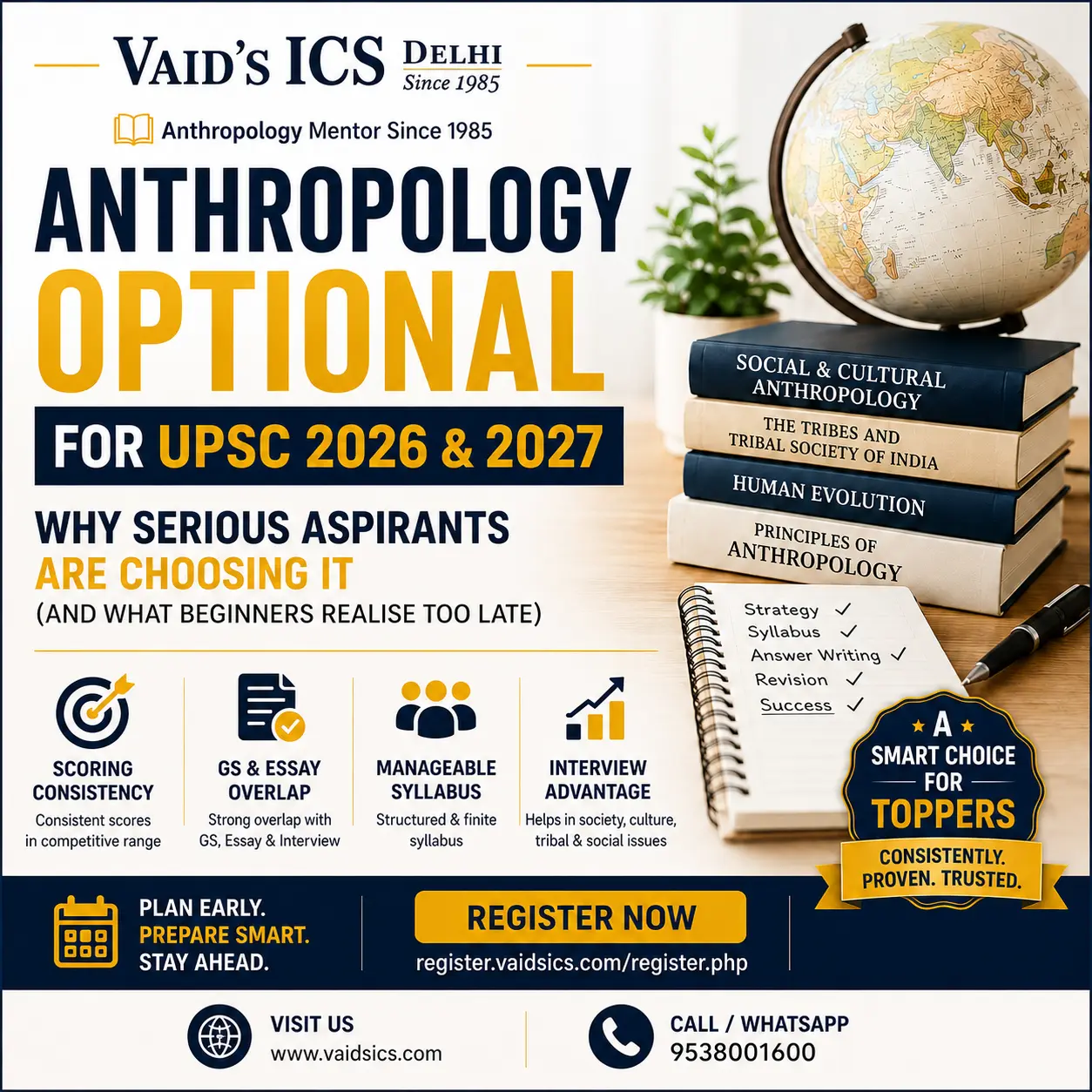
Why UPSC Aspirants Are Choosing Anthropology Optional in 2026 & 2027 | Vaid’s ICS

Why Serious UPSC Aspirants Are Choosing Anthropology Optional in 2026 & 2027 And What Most Beginners Realise Too Late Reviewed by Vaid Sir | Anthropology Mentor Since 1985 Before Anything Else, Let’s Talk About the Real Problem When aspirants look back at their UPSC preparation journey, many regret things like choosing the wrong sources, delaying answer writing, ignoring revision, or spending too much time on current affairs. But among Anthropology Optional rankers, one observation appears repeatedly: “I should have started earlier.” Not necessarily because the subject was impossible. Not because the syllabus was too vast. But because they spent months hesitating before making a clear optional decision. And that hesitation matters more than most aspirants realise. In UPSC preparation, confusion is expensive. A delayed optional decision often leads to fragmented preparation, weak answer writing, inconsistent revision, and rushed Mains preparation later. This article is not an attempt to convince every aspirant to choose Anthropology Optional. Different optionals work for different people. The goal here is simpler: to explain honestly where Anthropology Optional performs strongly, where aspirants misunderstand it, and who should seriously evaluate it for UPSC 2026 and 2027. The Optional Selection Advice Most Aspirants Receive Is Too Generic Most optional-selection advice sounds predictable: “Choose what interests you.” “Pick something overlapping with GS.” “Take the subject you enjoy reading.” None of these are completely wrong. But none of them are sufficient either. Optional selection is one of the highest-impact decisions in your UPSC preparation. A poor optional fit does not only affect marks. It affects: motivation consistency answer-writing quality revision efficiency interview confidence overall preparation energy That is why optional selection should not be based only on hearsay, trend, fear, or someone else’s experience. The Three Criteria That Actually Matter 1. Scoring Consistency The important question is not: “Can someone score 340?” Almost every optional has produced exceptional scores occasionally. The better question is: “Can disciplined aspirants consistently score in a competitive range?” Anthropology Optional has shown relatively stable scoring across multiple UPSC cycles, especially among aspirants who: complete the syllabus properly practice answer writing consistently use diagrams effectively revise regularly integrate examples and case studies in answers This is one reason why many serious aspirants evaluate Anthropology Optional with greater attention. 2. Cross-Paper Utility Anthropology Optional performs strongly because it does not remain limited to the optional papers alone. It has meaningful overlap with: GS Paper 1 Essay Social issues Tribal development topics Interview preparation Topics such as tribal communities, caste, kinship, culture, social change, identity, women and society, development, and tradition regularly help aspirants develop a more mature understanding of society. 3. Competition Density Anthropology Optional usually operates with a comparatively manageable syllabus and clearer answer-quality expectations. Unlike some subjects where the reading list can become endless, Anthropology has a more structured syllabus. With the right preparation plan, aspirants can build strong command over the subject in a disciplined manner. What Makes Anthropology Optional Different? The Syllabus Is Surprisingly Finite Anthropology Optional may look intimidating at first because terms like genetics, fossil evidence, primatology, kinship, and paleoanthropology appear unfamiliar. But once the syllabus is understood properly, most aspirants realise something important: The subject is highly structured. Paper 1 has conceptual and scientific foundations. Paper 2 connects those concepts with Indian society, tribes, caste, development, and constitutional issues. Once the structure becomes clear, the subject becomes far more approachable. You Do Not Need an Anthropology Background One of the biggest misconceptions is that Anthropology Optional is only for students from biology, science, or anthropology backgrounds. That is not true. The majority of successful Anthropology Optional candidates did not study anthropology academically before UPSC. Anthropology for UPSC is not university anthropology. It is an exam-oriented, structured version of the discipline. If an aspirant can understand basic concepts, revise consistently, and present answers clearly, the subject can be approached even without prior academic exposure. Physical Anthropology Is Not as Difficult as It Looks Many beginners get nervous when they see topics related to human evolution, genetics, fossils, race, and primates. But UPSC does not expect medical-level biology knowledge. What the exam actually rewards is: conceptual clarity structured explanation diagram usage relevant examples good answer presentation With proper guidance and repeated revision, Physical Anthropology becomes one of the most scoring areas for many aspirants. The GS and Essay Overlap Is Real Anthropology Optional helps aspirants develop a strong understanding of society, culture, identity, and human development. This becomes useful in GS and Essay topics related to: tribal communities caste and social change women and society development and displacement social reform identity and tradition Indian society Many Anthropology students find that their optional preparation improves their ability to write mature, balanced, and example-rich answers in GS and Essay as well. The Interview Advantage Is Often Ignored Optional subject knowledge does not end with Mains. Anthropology students are often more comfortable handling discussions involving: tribal policy identity culture and tradition social change constitutional provisions development conflicts These areas are highly relevant to civil services because administrators regularly deal with society, communities, welfare, development, and conflict resolution. That is why Anthropology can also contribute to better personality-test preparedness. Who Should Seriously Consider Anthropology Optional? Anthropology Optional is usually a strong fit for: beginners who have not finalised their optional aspirants preparing for UPSC 2026 or 2027 working professionals looking for a finite syllabus repeaters considering a practical optional switch aspirants who want overlap with GS, Essay, and Interview students who prefer structured and diagram-based answers However, Anthropology Optional still requires discipline. It is not a shortcut. It rewards aspirants who prepare systematically. The Biggest Mistake Beginners Make Most beginners start preparation by immediately collecting books, PDFs, notes, and topper copies. But a better beginning looks like this: Week 1: Understand the syllabus completely. Week 2: Study previous year questions carefully. Week 3: Begin with Human Evolution and Fossil Evidence. Week 4: Study quality answers before writing your own. This approach helps aspirants avoid confusion and build the subject step by step. The goal should … Read more