
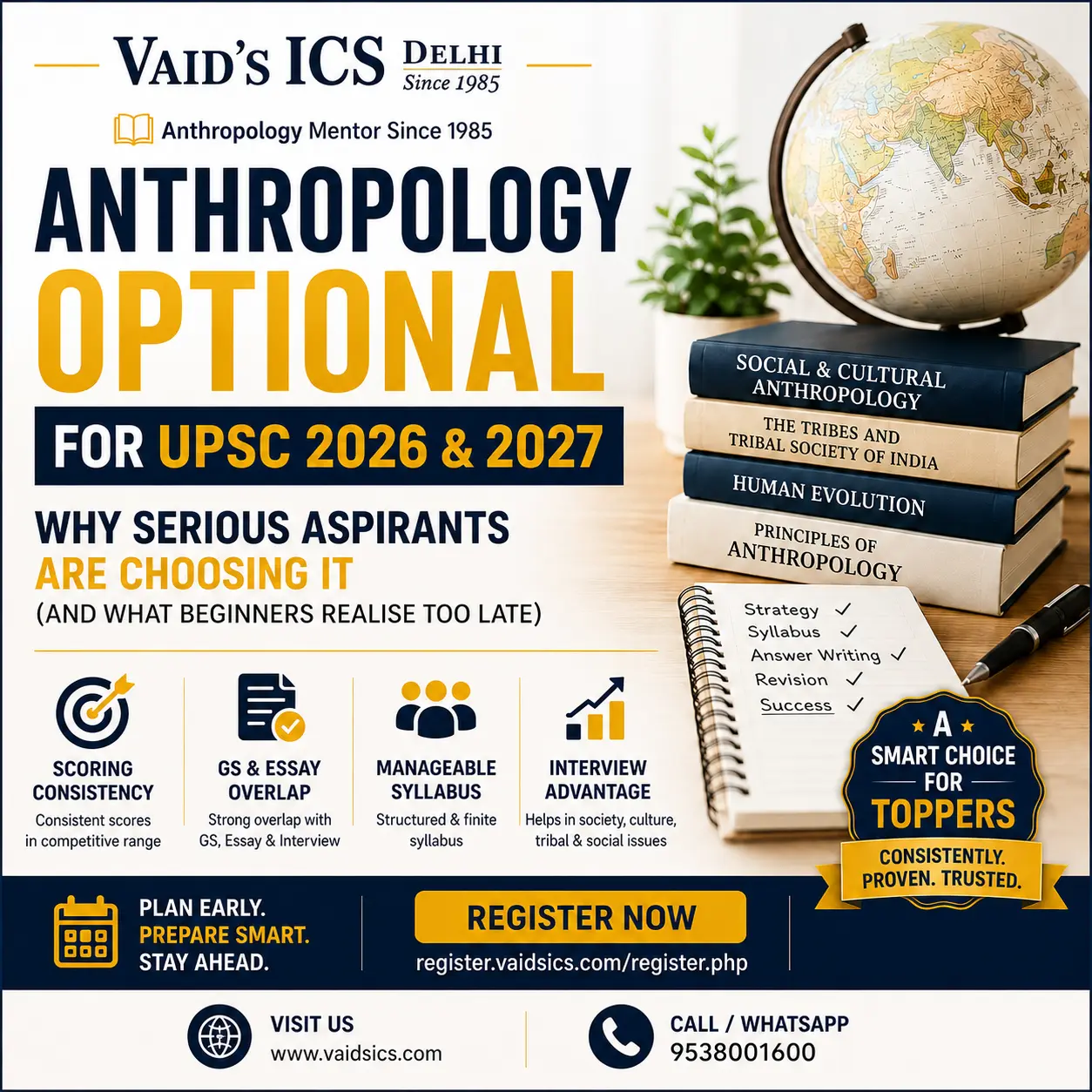
Why Serious UPSC Aspirants Are Choosing Anthropology Optional in 2026 & 2027 And What Most Beginners Realise Too Late
Reviewed by Vaid Sir | Anthropology Mentor Since 1985
Before Anything Else, Let’s Talk About the Real Problem
When aspirants look back at their UPSC preparation journey, many regret things like choosing the wrong sources, delaying answer writing, ignoring revision, or spending too much time on current affairs.
But among Anthropology Optional rankers, one observation appears repeatedly:
“I should have started earlier.”
Not necessarily because the subject was impossible. Not because the syllabus was too vast. But because they spent months hesitating before making a clear optional decision.
And that hesitation matters more than most aspirants realise.
In UPSC preparation, confusion is expensive. A delayed optional decision often leads to fragmented preparation, weak answer writing, inconsistent revision, and rushed Mains preparation later.
This article is not an attempt to convince every aspirant to choose Anthropology Optional. Different optionals work for different people.

The goal here is simpler: to explain honestly where Anthropology Optional performs strongly, where aspirants misunderstand it, and who should seriously evaluate it for UPSC 2026 and 2027.
The Optional Selection Advice Most Aspirants Receive Is Too Generic
Most optional-selection advice sounds predictable:
- “Choose what interests you.”
- “Pick something overlapping with GS.”
- “Take the subject you enjoy reading.”
None of these are completely wrong. But none of them are sufficient either.
Optional selection is one of the highest-impact decisions in your UPSC preparation.
A poor optional fit does not only affect marks. It affects:
- motivation
- consistency
- answer-writing quality
- revision efficiency
- interview confidence
- overall preparation energy
That is why optional selection should not be based only on hearsay, trend, fear, or someone else’s experience.
The Three Criteria That Actually Matter
1. Scoring Consistency
The important question is not:
“Can someone score 340?”
Almost every optional has produced exceptional scores occasionally.
The better question is:
“Can disciplined aspirants consistently score in a competitive range?”
Anthropology Optional has shown relatively stable scoring across multiple UPSC cycles, especially among aspirants who:
- complete the syllabus properly
- practice answer writing consistently
- use diagrams effectively
- revise regularly
- integrate examples and case studies in answers
This is one reason why many serious aspirants evaluate Anthropology Optional with greater attention.
2. Cross-Paper Utility
Anthropology Optional performs strongly because it does not remain limited to the optional papers alone.
It has meaningful overlap with:
- GS Paper 1
- Essay
- Social issues
- Tribal development topics
- Interview preparation
Topics such as tribal communities, caste, kinship, culture, social change, identity, women and society, development, and tradition regularly help aspirants develop a more mature understanding of society.
3. Competition Density
Anthropology Optional usually operates with a comparatively manageable syllabus and clearer answer-quality expectations.
Unlike some subjects where the reading list can become endless, Anthropology has a more structured syllabus. With the right preparation plan, aspirants can build strong command over the subject in a disciplined manner.
What Makes Anthropology Optional Different?
The Syllabus Is Surprisingly Finite
Anthropology Optional may look intimidating at first because terms like genetics, fossil evidence, primatology, kinship, and paleoanthropology appear unfamiliar.
But once the syllabus is understood properly, most aspirants realise something important:
The subject is highly structured.
Paper 1 has conceptual and scientific foundations. Paper 2 connects those concepts with Indian society, tribes, caste, development, and constitutional issues.
Once the structure becomes clear, the subject becomes far more approachable.
You Do Not Need an Anthropology Background
One of the biggest misconceptions is that Anthropology Optional is only for students from biology, science, or anthropology backgrounds.
That is not true.
The majority of successful Anthropology Optional candidates did not study anthropology academically before UPSC.
Anthropology for UPSC is not university anthropology. It is an exam-oriented, structured version of the discipline.
If an aspirant can understand basic concepts, revise consistently, and present answers clearly, the subject can be approached even without prior academic exposure.
Physical Anthropology Is Not as Difficult as It Looks
Many beginners get nervous when they see topics related to human evolution, genetics, fossils, race, and primates.
But UPSC does not expect medical-level biology knowledge.
What the exam actually rewards is:
- conceptual clarity
- structured explanation
- diagram usage
- relevant examples
- good answer presentation
With proper guidance and repeated revision, Physical Anthropology becomes one of the most scoring areas for many aspirants.
The GS and Essay Overlap Is Real
Anthropology Optional helps aspirants develop a strong understanding of society, culture, identity, and human development.
This becomes useful in GS and Essay topics related to:
- tribal communities
- caste and social change
- women and society
- development and displacement
- social reform
- identity and tradition
- Indian society
Many Anthropology students find that their optional preparation improves their ability to write mature, balanced, and example-rich answers in GS and Essay as well.
The Interview Advantage Is Often Ignored
Optional subject knowledge does not end with Mains.
Anthropology students are often more comfortable handling discussions involving:
- tribal policy
- identity
- culture and tradition
- social change
- constitutional provisions
- development conflicts
These areas are highly relevant to civil services because administrators regularly deal with society, communities, welfare, development, and conflict resolution.
That is why Anthropology can also contribute to better personality-test preparedness.
Who Should Seriously Consider Anthropology Optional?
Anthropology Optional is usually a strong fit for:
- beginners who have not finalised their optional
- aspirants preparing for UPSC 2026 or 2027
- working professionals looking for a finite syllabus
- repeaters considering a practical optional switch
- aspirants who want overlap with GS, Essay, and Interview
- students who prefer structured and diagram-based answers
However, Anthropology Optional still requires discipline. It is not a shortcut. It rewards aspirants who prepare systematically.
The Biggest Mistake Beginners Make
Most beginners start preparation by immediately collecting books, PDFs, notes, and topper copies.
But a better beginning looks like this:
- Week 1: Understand the syllabus completely.
- Week 2: Study previous year questions carefully.
- Week 3: Begin with Human Evolution and Fossil Evidence.
- Week 4: Study quality answers before writing your own.
This approach helps aspirants avoid confusion and build the subject step by step.
The goal should not be to finish books quickly. The goal should be to build exam-oriented clarity.
What Realistic Scores Actually Look Like
A focused first-time aspirant with proper syllabus coverage, consistent answer writing, revision discipline, and diagram practice can realistically target around 280–310 marks in Anthropology Optional.
Higher scores are possible, but they require:
- strong command over the syllabus
- regular answer writing
- multiple revisions
- effective use of diagrams
- case studies and examples
- proper test-series feedback
Anthropology rewards consistency more than last-minute preparation.
A Word About Coaching and Mentorship
Anthropology Optional can absolutely be prepared through self-study.
But mentorship becomes valuable in areas where aspirants often struggle, such as:
- answer-writing feedback
- diagram improvement
- current affairs integration
- syllabus prioritisation
- test performance analysis
- preparation direction
Aspirants often lose time not because they are not working hard, but because they are working without the right direction.
Final Thought
Anthropology Optional is not the perfect optional for everyone.
But many aspirants dismiss it without understanding:
- how manageable the syllabus can become
- how useful the GS and Essay overlap is
- how structured the preparation can be
- how important early optional clarity is
- how answer writing and diagrams can improve scoring potential
Optional selection should be based on clarity, not anxiety.
If you are preparing for UPSC 2026 or 2027, this is the right time to understand Anthropology Optional properly before making a decision.
Join Anthropology Optional Guidance with Vaid Sir
Understand the syllabus, scoring strategy, answer-writing approach, and preparation roadmap for Anthropology Optional.
Anthropology Optional | VAID’S ICS Delhi | Since 1985
1 thought on “Why UPSC Aspirants Are Choosing Anthropology Optional in 2026 & 2027 | Vaid’s ICS”