
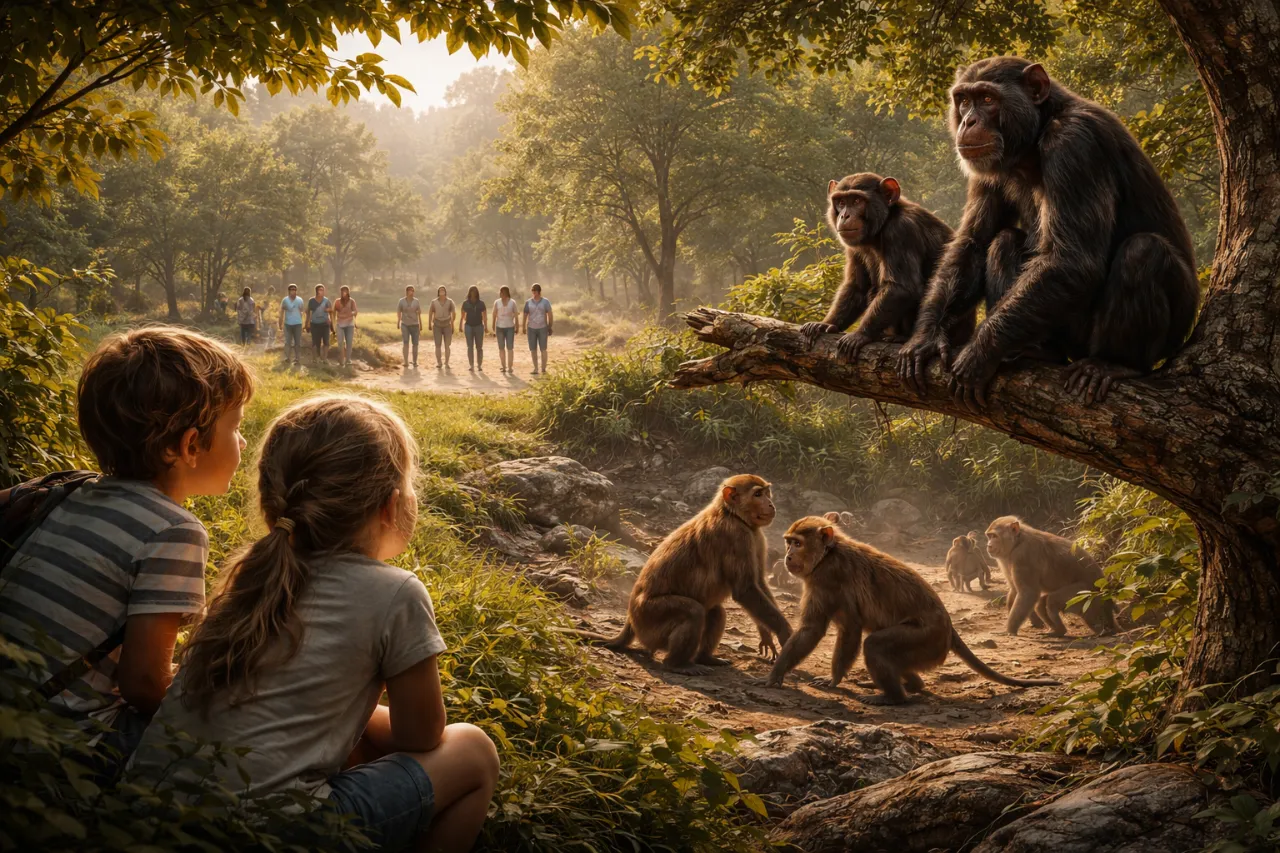
In one 2025 experiment, children and chimpanzees preferred videos of social interaction and sometimes gave up small rewards to keep watching. In a separate study, macaques paid most attention to conflict between other monkeys. Taken together, the two studies suggest that primate social attention, the pull to watch what others are doing, looks far older than human culture. For Paper I it is a clean, recent example of primate social organisation and social learning.
Source: Laura Lewis et al., Proceedings of the Royal Society B (2025), and Liesbeth Sterck et al., Animal Cognition (2025).
A shared drive to watch others
Lewis and colleagues report one experiment. Children aged four to six and adult chimpanzees watched videos of either social interactions or solitary individuals. Both groups preferred the social scenes, and both were willing to give up small rewards to keep watching. So a reasonable reading is that attending to social life is rewarding in itself. That holds for two species separated by millions of years of evolution.

Macaques and the pull of conflict
A separate study, led by Sterck, tested long-tailed macaques. Males and females alike paid more attention to aggressive encounters than to peaceful grooming, and they watched familiar individuals most closely. Humans show a similar pattern in their interest in conflict-driven news and in the lives of people they know. However, hold that analogy lightly, because it is not evidence of identical mechanisms.
| Study | Subjects | Reported pattern |
|---|---|---|
| Lewis et al. | Children aged 4 to 6 and adult chimpanzees | Preferred social scenes over solitary ones and gave up small rewards to keep watching |
| Sterck et al. | Long-tailed macaques | Watched aggression more than grooming and watched familiar individuals most closely |
Why hierarchy is worth watching
The interest in aggression is not idle. In a group-living primate, knowing who is dominant over whom helps an individual avoid threats, choose allies and time its own moves. Watching others is therefore a way of reading the dominance hierarchy, which is why attention and rank belong in the same answer.
Reputation and the cost of being ignored
The primatologist Gillian Forrester has suggested that attention also helps maintain reputation. In ancestral primate and human groups, a damaged reputation could mean less access to food, fewer mating opportunities and even ostracism, so watching carefully may have paid off. Treat this as an interpretation offered in commentary on the studies, not a result the experiments themselves demonstrated.
From social attention to culture
Taken together, the studies fit the idea that observing others evolved to track group dynamics, sustain bonds, detect threats and support social learning, the route by which traditions spread. They do not show that macaques gossip or that attention caused culture. They show a widely shared interest in social information, which human gossip and news habits may have built on.
Using it in UPSC Mains
Use it under Paper I, Section 1.5, which lists primate behaviour. Pair it with classic accounts of social organisation to argue that social cognition is conserved across anthropoids. Then add the limits: the sample sizes, the testing settings, and the leap from watching time to evolutionary function.
The closest exam question is Forms of Primate Social Organisation (2022); attention and hierarchy give it a current example. For more primate-behaviour questions, see the Human Evolution and Primatology PYQs. For related reading, see Bonobos and inequity aversion and Orangutans and Metabolic Flexibility. The wider syllabus map is in the Anthropology Optional complete guide.
Sources
Lewis, L. et al. (2025), Proceedings of the Royal Society B. Sterck, L. et al. (2025), Animal Cognition.