

The Nicobarese speak a language that belongs to the Austroasiatic family, the same family as Khmer and Munda languages. Where do their ancestors come from, and when did they reach the islands? A 2024 study of 1,559 people from South and Southeast Asia gives a specific answer: the Nicobarese share ancestry with Austroasiatic-speaking populations on the mainland, and their ancestors settled the islands later than earlier language-based theories assumed. For Optional Paper II, it is a clean case of language, genes and migration being read together.
Source: European Journal of Human Genetics (December 2024), DOI 10.1038/s41431-024-01720-w, from a nine-institution team co-led by K. Thangaraj (CSIR-CCMB) and G. Chaubey (BHU). Checked through the CCMB press note of 6 December 2024 and the abstract record, not the full text.

What the team did
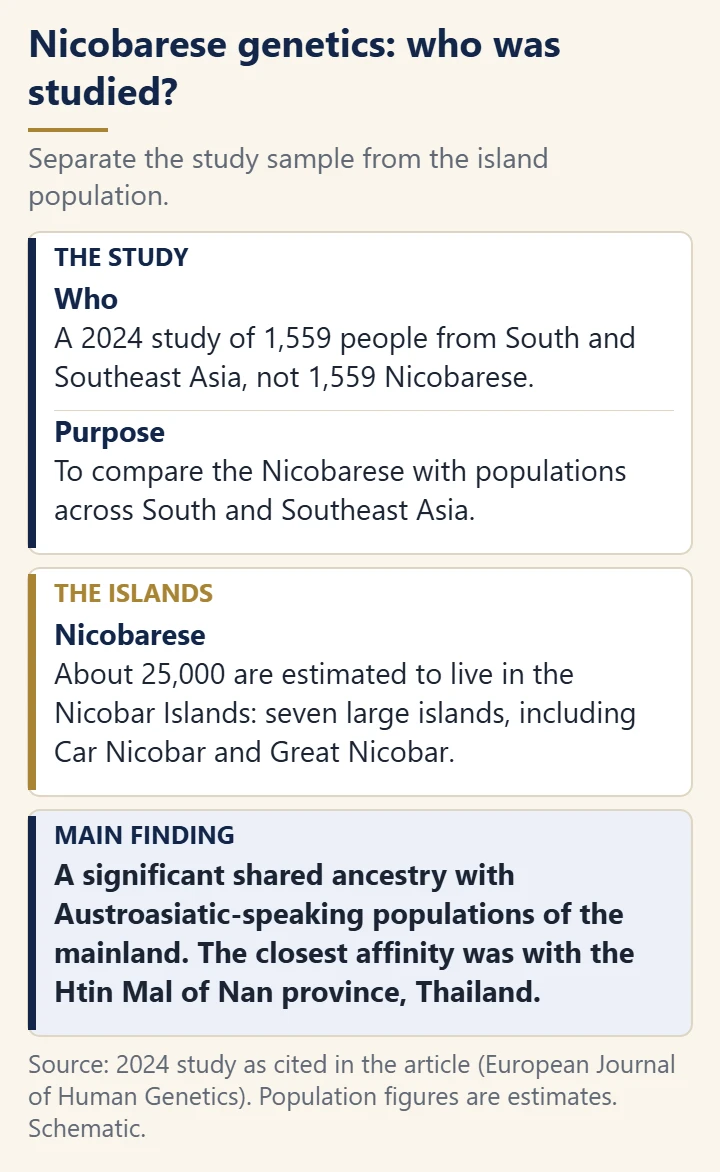
The researchers used DNA markers inherited through mothers (mitochondrial), through fathers (Y chromosome) and from both parents (autosomal). Together these let them compare the Nicobarese with populations across South and Southeast Asia. The Nicobar archipelago lies south of the Andaman Islands. It has seven large islands, including Car Nicobar and Great Nicobar, and about 25,000 Nicobarese are estimated to live there.
The Htin Mal link
The study found a significant shared ancestral connection between the Nicobarese and Austroasiatic populations across South and Southeast Asia. The closest affinity was with the Htin Mal, an Austroasiatic-speaking group on the Southeast Asian mainland, in Nan province of Thailand near the Laos border. In addition, the Htin Mal and Nicobarese show strong genetic drift from each other, which means each has changed since they separated. The authors argue that both groups are useful genetic proxies for ancient Austroasiatic heritage. Their wider point is that Austroasiatic peoples were once spread widely across Southeast Asia, and that the Nicobarese are part of a South and Southeast Asian continuum, not an isolated anomaly.
When did they arrive?
Earlier theories placed the linguistic ancestors of the Nicobarese on the islands in the early Holocene, about 11,700 years ago. The new genetic analysis suggests that the islanders settled there only about 5,000 years ago. This date is the authors’ estimate, based on genetic patterns, and it comes through a press note. It is not an archaeological date for a first landing, so present it as “genetic evidence suggests”. Meanwhile, the Andamanese carry a different and much older ancestry, and should not be folded into this claim.
Island life and isolation
Also, the Nicobarese live mainly on forested islands. They keep pigs, goats and poultry and use forest and coastal resources, especially the coconut palm. This subsistence pattern, together with island geography, has supported relative isolation and cultural continuity. However, treat isolation as a reading of the genetic and ecological picture. Genetic closeness describes shared ancestry in language-linked populations. It does not rank anyone, and it says nothing about present-day culture.
Using it in UPSC Mains
Paper II clause 6.1 covers the bio-genetic variability, linguistic and socio-economic characteristics of tribal populations in India. Use the Nicobarese case to show that language families and genetic ancestry can correspond, as with Austroasiatic, and that island populations can preserve distinct lineages. Finally, state the limits: a single study, marker-based estimates, and a date that rests on inference. The policy side of the same islands is covered in the Great Nicobar project note.
For practice, use the 2016 Paper II question on bio-genetic variability of Indian tribes and the 2020 Paper II question on linguistic classification of Indian tribes. More questions sit under Tribal India PYQs. The wider syllabus map is in the Paper 2 tribal syllabus guide, with recurring patterns in the Anthropology PYQ analysis and the complete optional guide.
Sources
European Journal of Human Genetics (2024), Nature.com article page, PubMed record; CSIR-CCMB press note, 6 December 2024.