
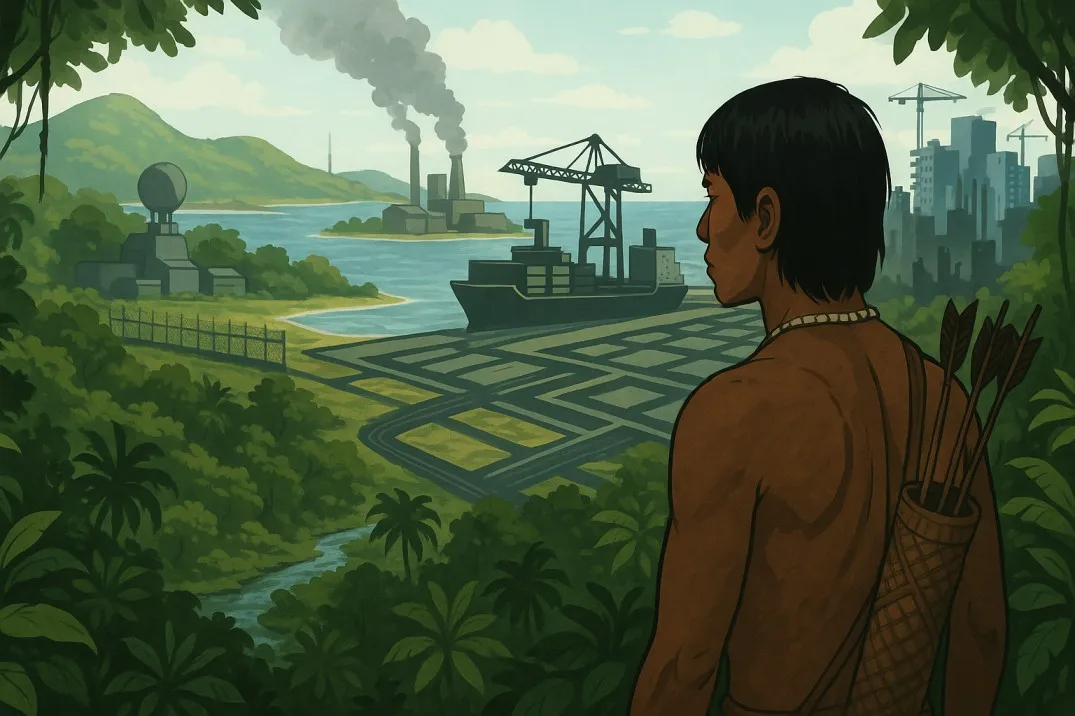
The Great Nicobar project is a large port, airport, power and township plan on an island whose interior is home to the Shompen, a Particularly Vulnerable Tribal Group. Supporters call it strategic and economically important. However, critics, including Survival International, warn that it could destroy the Shompen’s way of life. For the Anthropology Optional, it is a live test of development-induced displacement.
Source: Survival International report “Crushed: How India Plans to Sacrifice One of the World’s Most Isolated Tribes to Create ‘The New Hong Kong'” (April 2025), an advocacy document; court status from the Free Press Journal report of 5 October 2026 (citing LiveLaw and Bar and Bench). Evidence level: advocacy report and news reports. Court status was current on 16 October 2026 and can change.

The project
In brief, the plan covers an international container transhipment terminal, a greenfield international airport, a gas-solar power plant and a planned township. The Free Press Journal puts the cost at about Rs 72,000 crore. Still, other reports give figures between Rs 72,000 crore and Rs 91,000 crore, and Survival cites about Rs 75,000 crore. Survival says the township would house around 650,000 residents and that the island could draw nearly one million tourists a year. These figures are not matched to a government document, so read them as Survival International’s account.
The Shompen
Meanwhile, the Shompen live in the rainforest interior of Great Nicobar. Estimates put their number at 200 to 300 people, while the 2011 Census counted 229. So they are best described as largely isolated, with limited and managed contact, and not as uncontacted. The Sentinelese of North Sentinel Island in the Andamans are a different case. They remain uncontacted, and the law bars outsiders from approaching them.
Furthermore, Survival warns that disease, displacement and ecological damage could threaten the Shompen’s survival. That is a prediction and not a measured outcome. By contrast, the government presents the project as a strategic and economic necessity and says it has safeguards for the Shompen.
What is reported, and what is in court
Several points have moved since April 2025. Reports say officials denotified part of the island’s tribal reserve in 2022, after a no-objection certificate from the Tribal Council. However, the Council later said it had withdrawn that certificate, and the National Commission for Scheduled Tribes sought a response in 2023. No source consulted confirms the current denotification status. Therefore, check the official notification.
On the legal side, therefore, the Calcutta High Court on 6 May 2026 held that public interest petitions challenging government actions linked to the project are maintainable. The Centre challenged that ruling. On 5 October 2026, the Supreme Court declined to interfere. It asked the High Court to complete pleadings and endeavour to hear the matters on 25 and 26 November 2026. The petitions raise environmental concerns and allege violations of the Forest Rights Act, 2006. Meanwhile, the Attorney General told the court that others had already challenged the environmental clearance before the National Green Tribunal. None of this settles the merits.
Using it in UPSC Mains
Paper 2, clause 6.3 covers developmental projects and their impact on tribal displacement and the problems of rehabilitation. This is a prospective case, since scholars argue the impact and nobody has measured it yet. Hence it is useful for the policy half of the clause, where an answer weighs a strategic project against the survival of a very small, largely isolated population and asks what rehabilitation could even mean for it. Note, too, the question that a Supreme Court bench member raised: should such a group integrate into the mainstream, or keep its distinct culture and identity?
The closest PYQs are development projects and forest-dwelling tribes (2019, Paper 2) and development-induced displacement (2020, Paper 2). Browse tribal problems and displacement for more. Our note on the Nicobarese genomic study covers a different population of the same islands, and the full optional guide shows how the topic fits the syllabus.
Sources
Free Press Journal, 5 October 2026; Supreme Court Observer on locus standi; Survival International report (April 2025), read through its summary in the earlier version of this article.