
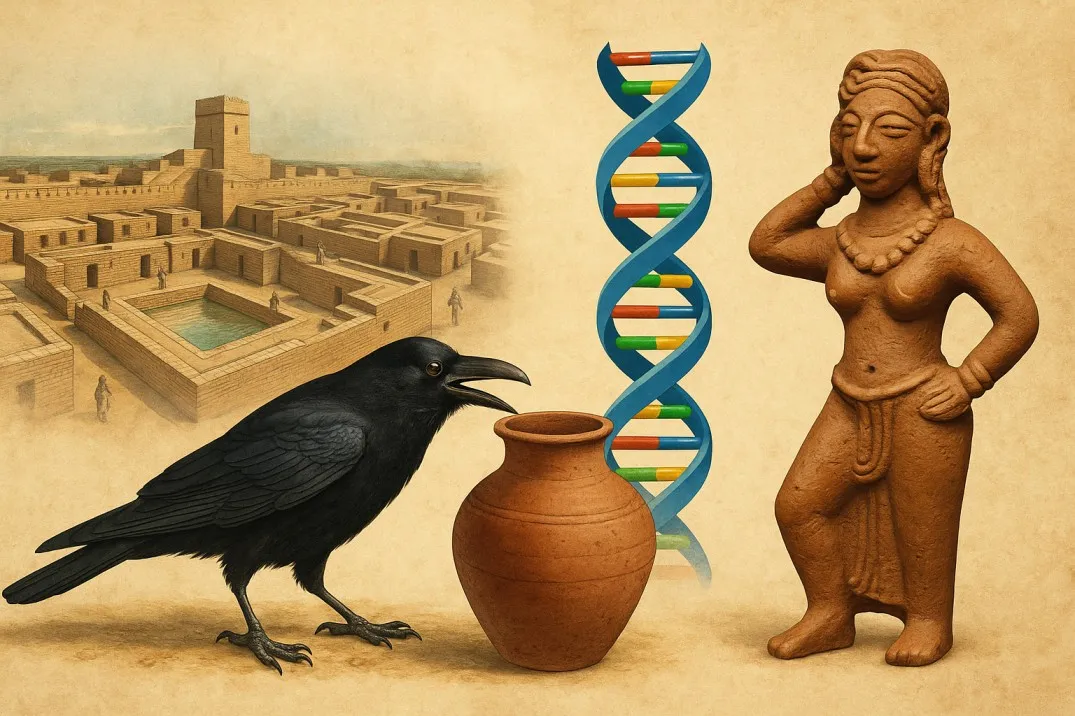
Public debate about the Harappans often swings between two errors. One diminishes them, and the other makes them the source of everything Indian. In 2024, the archaeologist Vasant Shinde argued for a middle course, one that credits the Indus people for what the evidence shows and no more. For Optional Paper II, the useful skill is to separate documented achievements from large inherited claims.
Source: a news interview with Vasant Shinde (ThePrint, 14 September 2024), which was not retrievable here, and his NIAS lecture “Contributions of the Harappans to the Evolution of Indian Knowledge System” (4 September 2024). Genetic evidence comes from Shinde et al., Cell (2019). Treat the interview points as one scholar’s emphasis.
What is well documented
Harappan cities in their mature phase, from about 2600 BCE, show planned streets, standard brick sizes and extensive drains. In addition, many houses had bathing areas and toilets that linked to sewers. For example, excavations at Mohenjo-daro, Harappa and Lothal support these features well. As a result, they allow a safe statement: the Indus people built some of the earliest planned urban sanitation in the ancient world.

However, words such as “pioneered” and “foundational” need care. They claim priority and influence, and priority is hard to prove for any single practice.
The thirsty crow
The interview used a comparison. Popular accounts link the thirsty-crow tale with a painted scene on a jar from Lothal. Aesop and the Panchatantra also tell the tale. Still, the resemblance is only suggestive. It does not prove that the story passed from the Indus to Greece or India.
Some accounts give 3300 BCE for the Lothal jar, but no source checked here supports that date. Lothal’s Harappan occupation belongs to the Mature Harappan period, roughly the late third to early second millennium BCE. Radiocarbon estimates for the site fall around 2200 to 1700 BCE. In fact, a date of 3300 BCE would belong to the early Harappan or pre-Harappan phase, and the city of Lothal came later.
The thin genetic record
Only one Harappan individual, a woman from Rakhigarhi, has yielded a usable genome so far. Moreover, she had ancestry related to ancient Iranians and Southeast Asian hunter-gatherers, with little or no Steppe ancestry (Shinde et al., 2019). One person cannot stand for a whole civilisation. Therefore, keep claims of identity or continuity modest.
Using it in UPSC Mains
Use the case to show how to test a scholar’s heritage claims. First, state the documented facts (planning, drainage, standard weights). Next, give the interpretive claims (priority, continuity, folk-tale links). Finally, name the evidence gaps. This structure also suits questions on urban planning, on the Harappan legacy and on ancient DNA.
In practice, two PYQs fit well: the 2018 Paper I question on Town Planning of Harappan Culture for the urban points, and the 2024 Paper II question on Rakhi Garhi evidence and Harappan linkages for the DNA section. More are under Prehistoric Archaeology PYQs. For the debate on Harappan and Vedic continuity, see archaeologists and Sanskrit scholars reading the Rigveda. The syllabus map is in the Anthropology Optional complete guide.
Sources
Shinde et al. (2019), Cell 179; NIAS lecture listing (4 September 2024); ThePrint interview report (14 September 2024), not retrieved; radiocarbon summary for Lothal from a Zoological Survey of India occasional paper (Agrawal 1964 estimate).