
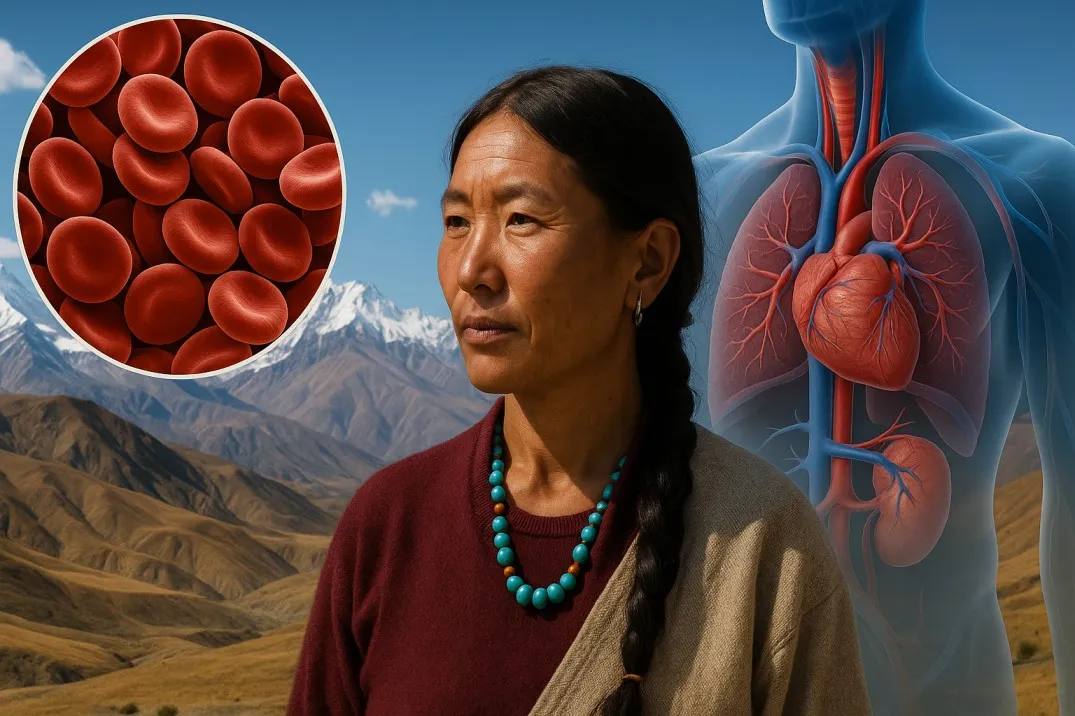
Evolution is usually told as a story of deep time, yet a 2024 study in Upper Mustang suggests that natural selection may still be acting on living people. The evidence comes from Tibetan women at high altitude whose body traits tracked how many children they had.
Source: Ye, Sun, Craig, Beall and colleagues, PNAS 121(45), 2024, “Higher oxygen content and transport characterize high-altitude ethnic Tibetan women with the highest lifetime reproductive success”. Evidence level: abstract and the Case Western Reserve University release. The full text was not independently reviewed.
Who was studied
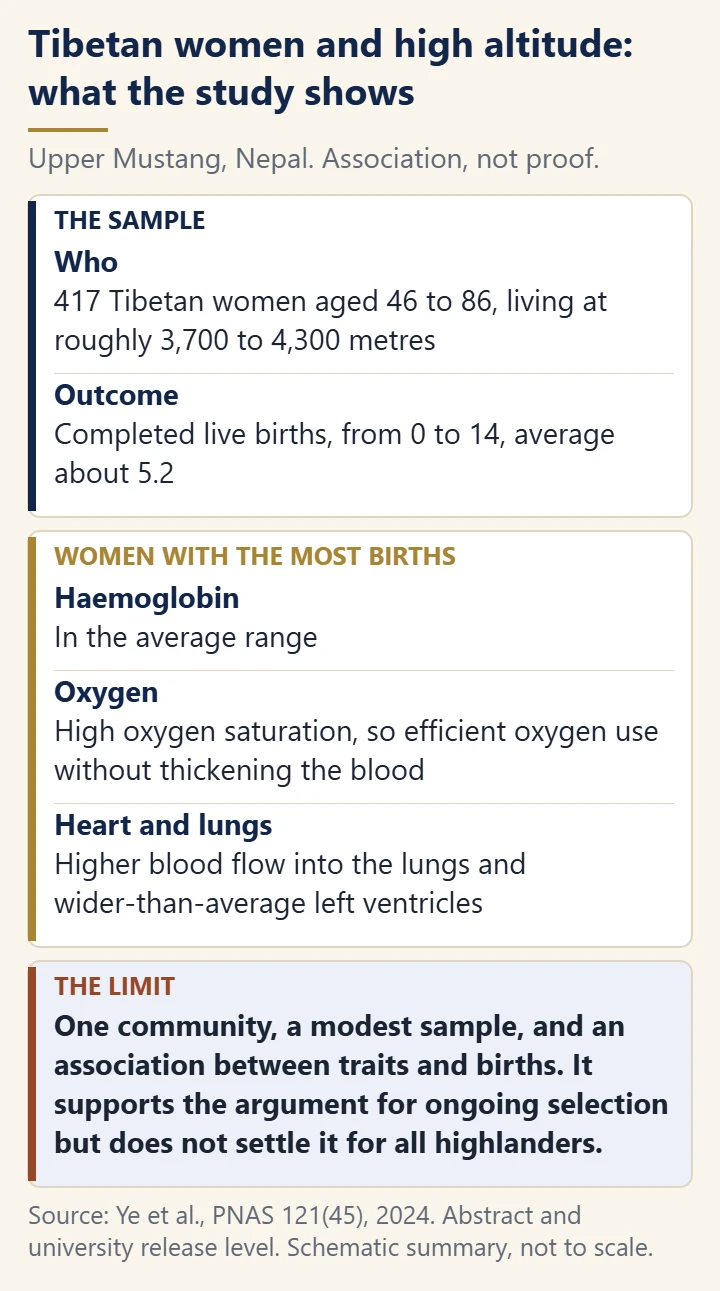
The sample was 417 Tibetan women aged 46 to 86 in Upper Mustang, Nepal, living at roughly 3,700 to 4,300 metres (about 12,000 to 14,000 feet). They were past childbearing age, so the researchers could count each woman’s completed number of live births. The count ranged from 0 to 14, with an average of about 5.2. The team also gathered reproductive histories, sociocultural information, physiological measurements and DNA samples.

What separated the most successful mothers
Everyone at a given altitude faces the same low oxygen, yet the women differed. Those with the highest live birth counts had hemoglobin concentrations in the average range but high oxygen saturation. This means efficient oxygen use without thickening the blood. Thicker blood forces the heart to work harder.
These women also showed higher blood flow into the lungs and wider-than-average left ventricles, which improve oxygen transport and circulation. The authors read the hemoglobin pattern as stabilizing selection, since extreme values predicted fewer births. They read the oxygen-saturation pattern as directional selection, because women with higher saturation had more births. They also report that the EPAS1 locus, a known target of selection, tracked hemoglobin concentration.
Culture works alongside biology
Cultural practice mattered as well. Women who began reproducing early and had longer marriages had more chances of multiple pregnancies. The physiological traits kept their effect even after the analysis allowed for these factors, which is why the study is a good example of biocultural adaptation.
How far the claim goes
Reproductive success is a fair measure of fitness, and Beall interprets the pattern as natural selection still acting on this population. However, this is one community with a modest sample, and the result shows an association between traits and births. It supports the argument for ongoing selection but does not settle it for all highlanders. The long-term genetic side, including the EPAS1 variant of Denisovan origin, sits in our note on Denisovans and the Tibetan Plateau.
Using it in UPSC Mains
Paper I, clause 9.7 covers bio-cultural adaptations (genetic and non-genetic factors) and physiological responses to environmental stresses, including high altitude. The Mustang study puts genetic adaptation, physiological response and cultural practice side by side in one population. That combination is what a high-altitude answer needs.
The closest PYQs are bio-cultural adaptation to high altitude (2019, Paper 1) and responses and acclimatization to high altitude (2017, Paper 1). Browse the human genetics and human biology topic page for more. Related reading: climate and human adaptation and the full optional guide.
Sources
Case Western Reserve University release; ScienceAlert summary; Evolution, Medicine and Public Health review note.