
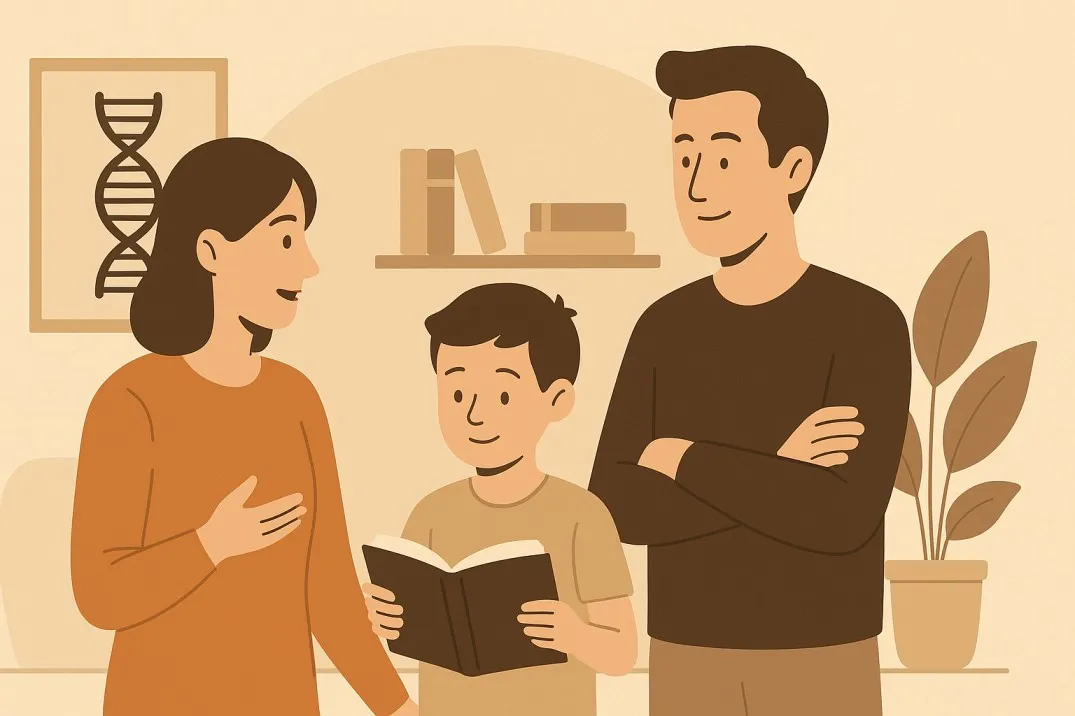
Parents give children more than half their genes each. They also build the home in which the child grows up. A UCL report from 2025 shows that these two roles overlap, because a parent’s genes can shape the home environment even when those genes never reach the child. Researchers call this genetic nurture, and it changes how we should read the old nature versus nurture debate.
Source: Morosoli and Pingault (UCL), “Understanding the intergenerational transmission of educational (under)achievement”, a Nuffield Foundation report (2025). Evidence level: executive summary and key findings of the report read in full; the detailed chapters and the study-level counts were not checked.
What genetic nurture means
A parent passes on half of their genetic material. The other half stays behind, yet it still influences the parent’s own traits and behaviour. A parent with genetic leanings towards valuing education, or towards strong non-cognitive skills such as perseverance, may create a home with books, routines and expectations. The child benefits from that environment, although no gene travelled from parent to child to cause it.

So what children receive is not only DNA. They also receive attitudes, behaviours and surroundings that partly reflect the parents’ genetics.
How the team tested it
The researchers did a systematic review and meta-analysis of published trio studies, which use mother-father-child genotype data. They also analysed polygenic scores for parents and children in large UK birth cohorts, at several developmental stages. A polygenic score measures a genetic propensity, not actual behaviour, and the report says so plainly.
What they found
First, genetic nurture plays a clear role in children’s educational outcomes, even after accounting for genetic transmission. Second, once the analysis allowed for family socioeconomic position and parental education, genetic nurture effects shrank by roughly three quarters. In other words, much of the effect runs through resources and opportunities.
Third, parental genetic propensities for personality, mental health and reproductive behaviour also affect offspring outcomes, and for these traits genetic nurture often exceeded genetic transmission. Fourth, genetic nurture effects were stronger in earlier childhood, at about ages 7 to 11, while genetic transmission became more pronounced in adolescence. Finally, mothers and fathers showed similar magnitudes for most traits, though age at first birth, number of children and smoking may differ.
Policy: what the authors will and will not say
The report suggests that interventions should suit the developmental stage, with parent-focused support earlier and child-focused help in adolescence. At the same time, the authors caution that genetic studies, including theirs, cannot directly inform policy decisions because the chain from genes to behaviour is long and complex. The effects are averages across many families. Nobody should use them to predict outcomes for an individual child.
The conclusion for an Anthropology answer is that nature and nurture are entwined processes and are not rival explanations.
Using it in UPSC Mains
Use genetic nurture when a question asks how heredity and environment interact, or how social inequality passes from one generation to the next. Pair it with one caution: nobody should use biological explanations to excuse or justify disadvantage.
For related practice, conceptual rather than exact matches (there is no genetic-nurture PYQ), see heritability and its estimation (2024, Paper 1), genetic and environmental factors in human growth (2019, Paper 1) and multifactorial traits in man (2024, Paper 1). The topic page on human genetics and human biology. The full optional guide shows where this sits in the syllabus, and India’s genetic diversity is a useful companion read.
Sources
Morosoli and Pingault, UCL Discovery report PDF; Nuffield Foundation project page.