
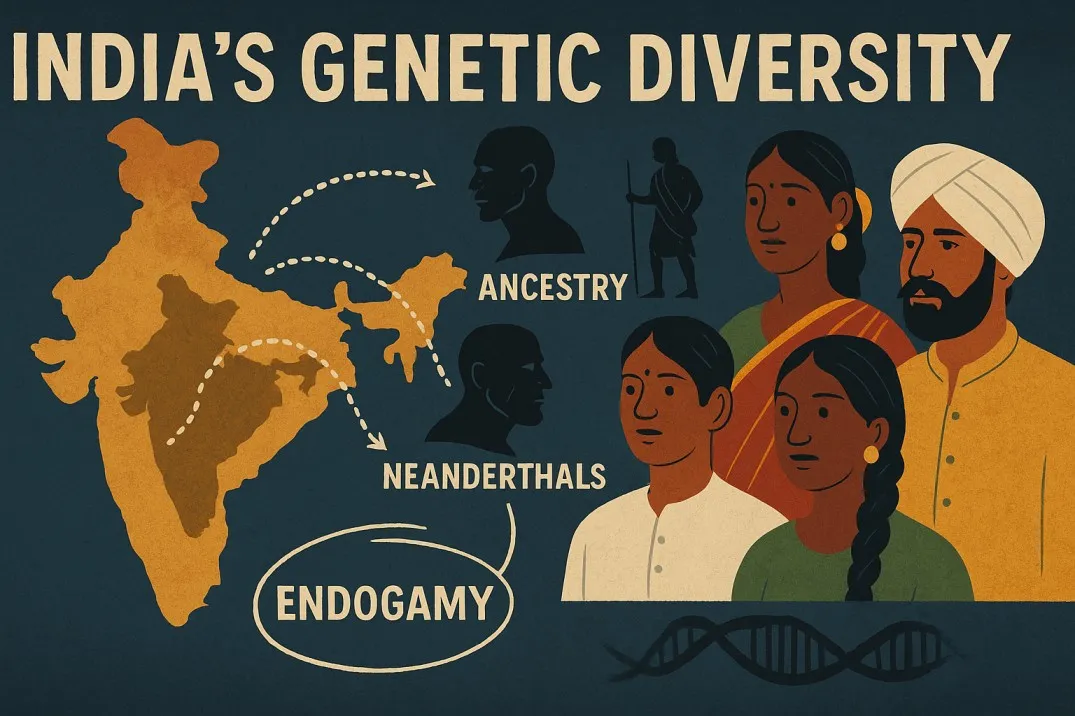
India holds some of the most varied human populations in the world, yet it has been thin in the genomic databases that shape textbook stories. A 2025 study in Cell helps close that gap. It sequenced 2,762 Indian genomes. The authors used them to model how migrations, archaic ancestry and marriage practices built present-day variation. For Optional Paper I, it gives you an Indian example of mutation, migration, isolation and drift working together.
Source: Elise Kerdoncuff, Laurits Skov, Priya Moorjani et al., “50,000 years of evolutionary history of India: Impact on health and disease variation”, Cell 188(13):3389 (June 2025), DOI 10.1016/j.cell.2025.04.027. Checked through the Cell Press release, the UC Berkeley summary and the bioRxiv preprint record, not the full published text.

The data
The sequences come from the LASI-DAD cohort, a nationally spread study of ageing in India. The 2,762 whole genomes cover most regions, major language groups and many communities. This breadth matters because earlier global panels were built mostly on European ancestry, so Indian variation was often read against the wrong baseline.
Three ancestral streams
First, the authors fit most Indian ancestry to three sources: South Asian hunter-gatherers, Iranian-farmer-related people, and Steppe pastoralists. Moreover, population structure follows geography and language. Two broad groups stand out: an Ancestral North Indian group related to West Eurasians and an Ancestral South Indian group that is not close to any present-day population.
Next, the team looked for the source of the Iranian-farmer-related ancestry among 15 ancient groups. The best match was ancient DNA from fourth-millennium BC Sarazm in Tajikistan. That site had known trade links to South Asia, and one burial had shell bangles like those at Indian Neolithic sites. However, ancient DNA from South and Central Asia is still scarce. These sources are therefore statistical matches, not direct ancestors.
Out of Africa and archaic ancestry
The split between Indians and sub-Saharan Africans dates to about 54,000 years ago. Europeans and East Asians show a similar timing, which supports a single major dispersal out of Africa. In addition, each Indian genome carries about the same Neanderthal share as other non-Africans, around 1.5 percent. However, Indians show the highest variation in Neanderthal ancestry among non-Africans. As a result, the team could reconstruct about 50 percent of the Neanderthal genome and 20 percent of the Denisovan genome. The senior author links this to India’s history of recent mixing and founder events.
Endogamy and health
India has thousands of ethno-linguistic and religious groups. Many have married mostly within the group for generations. Therefore, founder events and consanguinity raise homozygosity, and this can make harmful recessive variants more common. Importantly, the finding is about demography and marriage rules, not about a “weak” group. For a worked case in one community, read endogamy and genetic risk in the Reddy community. In addition, some archaic variants affect immune function, so health research needs Indian reference data.
Reading the result carefully
Also, ancestry proportions describe how gene pools were assembled over millennia. They do not rank groups or fix anyone’s traits. For example, the three-source model is a statistical summary, and the shares differ widely between groups. Archaeology adds separate evidence. Mehrgarh, about 8,000 to 9,000 years old, is the usual reference point for early farming in the north-west. Scholars still debate how far farming arrived from outside and how far it developed locally.
Using it in UPSC Mains
Paper I covers genetic polymorphism and the causes of change in gene frequency, which are mutation, isolation, migration, selection, inbreeding and genetic drift. Meanwhile, Paper II covers the bio-genetic variability of tribal populations. In an answer, first name the evolutionary force. Then add the Indian example: archaic admixture and migration for diversity, endogamy and founder effects for drift and health risk.
For practice, use the 2022 Paper I question on evolutionary forces and human diversity and the 2020 question on emergence and dispersal of modern Homo sapiens. More are under Human Genetics and Human Biology PYQs. For a Nicobarese genomic case, see genomic evidence for Indian population history, and for the syllabus map the Anthropology Optional complete guide.
Sources
Kerdoncuff et al. (2025), Cell 188(13), DOI 10.1016/j.cell.2025.04.027; Cell Press release (via ScienceDaily); UC Berkeley QB3 summary (24 July 2025).
1 thought on “India’s Genetic Diversity”
Comments are closed.