
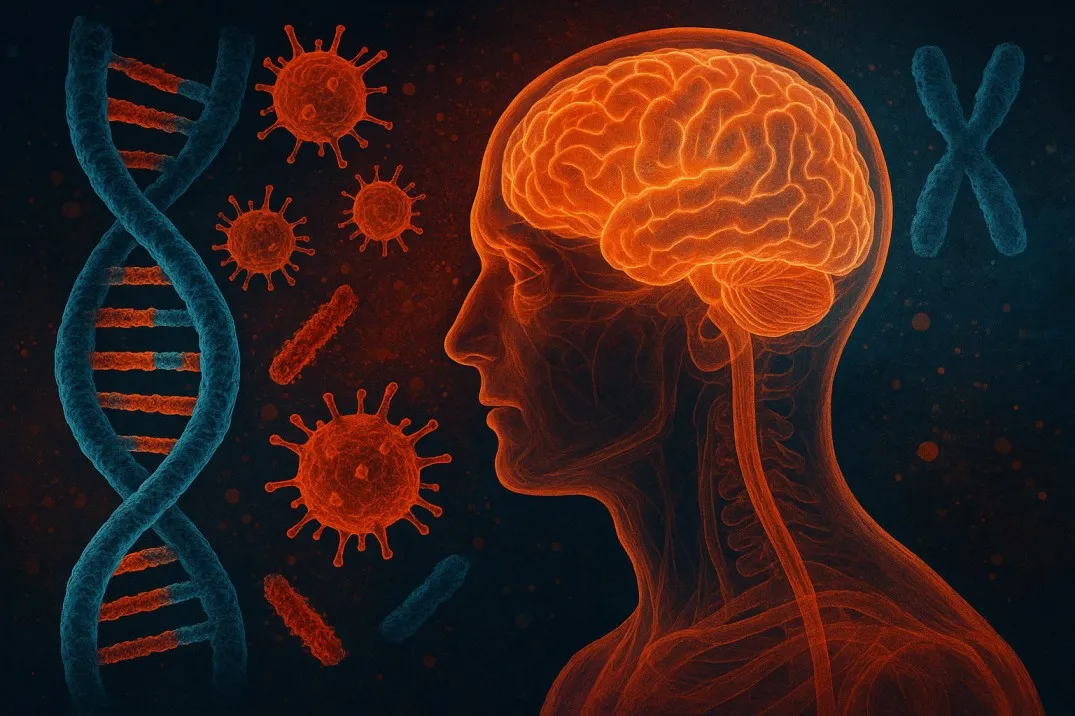
Scraps of ancient viral DNA sit inside every human genome, and a 2024 study links a few of them to the risk of depression, schizophrenia and bipolar disorder. The headline can mislead, because this is not DNA recovered from fossils. It is viral sequence that our ancestors inherited and that we still carry.
Source: Duarte, Pain, Bendall et al., with Timothy Powell and Douglas Nixon as co-senior authors, Nature Communications (May 2024), DOI 10.1038/s41467-024-48153-z. Evidence level: abstract, King’s College London release and press summaries (NDTV, 3 June 2024, was the original trigger). The full text was not independently reviewed.
What HERVs are
Human endogenous retroviruses (HERVs) are remnants of retroviruses that infected our ancestors and became part of the genome. They make up nearly 8% of human DNA. Researchers once dismissed them as “junk”, but some are now thought to take part in regulating genes, including in the brain. Still, the function of most HERVs is unknown.

What the researchers did
The team ran transcriptome-wide association studies that treat HERV expression as a trait. They used RNA sequencing and genetic data from 792 post-mortem brain samples. In European-ancestry samples they found 1,238 HERVs whose expression is regulated in cis, that is, by nearby genetic variants.
Of these, 26 expression signals were associated with psychiatric disorders, and five stayed significant after fine-mapping. The authors call those five high-confidence risk HERVs. They differ from the HERVs earlier studies had linked to these conditions, so the work adds new candidates to the list.
Reading the claim carefully
Three points keep the claim honest. First, the result is a statistical association with risk and does not show cause. Second, the authors state that they have not shown how these sequences act in brain cells. Third, psychiatric conditions are multifactorial, so no single HERV signal predicts illness in an individual.
That is exactly the nuance an examiner looks for. A good answer says that a non-coding, once-dismissed part of the genome now matters for disease, and it adds that the evidence is correlational.
Why it matters for Anthropology
The study speaks to human genetic variation, to gene-environment interaction and to the evolutionary background of modern disorders. Further work on thousands of HERVs could change how we think about genetic vulnerability, brain development and the origins of psychiatric disease. Until then, treat these findings as leads and not as answers.
Using it in UPSC Mains
Paper I, clause 9.4(d) covers human DNA profiling, gene mapping and genome study, and clause 9.1 covers DNA technology. Use this study as a current example when an answer on genome mapping, association studies or multifactorial traits needs a case of non-coding DNA that matters. It illustrates method and caution together, and it is not a syllabus topic by itself.
The closest PYQs are multifactorial traits in man (2024, Paper 1), which fits the polygenic and gene-environment point, and genome-wide disease association studies (2025, Paper 1), which fits the method. Browse human genetics and human biology for more. Single-gene disorders are a contrast case here, since psychiatric risk is not Mendelian. Related reading: the full optional guide and India’s genetic diversity.
Sources
Duarte et al., Nature Communications (2024), DOAJ record; King’s College London release; Neuroscience News summary.