
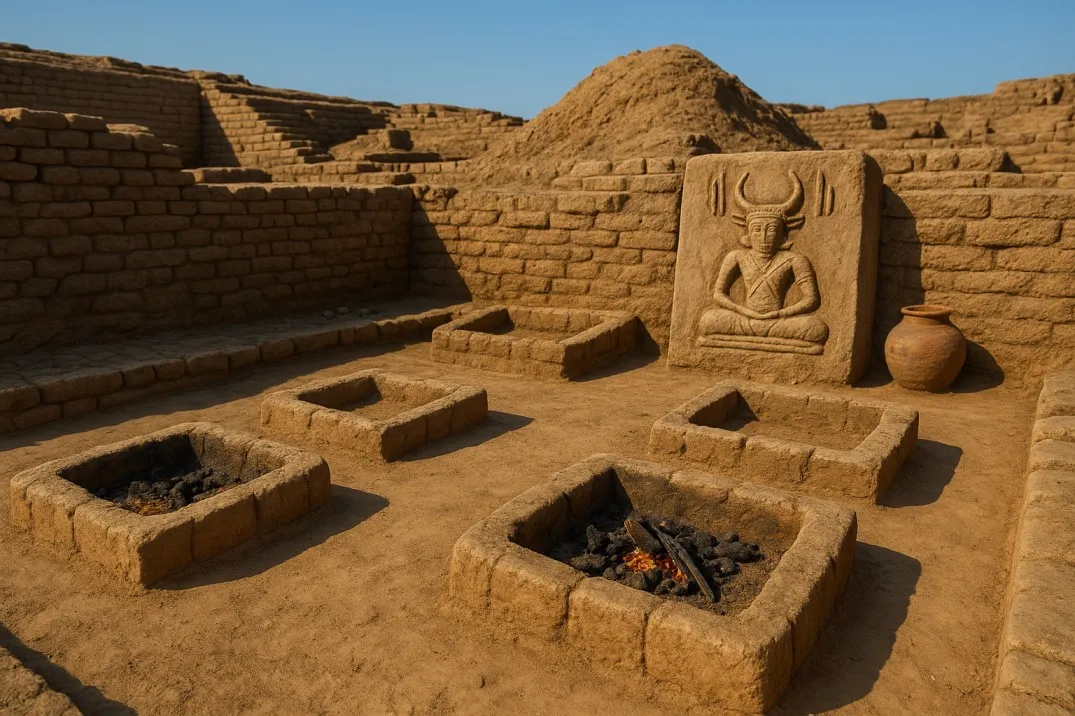
Were the people of the Harappan cities the same community that composed the Rigveda? In June 2024, newspaper reports said that archaeologists and Sanskrit scholars would test this idea. They plan to read the Rigveda against Harappan sites. It is a hypothesis, and a disputed one. For Optional Paper II, the better use of the story is to learn how to weigh textual, material and genetic evidence together.
Source: report in The Hindu (5 June 2024) on the work of Vasant Shinde and colleagues. The original article could not be retrieved here, so the project details come from secondary summaries and count as claims. Genetic evidence comes from Shinde et al., Cell (2019).
What was proposed
For example, Vasant Shinde, former Vice-Chancellor of Deccan College, argued that a close reading of the Rigveda helps explain cultural patterns at Harappan sites such as Rakhigarhi, Banawali, Kalibangan and Dholavira. In particular, the reports mention fire altars and ritual platforms at Rakhigarhi, which he sees as resembling Rigvedic ritual. They also note that many Harappan sites lie along the Ghaggar-Hakra (Saraswati) river system, and the Rigveda names a Saraswati often. In addition, Shinde has suggested that parts of the Vedic corpus may overlap with the Harappan period.

What the genetic evidence says
First, the Cell study of 2019 sequenced DNA from one woman buried at Rakhigarhi. Her ancestry fitted a mixture of people related to ancient Iranians and Southeast Asian hunter-gatherers, as the abstract puts it. It showed little or no Steppe pastoralist ancestry, and it did not come from the Iranian farmers themselves. The authors drew no conclusion about language or about the Rigveda. Moreover, the result rests on a single individual, and critics have stressed this. However, other ancient DNA work (Narasimhan et al., Science 2019) found Steppe-related ancestry spreading into South Asia in the second millennium BCE. As a result, many scholars read this as a later arrival, which complicates any claim of full continuity.
Why it stays contested
First, scholars debate the date and region of the Rigveda. Second, altar-like structures do not identify a language or a people. Third, a shared river name shows that the text knew a landscape, not that its authors were Harappans. Therefore, place the continuity argument beside the migration view and the mixed-ancestry view, then state what each can and cannot explain.
Using it in UPSC Mains
For your answer, frame the evidence types: texts, archaeology and ancient DNA. Next, name Rakhigarhi, the fire-altar claim and the Steppe-ancestry finding. Finally, state that the question is open. Single-site, single-individual evidence cannot settle it.
In practice, two PYQs fit best: the 2024 Paper II question on Rakhi Garhi evidence and Harappan linkages and the 2014 Paper II question on Harappan religion and later Hinduism. More are under Prehistoric Archaeology PYQs. Also, for the Harappan legacy in knowledge and technology, read the Harappans’ contribution to ancient Indian knowledge. The syllabus map is in the Anthropology Optional complete guide.
Sources
Shinde et al. (2019), An Ancient Harappan Genome Lacks Ancestry from Steppe Pastoralists or Iranian Farmers, Cell 179; Narasimhan et al. (2019), Science; The Hindu report of 5 June 2024 as summarised by secondary sources.