
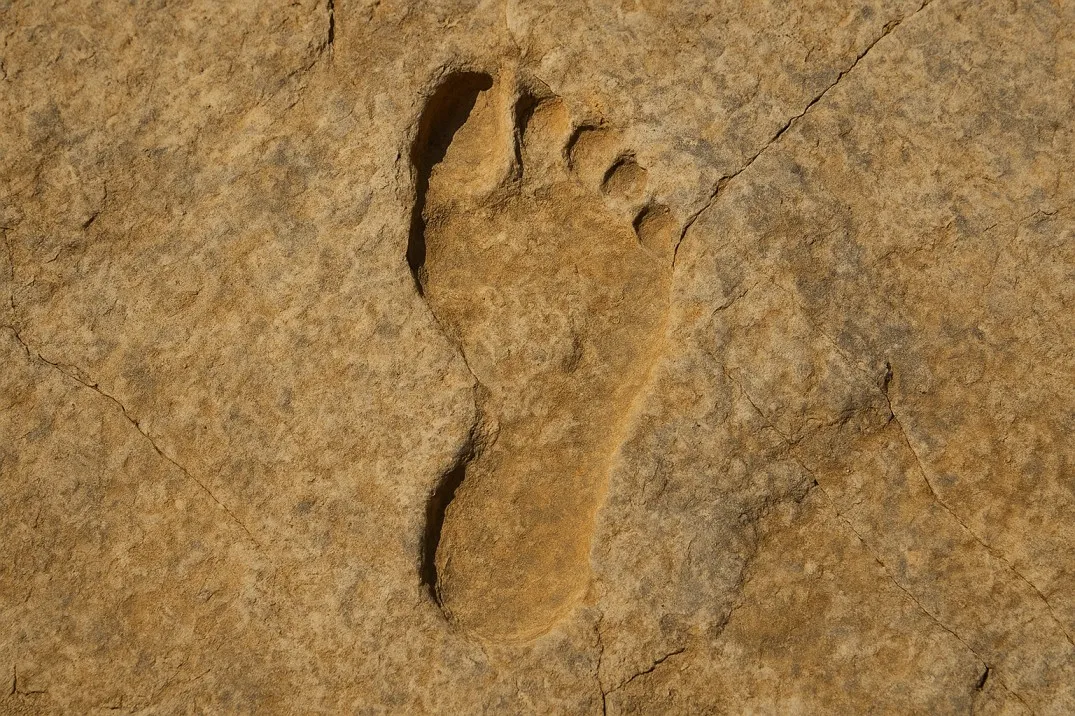
The Trachilos footprints are fossil tracks from western Crete. Some researchers read them as the marks of an upright walker, possibly an early hominin. Others doubt that reading, and the age of the rocks is also disputed. That makes the case useful in an Anthropology answer, as long as you keep its three separate questions apart.
Sources: Gierliński et al., Proceedings of the Geologists’ Association (2017); Kirscher et al., Scientific Reports (2021); Zachariasse and Lourens, Scientific Reports (2022); press coverage in The Greek Herald, 30 May 2025.
How the tracks came to light
According to press accounts, the Polish palaeontologist Gerard Gierliński first noticed the tracks in 2002, on a coastal rock slab at Trachilos near Kasteli in western Crete. From 2010 his student Grzegorz Niedźwiedzki led a detailed study. The team’s 2017 paper described hominin-like footprints and placed them in the late Miocene, at about 5.7 million years. Headlines often round that figure to six million years.

What the footprints show
What made the slab remarkable was the anatomical detail. The authors describe several traits that we associate with later hominins:
- a big toe that is not opposable and lies in line with the other toes, unlike the grasping foot of an ape
- a wide, triangular sole
- a pointed heel
- a slight arch, as the study reports
Together these suggest a clawless, five-toed animal that walked on two feet with the whole sole on the ground.
What the Trachilos Footprints May Show
Reported
- Western Crete; tracks around six million years old, and if validated the oldest known bipedal primate footprints.
- Big toe aligned like a human’s, wide triangular sole, pointed heel, slight arch.
Disputed
- The oldest-footprint claim applies only if validated.
- The Europe claim holds only if the tracks are correctly classified.
Treat this as a proposed early-bipedalism case, not a settled conclusion.
Three questions, kept apart
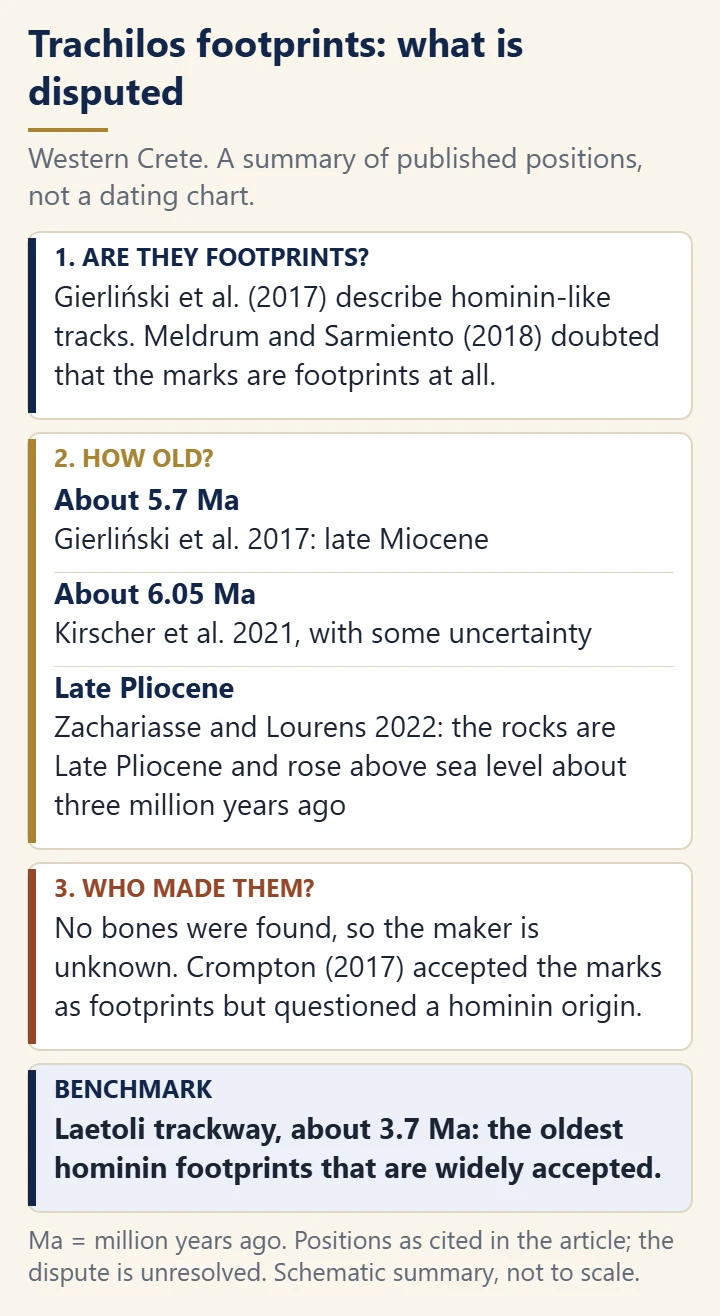
Are they footprints of a biped? The 2017 authors say the tracks look hominin-like. Not every specialist accepts that. As Zachariasse and Lourens summarise the debate, Meldrum and Sarmiento (2018) doubted that the marks are footprints at all, while Crompton (2017) accepted them as footprints but questioned a hominin origin.
Who made them? No bones were found, so the maker is unknown. The authors suggest an early member of the human line as the likeliest candidate. They also accept that an unknown late Miocene primate could have evolved a similar foot independently, and they call their own interpretation potentially controversial.
How old are they? Here two published readings compete. Kirscher and colleagues (2021) combined foraminifera, calcareous nannoplankton, magnetic polarity and cyclic changes in the rock. They put the tracks at about 6.05 million years, around 0.35 million years older than the first estimate, while noting some remaining uncertainty. Zachariasse and Lourens (2022) reached the opposite view. Using new foraminifera data and the regional geology, they argue that the 6.05-million-year, shallow-marine interpretation is incorrect. In their reading, the rocks are Late Pliocene and rose above sea level about three million years ago. They also point out that Crete was then an island, about 100 km of open sea from the European mainland.
Neither paper settles the matter for the other. If the younger reading is right, the tracks cannot be six million years old, and the case for a hominin in Europe at that time falls away.
Why it would matter if it held
The accepted story places early bipedal hominins in Africa. The benchmark evidence is African: fossils such as Orrorin and Ardipithecus, and the Laetoli trackway of about 3.7 million years, the oldest hominin footprints that are widely accepted. A hominin trackway in Crete at six million years would be far older than Laetoli and outside Africa. That is why the claim attracted attention, and also why it needs strong evidence on all three questions.
Using it in UPSC Mains
It fits Paper I, Section 1.5, where the syllabus lists skeletal changes due to erect posture and their implications. Use it as a short, flagged example. Write “proposed” or “disputed”, name the three questions, and say that specialists contest both age and maker. Compare it with Laetoli and with African fossils such as Australopithecus. Never write that the footprints are human, or that they rewrite human origins.
Practise with the PYQs Evolutionary Significance of Bipedalism and Erect Posture (2019) and Skeletal Changes Due to Erect Posture (2016). More questions are in the Human Evolution and Primatology PYQs. For related reading, see Why Most Early Human Dispersals Out of Africa Failed. The wider syllabus map is in the Anthropology Optional complete guide.