
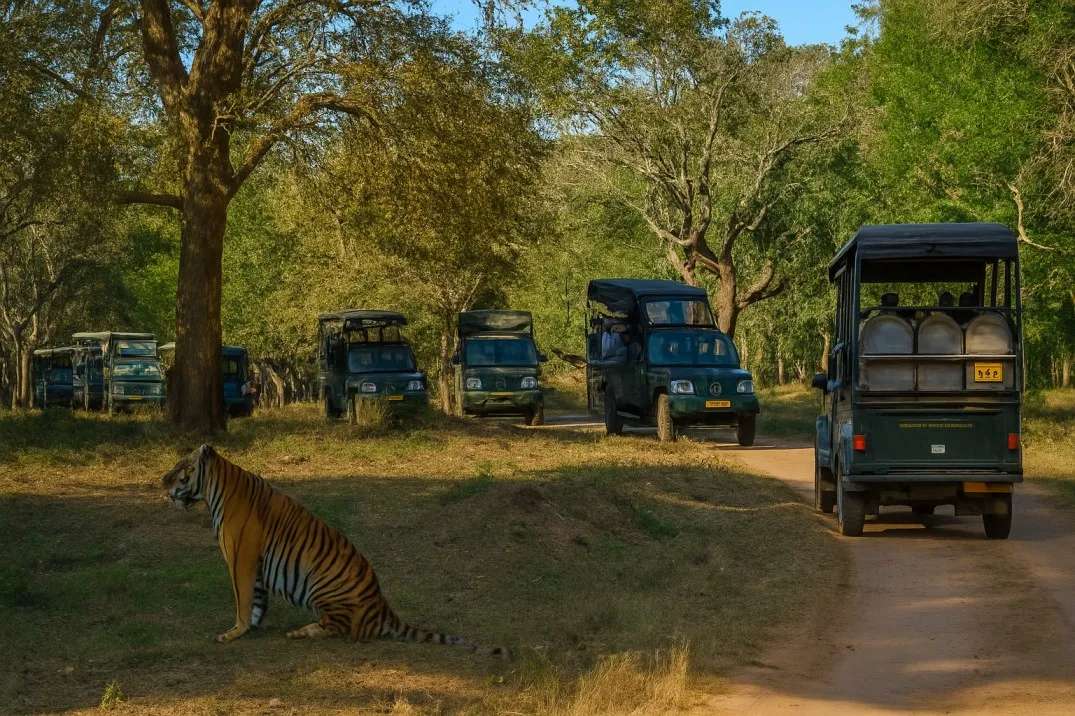
In May 2025, families of the Jenu Kuruba, a Particularly Vulnerable Tribal Group, walked back into Nagarhole Tiger Reserve in Karnataka to live on land they say they were evicted from forty years earlier. Their return turned a conservation reserve into a test of what the Forest Rights Act promises and what a tiger reserve allows.
The Guardian report (22 August 2025) prompted this note, but its full text was not retrieved. The Down To Earth report (12 May 2025) was reviewed in full. Evidence level: news reports and community statements. The Guardian text was not retrieved, and reports differ on some dates and numbers, so treat those as reported.
Background: eviction from Nagarhole
The Jenu Kuruba, whose name means “honey collector”, gather honey, medicine, fruit, tubers, bamboo and thatch from the forest. Down To Earth reports that officials evicted them around 1985 to 1986, when Nagarhole came under wildlife protection. They say this stripped them of homes, community spaces and religious sites. With no meaningful rehabilitation, many ended up as low-paid workers on nearby coffee plantations. A 2014 report commissioned by the Karnataka government described them as the “major victims” of displacement in the Nagarhole landscape. It also noted “vanished” villages. Nobody had documented them, because they were small and remote.

The legal framework
The community’s claim rests on the Forest Rights Act (FRA), 2006. As a PVTG, the Jenu Kuruba can also claim habitat rights under section 3(1)(e). Down To Earth reports that they filed claims in 2009, and that a joint revenue and forest verification took place in September 2024. Villagers say officials then delayed the next step, so they decided to return.
Two laws meet here, and an answer should name both. The FRA recognises individual and community rights. The Wildlife (Protection) Act, 1972 restricts entry and residence in protected areas, and the forest department cited it, as reported, when it called the return trespass. The FRA allows rights inside a critical wildlife habitat to change only on strict conditions (section 4(2)). These are the free consent of the gram sabha, proof of irreversible harm to wildlife, and a secure resettlement package. The live question is therefore one of process. Who decides, and with whose consent? It is not a simple contest between tigers and people.
The return and the state’s response
Down To Earth reports that 52 families entered the village site on 5 May 2025 after announcing their plan at a press conference. Authorities removed about 150 people on 6 May. On 8 May, a forest officer’s letter cited a High Court injunction and asked the community to vacate. The injunction, running until 23 July 2025, bars joint surveys and committee meetings on FRA recognition inside the reserve. Later reports, including the Guardian as summarised in the earlier version of this note, describe the demolition of shelters in June. The reports give different dates and numbers, so check them before quoting.
The official stand stays focused on wildlife protection and strict no-settlement rules inside tiger reserves. The community, however, says it holds satellite imagery from 1965 that shows clearings where its homes and shrines stood. This is the community’s own evidence, as reported, and it has not been checked independently. One report adds that the claims first filed in 2009 remain unrecognised. So look for later developments before treating any status as final.
Using it in UPSC Mains
Paper 2, clause 6.3 covers developmental projects and their impact on tribal displacement and problems of rehabilitation, together with the development of forest policy and tribals. Nagarhole is a conservation-led displacement, a close cousin of project-led displacement, and it tests the same questions on rehabilitation and rights. Use it to show that forest policy, and not only dams and mines, produces displacement.
Three PYQs fit: forest policies from 1878 to 2006 (2024, Paper 2), the Forest Rights Act and livelihood (2021, Paper 2) and development-induced displacement (2020, Paper 2). The tribal problems and displacement topic page has more. Read the full optional guide as well.
Sources
Down To Earth, 12 May 2025; The South First on the Jenu Kuruba; The Guardian (22 August 2025), cited from the earlier version of this note.
1 thought on “People v Tigers: Evicted Indian Tribe Camps in Reserve to Reclaim Ancient Lands”
Comments are closed.