
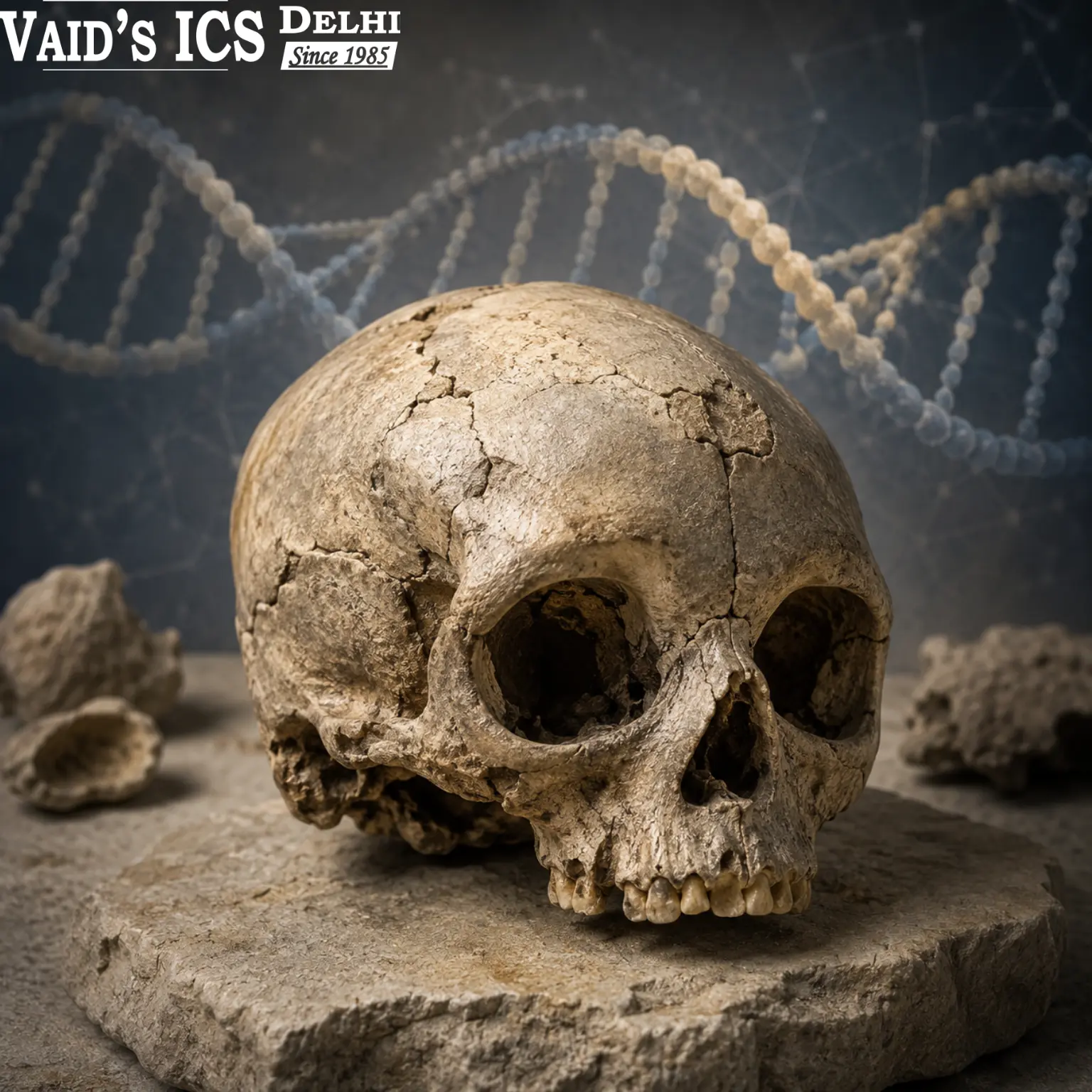
Source: reanalysis published in l’Anthropologie (2025); original fossil from Skhul Cave, Mount Carmel.
A 2025 reassessment of a famous fossil child from Skhul Cave has revived a long-running question in human evolution: could this individual be a human Neanderthal hybrid? In addition, the claim is striking and directly relevant to UPSC Anthropology Paper 1 — but, as this note explains, the hybrid interpretation is proposed and debated, not settled.
Why this matters: it puts admixture between Homo sapiens and Neanderthals, and the origins of intentional burial, into a single vivid case for Paper 1.
Syllabus relevance: Anthropology Paper 1 — Neanderthals, modern human origins, hominin admixture, and mortuary/burial evidence.
Best use in answers: use it to discuss gene flow between hominins and the interpretive caution needed with fossil reconstructions.
The fossil and the site
Moreover, the Skhul child was excavated at Skhul Cave on Mount Carmel (present-day Israel), a site associated with early Homo sapiens in the Levant dated to roughly 140,000–100,000 years ago. Scholars often cite Skhul among the oldest known intentional human burials — though which site holds the very “oldest” burial is itself debated.

What the 2025 study proposed
Re-examining the skull and jaw with modern imaging, the researchers argued that the child’s anatomy mixes features usually linked to Homo sapiens with traits considered more Neanderthal-like. On that basis they proposed the individual may represent a hybrid of the two populations.
Why scholars debate the human Neanderthal hybrid claim
Furthermore, many specialists urge caution. In particular, the key points of disagreement are:
- Anatomical “intermediacy” can also reflect normal variation within early Homo sapiens, not hybridisation.
- The fossil is fragmentary, and excavators recovered it long ago, which complicates fresh analysis.
- No ancient DNA confirms hybrid ancestry for this specimen.
So the honest position for an answer is: the hybrid reading is a plausible but contested hypothesis, consistent with wider genetic evidence that Homo sapiens and Neanderthals interbred, but not proven for Skhul.
The bigger picture: admixture in human evolution
Similarly, independent genetic studies have firmly established that non-African modern humans carry a small percentage of Neanderthal DNA, showing that the two groups did interbreed. Whether or not the Skhul child is a hybrid, the case usefully illustrates how hominin boundaries were porous and how populations exchanged genes.
Why this matters for UPSC Anthropology
In fact, it connects to Paper 1 themes of Neanderthals, modern human origins and evolutionary methods — see the Paper 1 human-evolution syllabus, and read it alongside our note on Neanderthal symbolic behaviour and on hominin diversity.
Use in Answer Writing
Syllabus topic: Neanderthals, modern human origins and hominin admixture (Paper 1).
Key concepts to apply: Homo sapiens–Neanderthal interbreeding; morphological variation vs hybridisation; intentional burial; interpretive caution.
How to use it in answers: present the Skhul reanalysis as a debated case, then anchor it in the confirmed genetic evidence for Neanderthal admixture.
Concepts to apply in answers
- Hominin admixture / gene flow between Homo sapiens and Neanderthals
- Morphological variation vs hybrid interpretation (methodological caution)
- Origins of intentional burial and mortuary behaviour
\n
\n
FAQ
Was the Skhul child definitely a hybrid?
No. A 2025 study proposed it, but the interpretation remains debated, and DNA has not confirmed it.
Did Neanderthals and modern humans interbreed?
Yes — genetics shows non-African modern humans carry Neanderthal DNA, whatever the status of the Skhul specimen.
Where does this fit in the syllabus?
Paper 1 — Neanderthals, modern human origins and admixture.
Preparing Anthropology Optional for UPSC?
Learn to weigh evidence and present debates like this in balanced Paper 1 answers with VAID SIR at VAID’S ICS.
Explore the Anthropology Optional programme →
VAID’S ICS has mentored Anthropology-optional rankers across years, including AIR 3 (2023) and AIR 1 (2020). See the full results.
Sources
- 2025 reanalysis of the Skhul child, l’Anthropologie (interpretation debated).
- Background: genetic evidence for Homo sapiens–Neanderthal admixture (Green et al., 2010 and subsequent studies).