
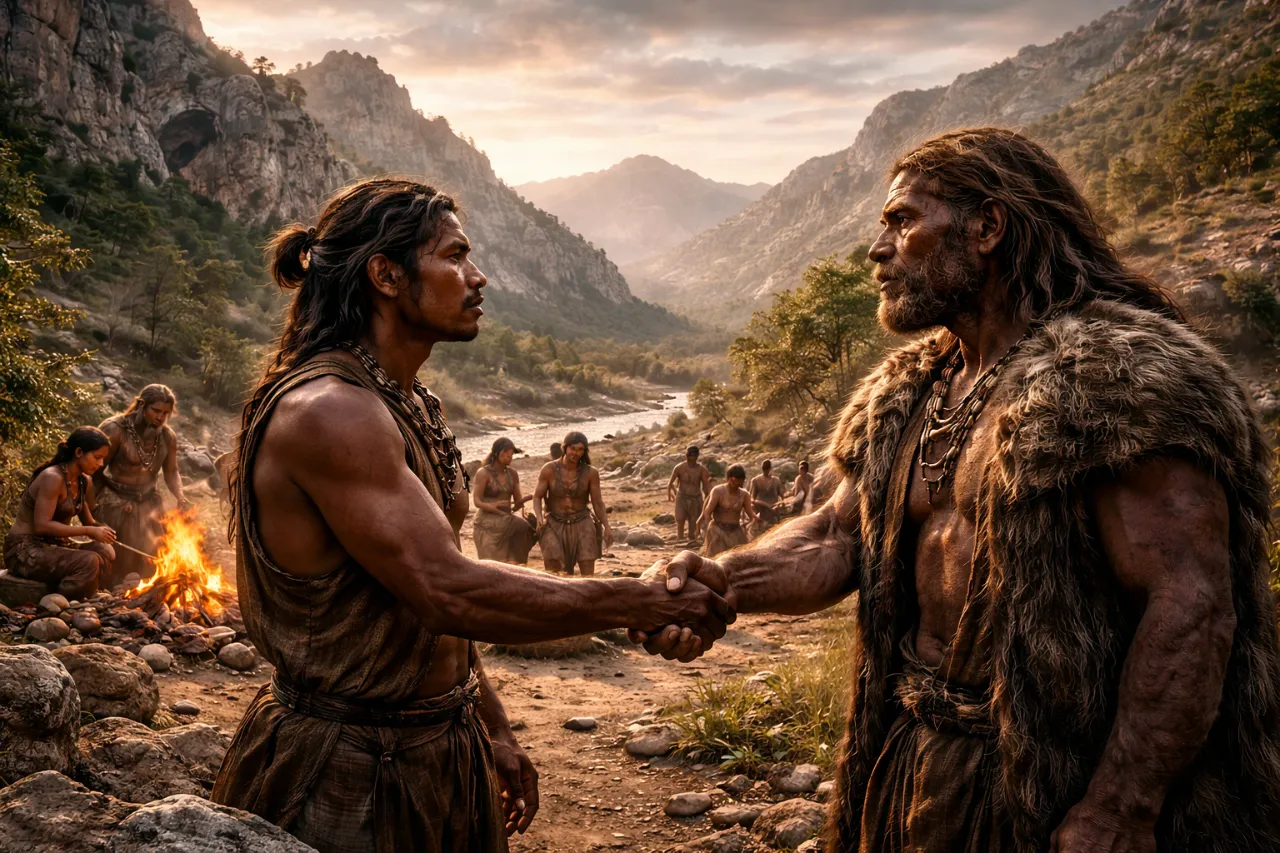
Where did modern humans and Neanderthals actually meet? A 2024 study in Scientific Reports proposes an answer: the Zagros Mountains of present-day Iran. The claim is a model-based inference, and that distinction is the part examiners care about.
Source: Guran et al., Scientific Reports 14, article 20475 (September 2024), “Reconstructing contact and a potential interbreeding geographical zone between Neanderthals and anatomically modern humans”. Evidence level: journal record and press summaries. The full text was not independently reviewed.
What kind of study this is
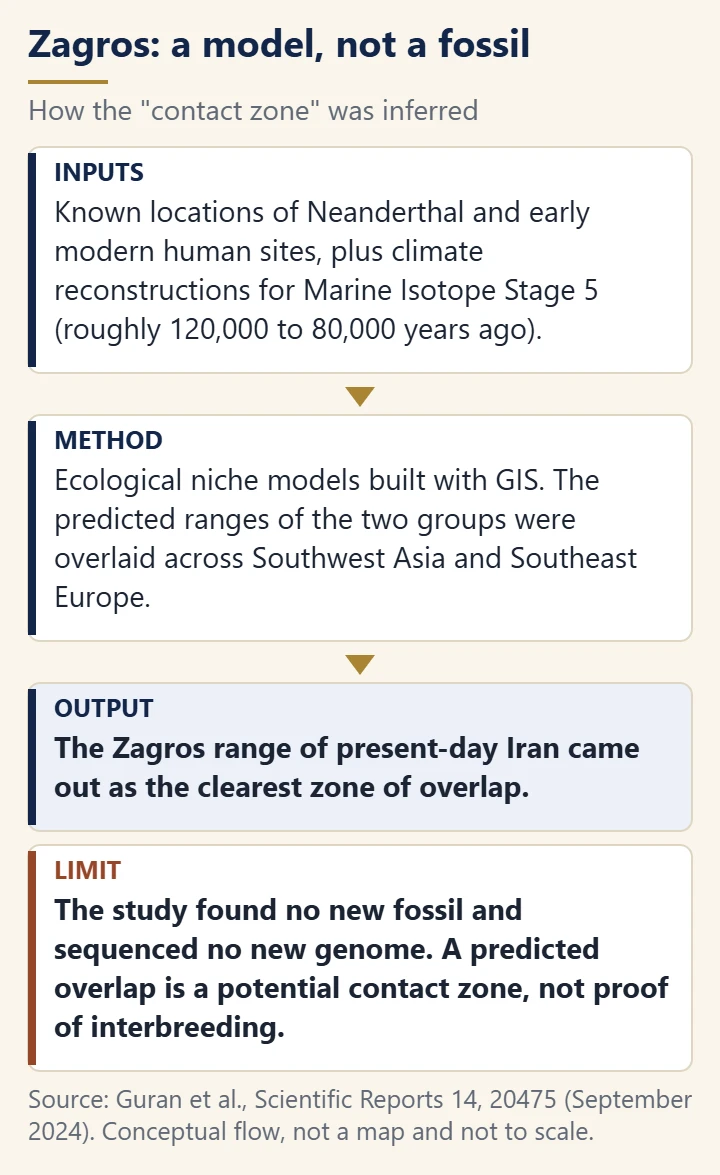
In fact, Guran and colleagues did not find a new fossil or sequence a new genome. They built ecological niche models with GIS, using climate reconstructions for Marine Isotope Stage 5 (roughly 120,000 to 80,000 years ago) and the known locations of Neanderthal and early modern human sites. Next, they overlaid the two predicted ranges across Southwest Asia and Southeast Europe.

The Zagros range came out as the clearest zone of overlap. The authors also suggest that it worked as a corridor, with modern humans moving north and Neanderthals moving south. However, press coverage reports smaller overlap areas in the northern Balkans, the southern Caucasus and the Iran-Afghanistan border region. Neanderthal remains from Zagros-region caves, such as the Bawa Yawan rock shelter, show that Neanderthals lived in the area.
Timing: contact is not the same as the mixing we carry
Archaeological and fossil evidence places modern humans in southwestern Asia between about 120,000 and 80,000 years ago. That window is earlier than the main pulse of Neanderthal ancestry in present-day non-Africans, which most genomic studies place at roughly 50,000 years ago. The model therefore shows where earlier contact was possible. It does not date the mixing that survives in our genomes.
The asymmetry puzzle
Today we carry Neanderthal DNA. Yet the traffic was not entirely one-way. The Altai Neanderthal genome contains segments from an early modern human population (Kuhlwilm et al., Nature, 2016), with gene flow dated to roughly 100,000 years ago. That signal was not found in the Denisovan or in the two European Neanderthals tested in the same study.
This raises questions about population size, the direction of gene flow and the demographic weight of Homo sapiens. So it is better to pose these questions than to claim answers.
Anthropological significance
Overall, the work supports the Out-of-Africa model with admixture. It also shows hybridisation as part of human evolution, and it moves the debate beyond simple replacement. Neanderthals were not erased at first contact; they interacted biologically with modern humans.
Using it in UPSC Mains
In an answer, state clearly that interbreeding is established from genomes, while the Zagros location is a modelled hypothesis. That separation shows precision. Also link it to the Skhul child debate and to early human dispersals out of Africa.
Practise with the PYQs on emergence and dispersal of modern Homo sapiens (2020, Paper 1) and evolutionary forces and human diversity (2022, Paper 1). The topic page on human evolution and primatology collects the rest, and the full optional guide shows where this fits.
Sources
Guran et al., Scientific Reports (2024), DOAJ record; ScienceAlert summary; Kuhlwilm et al., Nature 530 (2016), cited from the earlier version of this article.