
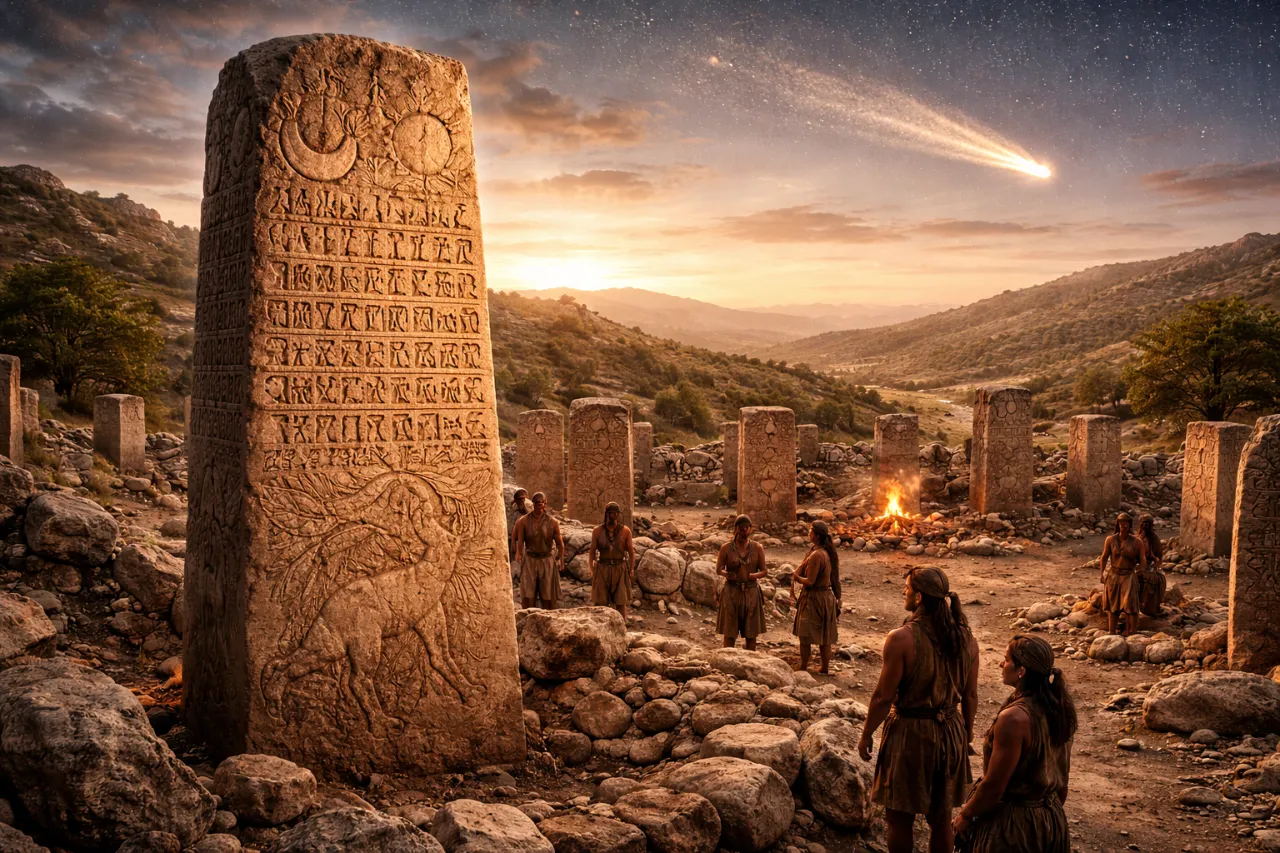
Are the V-shaped marks on a Göbekli Tepe pillar a calendar? A 2024 paper says they could be, and links them to a comet strike. The idea is bold and widely reported, yet it is one researcher’s reading of the carvings and not a settled finding. For Optional Paper I, its value lies in what it shows about the site and in how to handle a contested claim.
Source: Martin Sweatman, University of Edinburgh, Time and Mind (August 2024); University of Edinburgh release. Checked through the release and press coverage.
The site
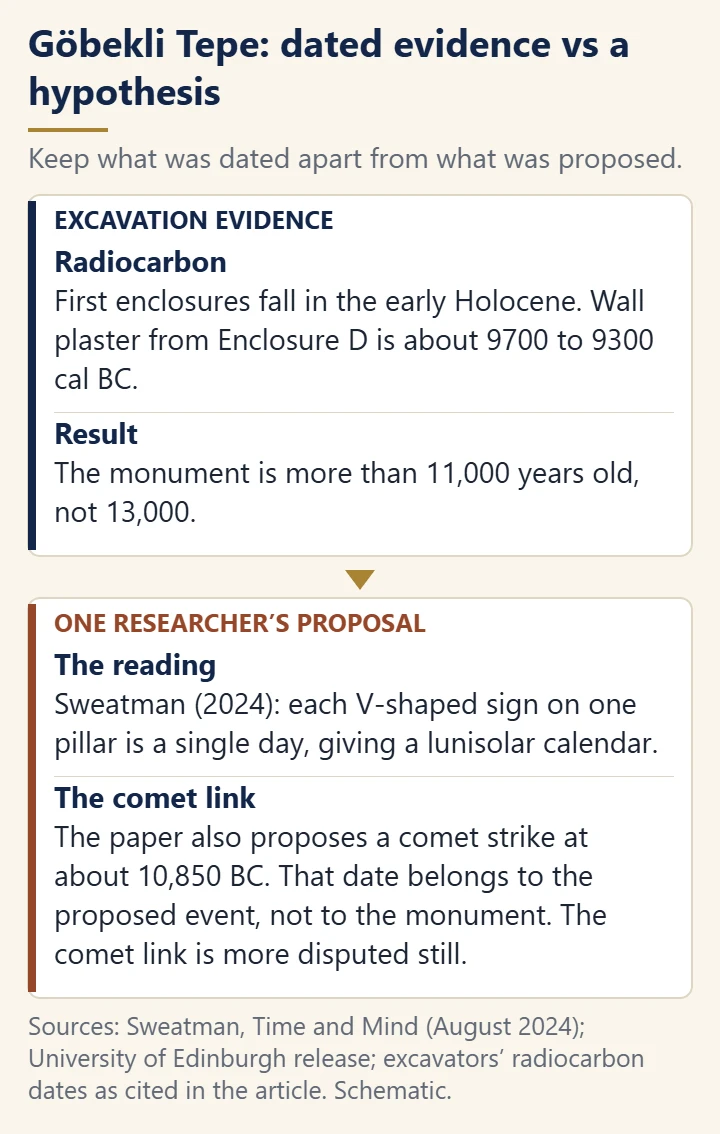
Göbekli Tepe in south-eastern Turkey has circular enclosures of massive T-shaped stone pillars, many carved with animals and abstract signs. It matters because monumental building appears there among people who, on current evidence, had not yet adopted farming. Excavators’ radiocarbon dates place the first enclosures in the early Holocene, with wall plaster from Enclosure D falling around 9700 to 9300 cal BC. The monument is therefore more than 11,000 years old, not 13,000.

The calendar claim
First, Sweatman reads each V-shaped sign on one pillar as a single day. On this reading the pillar records a solar year of 365 days, made of 12 lunar months plus 11 extra days. Next, a V worn around the neck of a bird-like figure is taken to mark the summer solstice. Therefore, the carvings would show both the moon and the sun, which is what a lunisolar calendar does.
In addition, the same paper proposes that the carvings commemorate a comet strike put at about 10,850 BC, which the author links to a cold phase lasting over 1,200 years. However, that date belongs to the proposed event. It is not an independent date for the carvings, and it is earlier than the dates for the enclosures themselves.
Why caution is needed
The reading depends on counting symbols as days and on matching animal figures to constellations. Those are choices, so other scholars may count or read them differently. The comet link is more disputed still. A careful answer states that the calendar is a hypothesis and keeps the site’s well-dated features, which are the monumental enclosures, the carved pillars and the likely ritual function, separate from it.
Using it in UPSC Mains
Use Göbekli Tepe as evidence that ritual and symbolic complexity can come before agriculture. As a result, it challenges the older idea that monuments follow settled farming. Mention the calendar only with a hedge, for example “Sweatman has argued”. Finally, show the contrast between the dated archaeology and the speculative reading.
No listed PYQ asks about prehistoric calendars or monumental sites. Browse the Prehistoric Archaeology PYQs and pick the Neolithic and Mesolithic questions for practice. For another debated claim about a ritual building, read the reported 8,000-year-old structure in Saudi Arabia. The syllabus map is in the Anthropology Optional complete guide.
Sources
Sweatman (2024), Time and Mind; University of Edinburgh School of Engineering news release; Dietrich and Schmidt, dating of Göbekli Tepe Enclosure D plaster (German Archaeological Institute research), as summarised in the PPND radiocarbon database.