
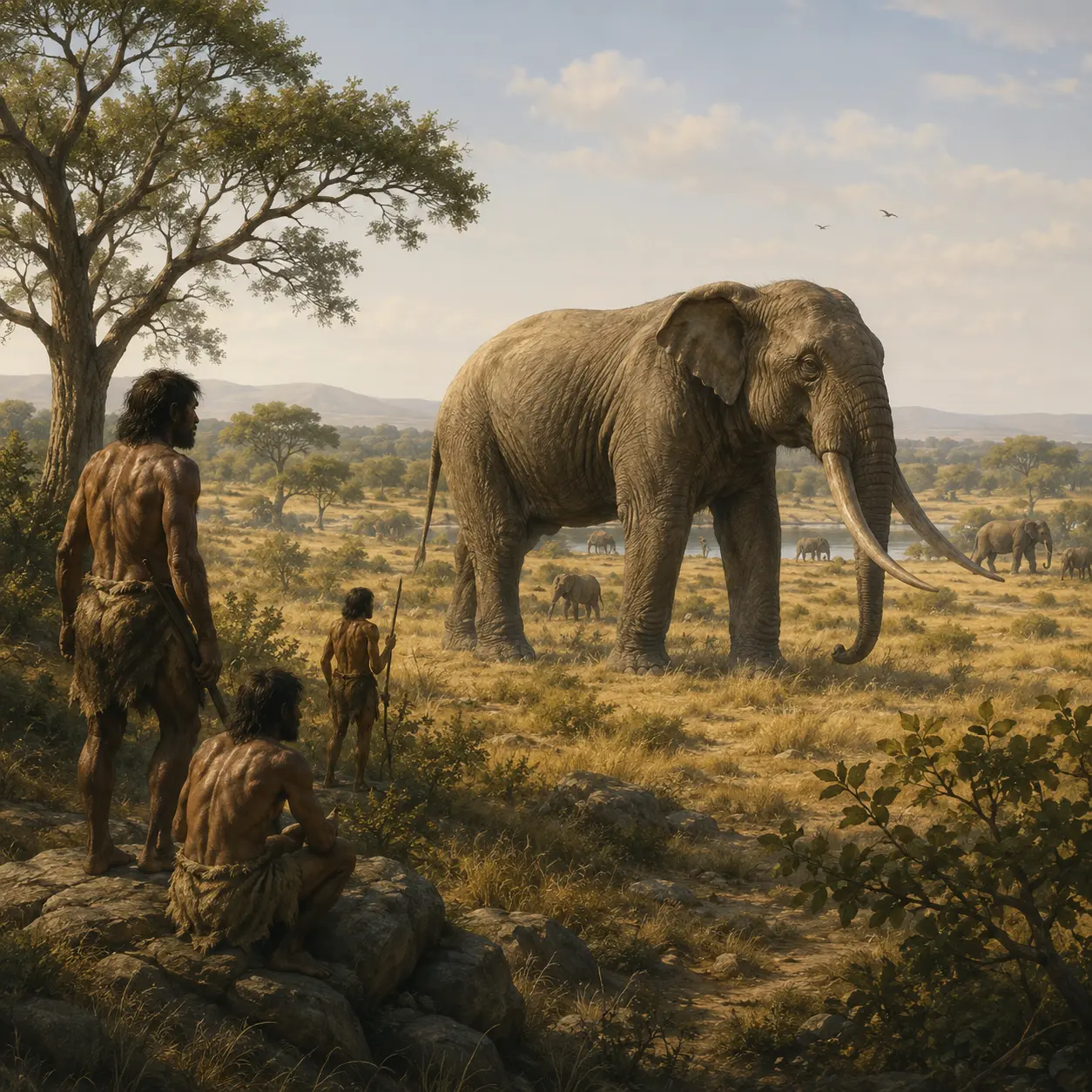
How early did humans begin to reshape ecosystems? A 2024 study in Science Advances by Torsten Hauffe, Juan Cantalapiedra and Daniele Silvestro modelled the history of proboscideans, the group that includes elephants and their relatives. It reports that extinction rates rose when early humans appeared, from about 1.8 million years ago, and rose far more with modern humans. This is a model result, so it needs careful framing.
Source: Hauffe et al., Science Advances 10(30), eadl2643, 24 July 2024.
The reported pattern
The authors modelled the evolutionary history of proboscideans from a large fossil dataset, using a probabilistic Bayesian neural network to estimate how often species arose and went extinct. They report that speciation was shaped by dietary flexibility and biogeographic events, and that the emergence of modern humans escalated extinction rates, with regional climate having a lesser effect in the model. The study’s press release reports a roughly fivefold rise in extinction rate when early humans appeared, from about 1.8 million years ago, and a far larger rise with Homo sapiens. Proboscideans were once far more diverse than the three living elephant species.

| Question | What is reported | Status |
|---|---|---|
| When did losses rise? | Modelled extinction rate rose as early humans appeared, from about 1.8 million years ago | Reported pattern, with dating uncertainty |
| Who may have driven it? | Early Homo, as Homo erectus spread beyond Africa | Hypothesis, contested |
| Other causes? | Climate change and habitat shifts | Cannot be ruled out |
Proboscideans matter for this question because they were the largest land animals available to early hominins. An adult elephant carries a very large amount of meat and fat, which makes it a high-reward but high-risk target for people with simple tools.
Why Homo erectus is in the frame
Around this time early Homo, including Homo erectus, spread out of Africa and into Eurasia. These hominins used stone tools and ate meat, and large animals offered a lot of food. The authors read the timing as consistent with human pressure on proboscideans, an overkill idea applied to the deep past. The result comes from a model of overlap in space and time, not from direct evidence of hunting each lost species.
Why caution is essential
A modelled association cannot show which humans hunted which species, or how often.
Correlation is not proof. Climate swung repeatedly in the early Pleistocene, and grasslands expanded while forests shrank. The authors report that regional climate had a lesser effect in their model, but a model cannot exclude every other cause. Evidence of butchery on elephant bones exists at some sites, yet it does not show that hunting caused declines across a whole continent. Dating errors could also make events look more closely linked than they were.
A balanced answer says that humans may have contributed, probably together with climate, and that the case is still debated.
Evidence and inference
The extinction pattern is a model estimate from fossil records. The role of humans is an inference from timing and overlap. The sentence to avoid is that Homo erectus wiped out elephants. The safer sentence is that the timing is consistent with human involvement, among other factors.
What it means for anthropology
The idea reframes early humans as ecological actors and not just passive survivors. It connects human evolution with ecology, extinction and later debates about the Quaternary megafauna losses, which are usually linked to Homo sapiens. Students sometimes assume that human-caused extinction began only with Homo sapiens. This work, if it holds, pushes the possible start much further back. If the early pattern is real, human influence on animal communities would be far older than farming or modern hunting.
Using it in UPSC Mains
Structure a short answer in this order: the pattern, the proposed human link, the alternative climate explanation, and a closing judgment that keeps the question open.
Use this in answers on Homo erectus under Paper I, clause 1.6(b), and on human interaction with the environment in Palaeolithic societies. It is best used as a short illustration of early human impact, always with the caveat that causation is unproven.
For related practice, a conceptual connection rather than a question on this finding, see the PYQ Geographical Distribution of Homo erectus (2024). More questions are in the Human Evolution and Primatology PYQs. For another early dispersal case, read Early Humans Walked from Turkey to the Mainland. For another Middle Pleistocene case from East Asia, read the Xujiayao hominin. The wider syllabus map is in the Anthropology Optional complete guide.