
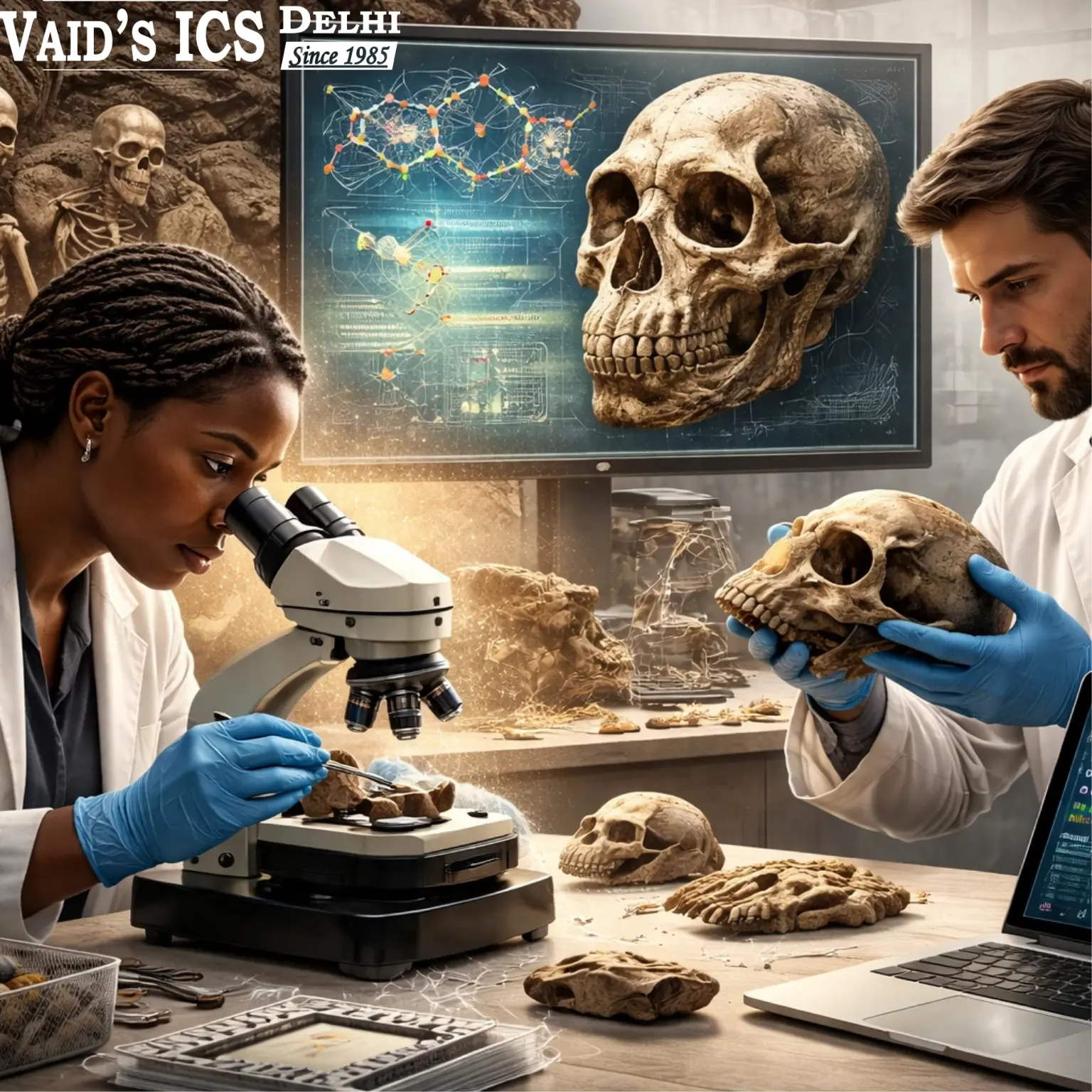
Source: Madupe et al., South African Journal of Science (7 February 2025).
Ancient proteins have, for the first time, revealed the biological sex of an Australopithecus africanus individual that lived in southern Africa millions of years ago. For UPSC Anthropology aspirants, this is a compact, high-value example of how molecular methods now sit alongside classical fossil morphology in the study of human evolution — squarely within Paper 1.
Why this matters: a molecular method (palaeoproteomics) determined the sex of a deep-time hominin where bones and DNA cannot, expanding the toolkit of physical anthropology.
Syllabus relevance: Anthropology Paper 1 — Australopithecines, methods in physical anthropology, dating and fossil interpretation.
Best use in answers: cite it as a recent example of molecular anthropology complementing skeletal morphology in human-evolution answers.
The discovery
Researchers analysed a fossil tooth of Australopithecus africanus (specimen Sts 63) from South Africa and recovered ancient enamel proteins. The protein evidence identified the individual as male — the first time the sex of an A. africanus individual has been established using molecular data rather than bone shape alone. The fossil is dated to roughly 3.5 to 2.0 million years ago.

The site: Sterkfontein and the Cradle of Humankind
The fossil comes from the Sterkfontein Caves (Member 4), part of the Cradle of Humankind, a UNESCO World Heritage Site near Johannesburg. Sterkfontein is one of the richest early-hominin sites in the world, yielding many Australopithecus fossils as well as early Homo and Paranthropus remains. (Note: Homo naledi — sometimes wrongly linked to Sterkfontein — actually comes from the nearby Rising Star cave system in the same Cradle of Humankind region, not from Sterkfontein itself.)
How the sex was determined
The team studied amelogenin, a protein involved in forming tooth enamel. Amelogenin occurs in slightly different, sex-linked forms encoded on the X and Y chromosomes. Detecting the Y-linked variant marks an individual as male. Because enamel is extremely hard and durable, these proteins can survive far longer than DNA.
What is palaeoproteomics?
The technique is called palaeoproteomics — the study of ancient proteins. It matters for deep-time human evolution because:
- Proteins are chemically more stable than DNA and can persist for very long periods in hard tissues like enamel.
- Ancient DNA rarely survives beyond a few hundred thousand years, so it is usually unavailable for australopithecine-age fossils.
- Protein sequences still carry biological information, including sex and some evolutionary relationships.
In short, where ancient DNA runs out, ancient proteins can extend molecular analysis much further back in time.
Anthropological significance
For physical anthropology, the study is important because it:
- Enables reliable sex determination in early hominins that are hard to sex from bones alone.
- Improves the study of sexual dimorphism in Australopithecus.
- Integrates molecular evidence with morphology, rather than relying on skeletal traits only.
- Opens cautious new lines of enquiry into social structure and life history in early hominins.
Why this matters for UPSC Anthropology
This is a ready example for Paper 1 questions on australopithecines and on methods in physical anthropology — map it to the Paper 1 human-evolution syllabus, and use the complete Anthropology optional guide for answer strategy.
Use in Answer Writing
Syllabus topic: Australopithecines and methods in physical anthropology (Paper 1).
Key concepts to apply: Palaeoproteomics; amelogenin sex determination; molecular vs morphological methods; sexual dimorphism.
How to use it in answers: cite the 2025 enamel-protein study of Sts 63 to show how molecular methods now supplement classical fossil analysis.
Previous Year Questions — UPSC Anthropology
- Explain the biological changes that made human beings capable of making cultures. (20 Marks, 2018)
- Describe the practical applications of DNA technology in the current scenario. (15 Marks, 2023)
\n
FAQ
What did the ancient-protein study find?
It identified an Australopithecus africanus individual (Sts 63) as male using enamel proteins — a first for the species.
Why use proteins instead of DNA?
DNA rarely survives in fossils millions of years old, whereas enamel proteins can persist much longer.
Where is this useful in the syllabus?
Paper 1 — australopithecines and methods in physical anthropology.
Preparing Anthropology Optional for UPSC?
Turn cutting-edge fossil research into high-scoring Paper 1 answers with VAID SIR’s structured Anthropology programme at VAID’S ICS.
Explore the Anthropology Optional programme →
VAID’S ICS has mentored Anthropology-optional rankers across years, including AIR 3 (2023) and AIR 1 (2020). See the full results.
Sources
- Madupe et al., palaeoproteomic analysis of an Australopithecus africanus enamel fragment, South African Journal of Science (2025): sajs.co.za