
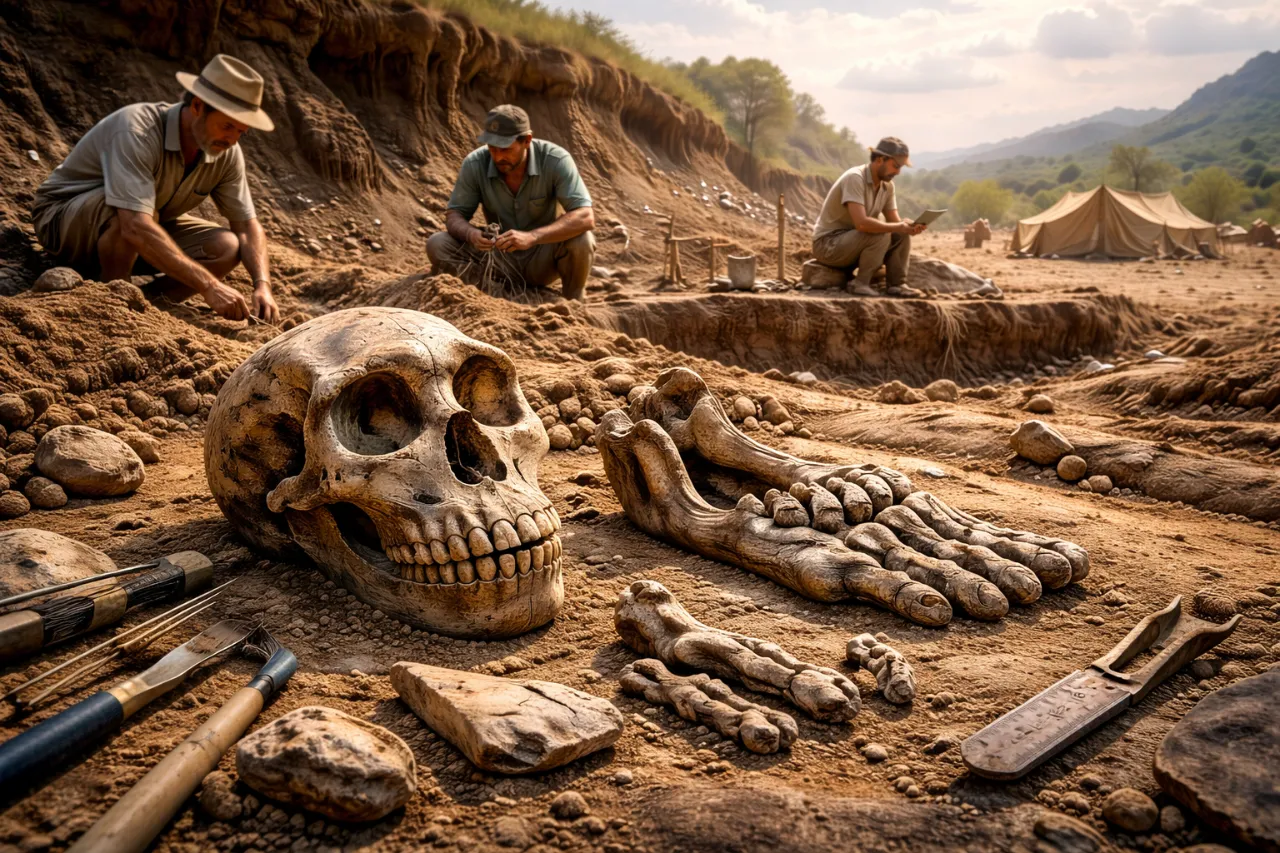
For years a fossil foot from Ethiopia had no species name. In November 2025, a Nature paper assigned it to Australopithecus deyiremeda. That places a second australopith species in the Afar region at the same time as Lucy’s species, A. afarensis. For Optional Paper I, the value lies in the shift from a single ancestral line to a branching bush.
Source: Yohannes Haile-Selassie et al., “New finds shed light on diet and locomotion in Australopithecus deyiremeda”, Nature (26 November 2025), DOI 10.1038/s41586-025-09714-4. Checked through publisher press material and press coverage, not the full text.
The foot and the new fossils
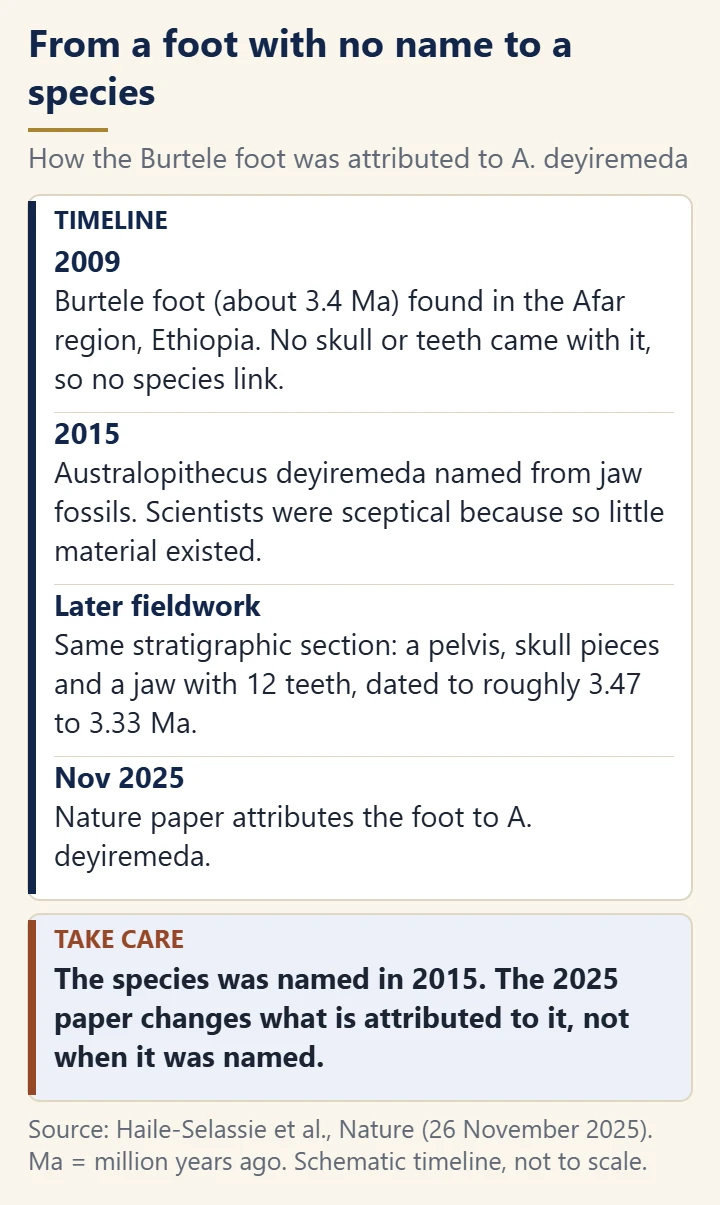
The Burtele foot, about 3.4 million years old, was found in 2009 in the Afar region. It could not be linked to a species because no skull or teeth came with it. Later fieldwork in the same stratigraphic section recovered a pelvis, skull pieces and a jaw with 12 teeth, dated to roughly 3.47 to 3.33 million years ago. The authors use these to attribute the foot to A. deyiremeda, a species first named in 2015 from jaw fossils.

Two points about the evidence matter. First, the species name rests on fossils from nearby deposits, so the attribution is an argument and not a measurement. Second, the original 2015 naming drew scepticism because so little material existed. The new finds address that problem but do not end all debate.
What the anatomy suggests
According to the reports, the foot kept an opposable big toe, which helps in climbing. On the ground the animal walked on two legs. Dental evidence suggests a diet of leaves, fruit and nuts from trees. By contrast, the big toe of A. afarensis lay in line with the other toes. Such differences in locomotion and diet suggest that the two species used the landscape in different ways.
Why it matters for the lineage
The finding supports the view that several hominin species lived in East Africa between about 3 and 3.5 million years ago. As a result, a tidy line from A. afarensis to later hominins becomes hard to defend. However, it does not remove Lucy’s species from the story. It only means that its place in the ancestry of Homo needs argument rather than assumption.
Using it in UPSC Mains
Present diversity as the finding and ancestry as an open question. Name the species, the site (Afar, Ethiopia), the age (about 3.4 million years), the new material and the competing readings. A strong answer also names the limits: the attribution depends on association in the same deposits.
The closest PYQ is the 2023 Paper I question on Australopithecus species and the Taung baby. More questions sit under Human Evolution and Primatology PYQs. For another recent australopith study, read ancient proteins and the sex of Australopithecus africanus. The syllabus map is in the Anthropology Optional complete guide. For another disputed case of early bipedalism, read the Trachilos footprints.
Sources
Haile-Selassie et al. (2025), Nature, DOI 10.1038/s41586-025-09714-4; Nature Asia press release; Science News coverage of the same paper.
1 thought on “New Species of Australopithecus Challenges the Human Family Tree”
Comments are closed.