
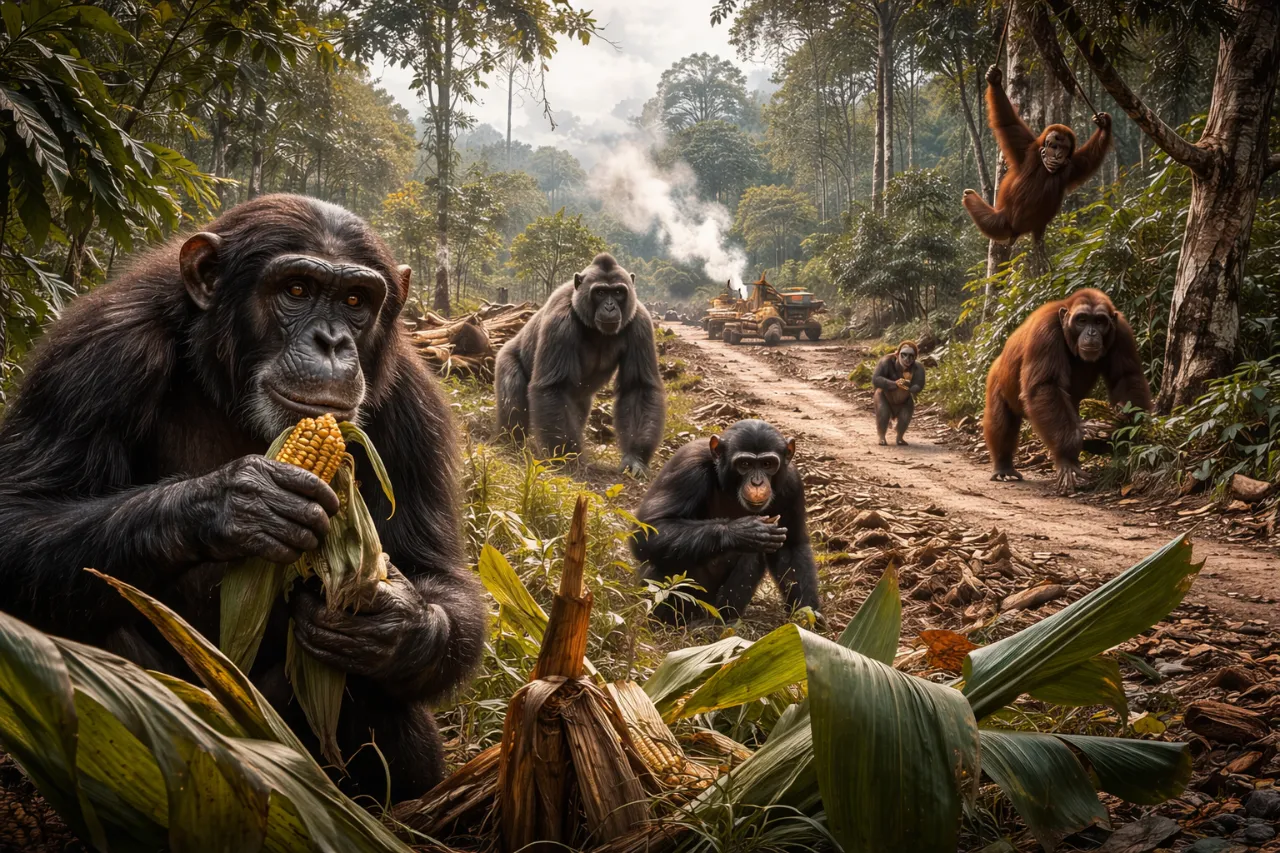
Source: Miranda A. Gilbert et al., Primates (4 February 2025) — a systematic review of great-ape behavioural responses to human disturbance.
Ape behavioural flexibility is one of the clearest windows biological anthropology has into how primates cope with a fast-changing world. A large 2025 review shows that great apes are quietly rewriting their daily routines wherever people reshape the forest. For UPSC Anthropology Paper 1, this is a compact, current example of primate behaviour, adaptation and human–animal interaction that also crosses into GS-III conservation.
Why this matters: it demonstrates behavioural flexibility — a core adaptive trait — in our closest relatives, and shows the early stages of human–primate coexistence and conflict.
Syllabus relevance: Anthropology Paper 1 — Primate behaviour and social organisation; adaptation; primatology and its methods; human–animal interaction.
Best use in answers: cite it as a recent, evidence-based case of behavioural plasticity and conservation anthropology, alongside classic primatology names.
What the review examined
Researchers led by Miranda A. Gilbert screened nearly 2,500 studies and retained 96 high-quality ones. Together these covered all seven living species of great ape: chimpanzees, bonobos, eastern and western gorillas, and Bornean, Sumatran and Tapanuli orangutans. As a result, it is one of the most comprehensive global assessments of how apes respond to people.

How human disturbance reaches the forest
The review identifies large-scale land-use change as the most frequent pressure. In particular, forests are converted to cropland, logged for timber, or fragmented by roads and settlements. Consequently, traditional ranging patterns break down and apes must adjust.
Ape behavioural flexibility in action
Across regions, apes showed several adaptive changes. For example, they take up crop foraging on human-grown food, shift nesting to new sites or change how often they reuse nests, and even use human roads to move more easily. Each of these reflects genuine behavioural flexibility rather than fixed instinct.
Safe adaptations versus risky ones
Importantly, the study separates low-risk from high-risk responses. Changes in nesting often helped apes avoid direct human contact and carried no negative outcome. By contrast, crop foraging and road use were linked to stress, injury, mortality and human–ape conflict, because they expose apes to retaliation, accidents and disease. In short, not every adaptation improves survival.
Species and context matter
Responses were also context-dependent. Some gorilla populations avoided logged forest entirely, while others entered it to exploit new foods. Therefore ape behaviour is shaped by local ecology, species traits and the intensity of disturbance — a nuance examiners reward.
Why it matters for Anthropology
For anthropology, the review does three things at once. First, it documents behavioural plasticity in non-human primates. Second, it illustrates the deep evolutionary roots of adaptability that we share with apes. Finally, it feeds directly into conservation anthropology, since policy must recognise that some adaptations raise conflict rather than reduce it.
Use in answer writing: deploy this as a modern illustration of behavioural flexibility in primate-behaviour and adaptation questions, and as an ecology-plus-conservation example.
Paper 1 link: Primate behaviour, social organisation and adaptation; primatology’s contribution to understanding human origins; human–animal interaction.
Relevant PYQs
• Jane Goodall’s contributions in studying primate behaviour. (10M / 2020)
• Role of Primatology in anthropological studies. (10M / 2013)
Also read
• Orangutans & Metabolic Flexibility: Primate Diet and Adaptation
• The Diet That Shaped Human Evolution
• Anthropology Optional Syllabus Explained
FAQ
Is behavioural flexibility the same as evolution? No. Flexibility is a within-lifetime behavioural adjustment; over many generations such flexibility can, however, shape evolutionary pathways.
Which apes were covered? All seven living great-ape species, from chimpanzees and bonobos to the three orangutan species and two gorilla species.
Preparing Anthropology Optional?
Primatology is a high-yield, scoring part of Paper 1. Explore our complete Anthropology Optional guide to see how case studies like this fit into answer writing. Mentored by Vaid Sir; Anthropology specialists since 1985.
References
Gilbert, M. A. et al. (2025). Behavioural responses of great apes to anthropogenic disturbance. Primates.