
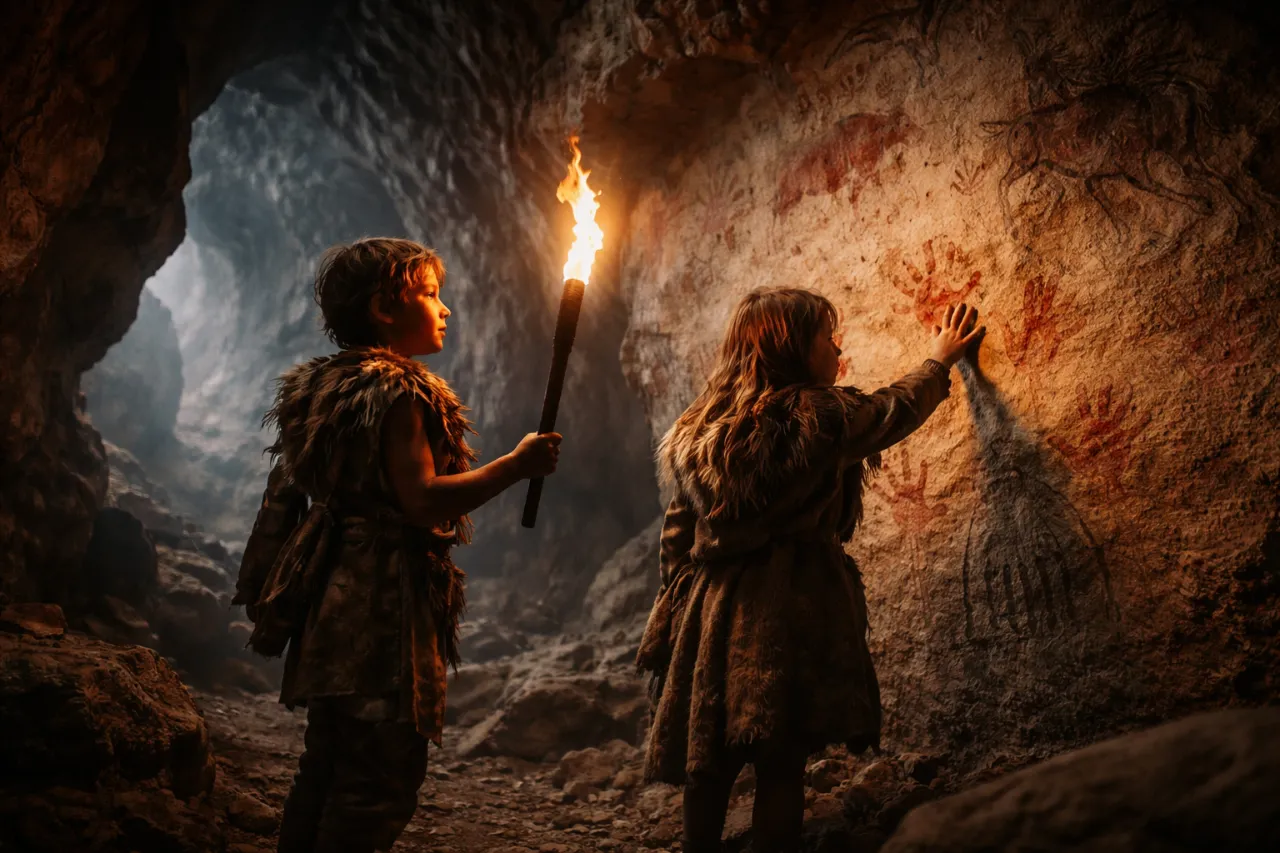
Why would hunter-gatherers take small children into dark, narrow caves? A 2025 study argues that the children were not just along for the ride. It proposes that they took part in cave art as ritual participants, perhaps as go-betweens with the spirit world. For Optional Paper I, it is a useful case of reading belief and social roles from prehistoric art.
Source: Ella Assaf, Yafit Kedar and Ran Barkai, Tel Aviv University, Arts 14(2), article 27 (4 March 2025). Checked through the university announcement, abstract record and press coverage.
The evidence
First, the authors start from about 400 decorated caves, mostly in France and Spain, dated between roughly 40,000 and 12,000 years ago. However, many are deep and hard to reach, with passages that require crawling or climbing. Inside them, researchers find handprints, finger flutings (finger-drawn lines in soft cave surfaces) and simple drawings. The authors attribute dozens of these marks to children aged about two to twelve, and some footprints also appear next to adult ones.

A new reading
Earlier explanations stressed learning. On that view, adults brought children into caves to pass on art and cave knowledge. The new study accepts that learning may have happened, but it argues for more. In the authors’ view, hunter-gatherers saw the world as full of powerful non-human forces, including animals, plants and ancestral spirits. Therefore, caves were thresholds to that world. Moreover, children, who stand between birth and adult status and between the human and the non-human, may have been seen as fit to reach it.
The concept to carry into your answer is liminality: a person or place in a threshold state. The study applies it to children as a social category.
Where the evidence is weaker
First, ages come from the size of marks, and this is a debated step. Other researchers also dispute whether the age of the maker can be read reliably from finger flutings. Painted hand stencils give firmer evidence of children’s presence. Second, the traces show that children were there. They do not say why. The ritual reading is a well-argued proposal, not a demonstrated fact.
Using it in UPSC Mains
For example, use it to show how archaeologists move from traces to social roles, and how anthropological concepts such as liminality and animism help in interpretation. Also pair it with the shamanistic readings of rock art, but keep the caution on age attribution in view. Finally, a balanced answer gives the learning explanation, the ritual explanation, the evidence for each and the limits.
Practise with the 2019 Paper I question on Upper Palaeolithic traditions in Europe. More are under Prehistoric Archaeology PYQs. For related reading, see the world’s oldest cave paintings and the Lindosa rock art and shamanism. The syllabus map is in the Anthropology Optional complete guide.
Sources
Assaf, Kedar and Barkai (2025), Arts 14(2), 27, MDPI open access; Tel Aviv University announcement; Archaeology News Online Magazine coverage.