
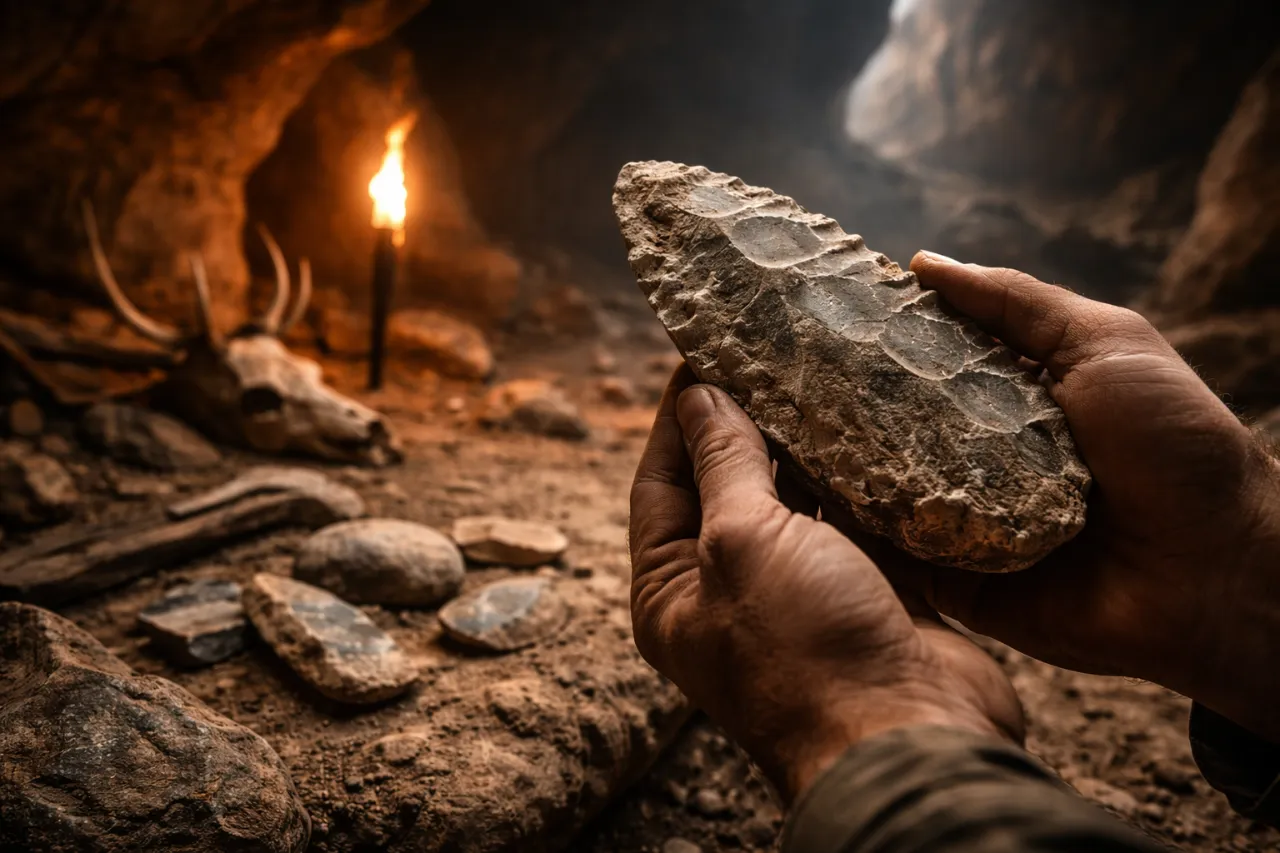
What happens to toolmakers when their main food source disappears? Researchers at two Lower Palaeolithic sites in Israel, Jaljulia and Qesem Cave, argue that hunters redesigned their stone tools. This followed the loss of elephants from the region. For Optional Paper I, it is a compact example of ecology shaping technology.
Source: Vlad Litov and Ran Barkai, Tel Aviv University, Archaeologies (23 February 2024); verified through the university release and press reports, not the full paper.
From elephants to fallow deer
For a very long time, hunters in the Levant relied on elephants and other large herbivores. These gave plentiful meat and fat. Around 400,000 years ago those animals disappeared. As a result, the hunters turned to smaller and faster prey, mainly fallow deer. Each kill gave less meat, so efficiency mattered more.

The Quina scraper
The study links this change to a new tool type, the Quina scraper. Its working edge is stepped and scale-like, with a durable bevel. Hunters could resharpen it many times. The tool is portable, so it suits long trips. The researchers say people used it to butcher deer and process hides. Others have suggested wider uses, such as working shelter materials or making clothing. These remain possibilities, not demonstrated functions.
The university release calls these the earliest such specialised tools. Treat that as the authors’ claim. Some press reports, though, give an earlier date for the first examples at Jaljulia. Check the paper before quoting any figure other than “about 400,000 years ago”.
Flint from far away
The flint came from the Samarian Mountains, about 20 km from the sites, although nearer sources existed. The researchers read this as knowledge of the landscape and planning ahead. They also see a preference for good raw material, even at a higher cost in effort. The same hills were probably the deer’s calving ground, which may explain the choice. That is an interpretation, so frame it as one.
Using it in UPSC Mains
Use this case to show a link between environment, diet and technology in the Lower Palaeolithic. It also feeds the debate on the Lower to Middle Palaeolithic transition, since it shows behavioural change well before Homo sapiens. Avoid stating that cognition changed. The evidence shows changed tools and prey. Any claim about thinking is an inference.
The closest PYQ is the 2020 Paper I question on Lower and Middle Palaeolithic Cultures. More are listed under Prehistoric Archaeology PYQs. For a different case of what stone tools can reveal about planning, see stone tools and early seafaring in Southeast Asia. The syllabus map is in the Anthropology Optional complete guide.
Sources
Litov and Barkai (2024), Archaeologies; Tel Aviv University release on the Jaljulia and Qesem Cave tools; Earth.com coverage of the same study.