
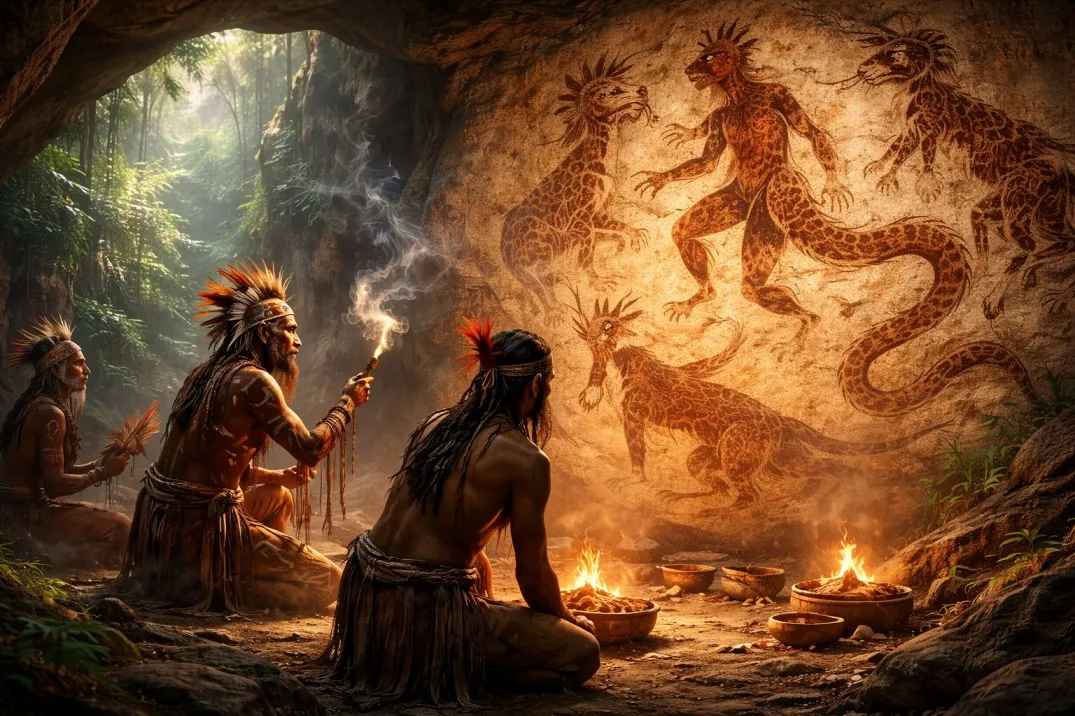
How do you read a painting when its makers are long gone? In the Colombian Amazon, archaeologists asked the living descendants of the region’s peoples. At Serranía de la Lindosa, a sandstone outcrop in Guaviare, thousands of red ochre paintings are now being read with Indigenous elders and ritual specialists. For Optional Paper I, it is a lesson in method as much as in prehistory.
Source: Jamie Hampson, José Iriarte and Francisco Aceituno, “A World of Knowledge: Rock Art, Ritual, and Indigenous Belief at Serranía de la Lindosa in the Colombian Amazon” (2024), special issue on rock art studies; University of Exeter news release, 7 November 2024. Checked through the release and abstract records.
The site and the paintings
The Serranía de la Lindosa holds tens of thousands of motifs in red ochre. They show native animals such as jaguars and anacondas, hunting scenes and figures that seem to change from human to animal. Scholars estimate that some paintings are more than 11,000 years old, around the Pleistocene to Holocene transition. Dates vary between reports, so quote them as estimates.

Archaeologists call this period Palaeoindian in the Americas, rather than Palaeolithic. Therefore “Pleistocene-era art” is a safer label than “Palaeolithic art” in an answer.
Asking the elders
Over three field seasons from 2021 to 2023, the team took 10 Indigenous elders and ritual specialists to six panels at Cerro Azul. The speakers included Desana, Tukano and Nukak people. The team recorded their words and translated them. The lead author says this is the first time in this part of the Amazon that research has fully included Indigenous views.
The elders did not read the images as plain records of what the artists saw. They stressed scenes of transformation, such as bird-human, sloth-human and lizard-human figures. They also pointed to animals that cross between earth, water and sky. The authors conclude that the art speaks of ritual specialists who negotiate spiritual realms, and of human and non-human worlds that are intertwined.
What to be careful about
Descendant communities gave these readings. Even so, they are interpretations, and no one can prove that today’s accounts match what the painters meant. The lead author argues that the art belongs to an animistic world view. Some press stories also say that the study “proves” shamanism in Pleistocene art. However, the evidence supports a link between the art and ritual specialists in this region only. It does not settle the origin of rock art elsewhere.
Using it in UPSC Mains
Use Lindosa to show how ethnoarchaeology and community-informed work can reshape interpretation. The older shamanistic reading of Palaeolithic art, linked with Lewis-Williams and Dowson, finds some support here. So does the criticism that outsiders often impose their own meanings. A strong answer presents both. It then states the method and its limits.
The 2026 Paper I question on Ethnoarchaeology and Classical Archaeology fits the method, and the 2022 question on Mesolithic rock art in the Indian subcontinent fits the theme. More are under Prehistoric Archaeology PYQs. For a different case of early art, read the world’s oldest cave paintings. The syllabus map is in the Anthropology Optional complete guide.
Sources
Hampson, Iriarte and Aceituno (2024), “A World of Knowledge”, rock art special issue; University of Exeter news release (7 November 2024).