
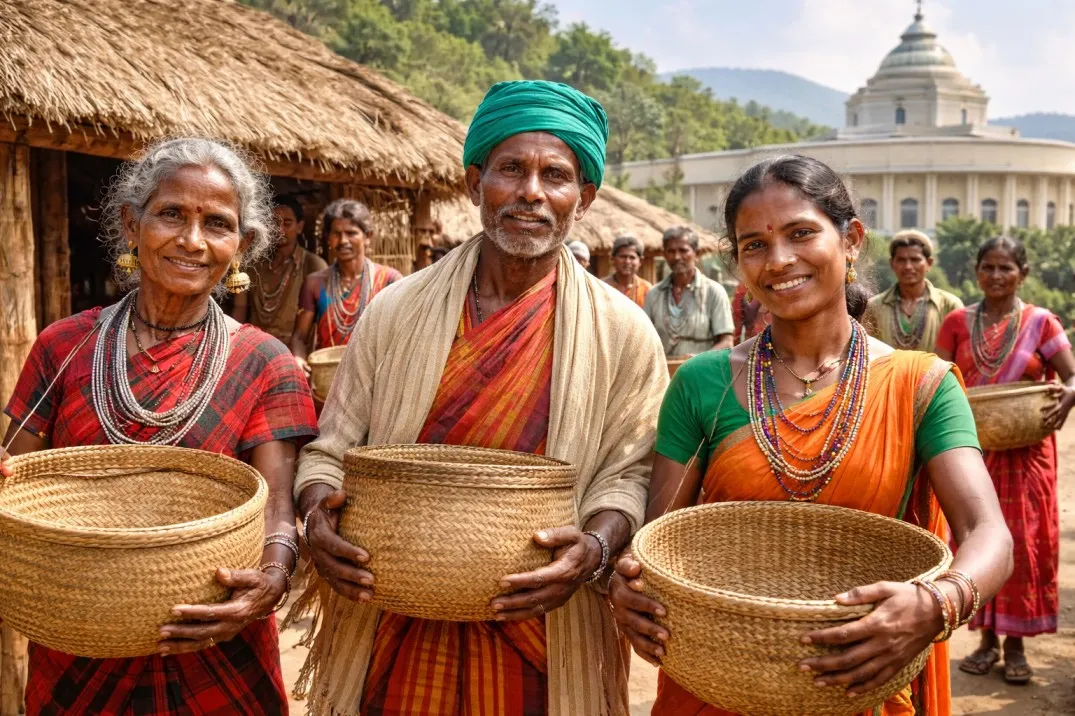
In February 2024, Parliament changed the list of Scheduled Tribes in Odisha. The change moved two communities, Tamadia and Tamudia, from the Scheduled Castes list into the Scheduled Tribes list. It also added others. The case shows that “tribe” in Indian law is a listed legal status. Moreover, Parliament can revise the list.
Source: The Hindu (9 February 2024) triggered this note. The legislative record comes from PRS Legislative Research and press reports of the Act’s passage. Evidence level: legislative tracker and press. Source basis: the PRS bill summary; the full gazette text of the Act was not reviewed.
What Parliament did
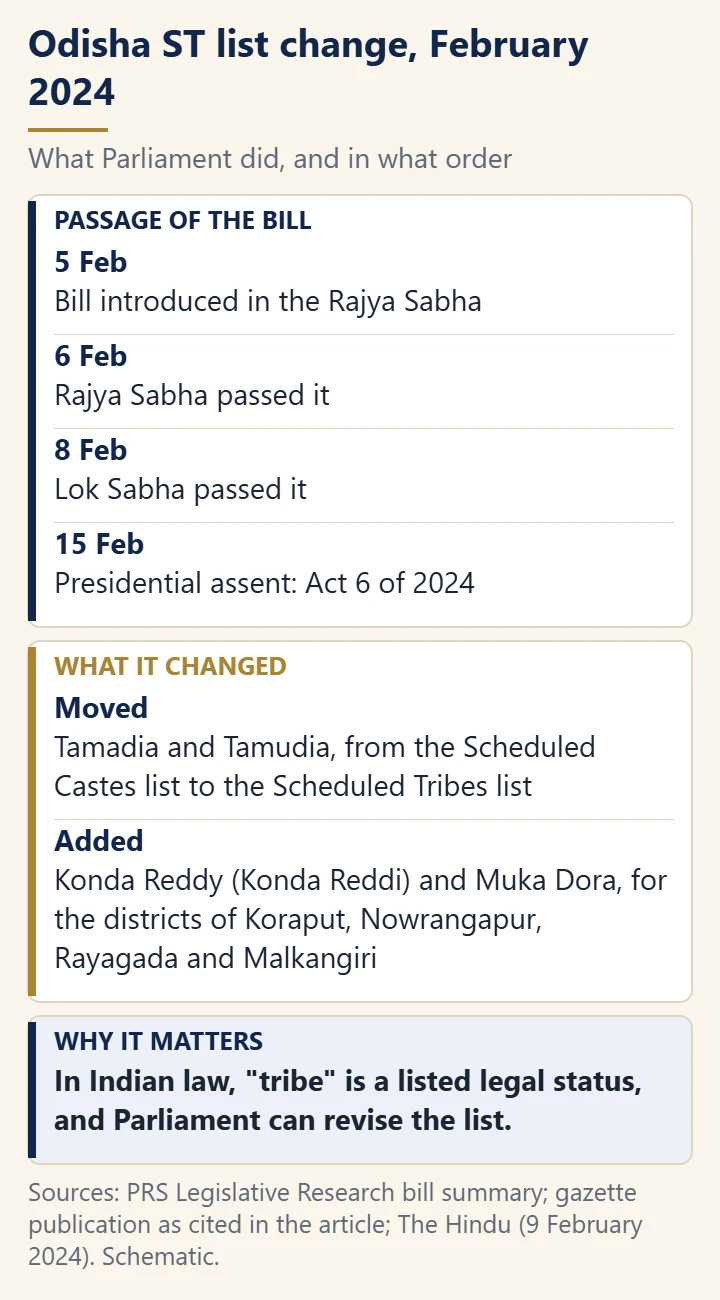
Ministers introduced the Constitution (Scheduled Castes and Scheduled Tribes) Orders (Amendment) Bill, 2024 in the Rajya Sabha on 5 February 2024. The Rajya Sabha passed it on 6 February and the Lok Sabha on 8 February. The Act (Act 6 of 2024) received the President’s assent on 15 February 2024, according to the gazette publication. It amends the Constitution (Scheduled Castes) Order, 1950 and the Constitution (Scheduled Tribes) Order, 1950 for Odisha.

According to PRS, the Bill removes the Tamadia and Tamudia communities from the Scheduled Castes list in Odisha and adds them to the Scheduled Tribes list. The bill text records them as variants under the Bhumij entry. In addition, the Bill adds the Konda Reddy (Konda Reddi). It also adds the Muka Dora, with spelling variants, for the districts of Koraput, Nowrangapur, Rayagada and Malkangiri. Finally, it adds synonyms or phonetic variants for some other communities.
What could not be verified
The Hindu report said that the move would bring relief to as many as 50 sub-tribes. The figure was not supported by the bill material and PRS summary reviewed, so it is omitted; the full gazette text was not independently checked. The reasonable reading is narrower. The Act changes the status of specific named communities and adds spelling variants for others. How the Odisha government has implemented the revised list is not confirmed here.
The inter-state problem
Anthropologist A.B. Ota highlighted the problem of inconsistent recognition across states. The Konda Reddy are a Scheduled Tribe in Andhra Pradesh, yet Odisha treated them as a Socially and Educationally Backward Class in the Malkangiri district. In the same way, the Muka Dora are tribal in Andhra Pradesh but did not appear in Odisha’s ST list. As a result, such gaps deprived groups of benefits according to state boundaries and not social reality. Ota described the inclusion as long overdue. He argued for periodic review of tribal classifications.
Legal basis and the anthropological test
Under Article 342, the President specifies the Scheduled Tribes for each state after consulting the Governor. Only Parliament can include or exclude a community by law. That is why the Odisha change needed legislation. Being listed is a legal status that follows administrative criteria. Traditionally these are the Lokur Committee (1965) criteria: primitive traits, distinctive culture, geographical isolation, shyness of contact and backwardness. Anthropologically, however, tribal identity rests on shared culture, ecology, livelihood patterns and social organisation, and not just on an administrative label.
Therefore ethnographic evidence of cultural continuity matters in a petition but does not by itself settle it. Likewise, the same community can be a Scheduled Tribe in one state and not in another.
Using it in UPSC Mains
Paper 2, clause 7.1 covers problems of exploitation and deprivation of Scheduled Castes, Scheduled Tribes and Other Backward Classes, and the constitutional safeguards for them. The safeguards operate only for communities on the list. This case shows the list itself being revised. So use it when an answer asks who qualifies as a tribe and how the tribe-caste boundary is administered.
The closest PYQs are the concept of Scheduled Tribe and administrators’ criteria (2025, Paper 2) and tribe and Scheduled Tribe (2018, Paper 2). For the tribe-caste continuum, see the significance of the tribe-caste continuum (2018, Paper 2). Browse tribal development policy and safeguards for more. Related reading: the Dongria Kondh and Niyamgiri, the Great Nicobar project and the full optional guide.
Sources
PRS Legislative Research, bill tracker; Gazette of India (Ministry of Law and Justice); LiveLaw on passage; The Hindu (9 February 2024), cited from the earlier version of this article.