
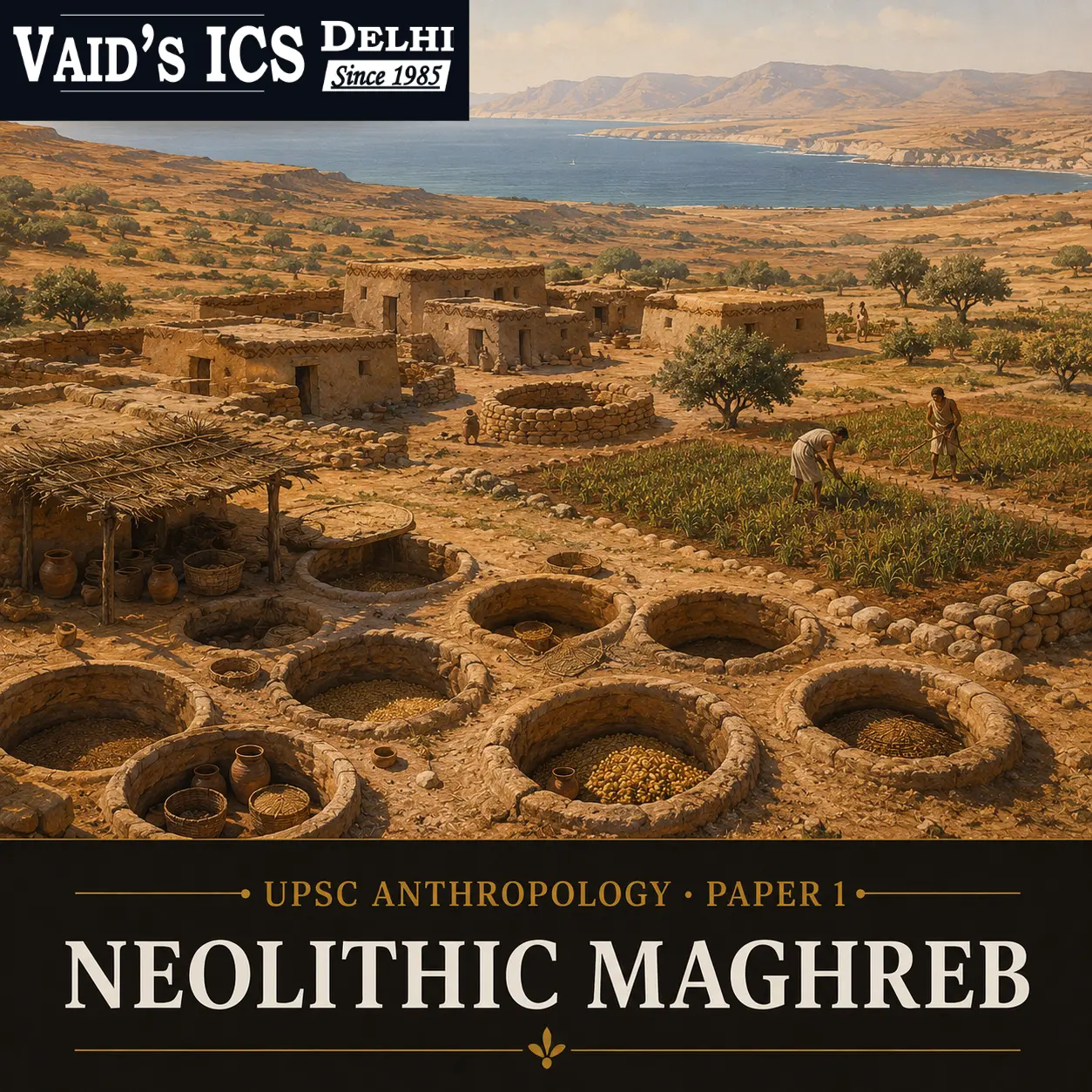
Source: phys.org | 23 September 2024 (Broodbank et al., Antiquity).
The discovery of a Neolithic society in Morocco is reshaping how anthropologists understand the spread of farming and the role of northwest Africa in Mediterranean prehistory. For UPSC Anthropology Paper 1, it is a fresh, examinable case study on the Neolithic transition and the principles of prehistoric archaeology.
Why this matters: a newly found African farming society reshapes the Neolithic story beyond the Near East and Europe — fresh Paper 1 case study.
Syllabus relevance: Anthropology Paper 1 — Neolithic culture, the Neolithic transition and principles of prehistoric archaeology.
Best use in answers: use Oued Beht (Morocco) as a recent example challenging Eurocentric models of the Neolithic and showing Mediterranean interaction.
The discovery
Archaeological fieldwork at Oued Beht, on Morocco’s Zemmour plateau, has uncovered a previously unknown farming society dated to roughly 3400–2900 BC — the earliest and largest known agricultural complex in Africa beyond the Nile. Reported by Broodbank, Bokbot, Lucarini et al. in the journal Antiquity (2024), the findings extend the story of early agriculture beyond the traditionally emphasised Near East and Europe. (The community sits at the Neolithic–Copper Age transition; older coverage often labels it simply “Neolithic.”)

Filling a major archaeological gap
The research addresses a long-standing gap in the archaeology of the Maghreb between roughly 4000 and 1000 BC — a period of major Mediterranean transformation involving the spread of farming, trade networks and increasingly complex social organisation. Until now the Maghreb’s role in this phase was underexplored.
Evidence of a farming society
Excavated sites reveal storage pits and settlement features indicating sedentary or semi-sedentary life — pointing to a Neolithic economy based on farming rather than purely hunting and gathering.
Connections across the Mediterranean
A key finding is the identification of contemporaneous sites in Iberia, across the Strait of Gibraltar, with similar pit structures. Iberian finds such as ivory and ostrich eggs had already hinted at African connections; the Moroccan evidence strengthens the case for regular interaction between northwest Africa and southern Europe in the fourth millennium BC.
Re-evaluating the role of the Maghreb
The Maghreb was not a peripheral zone but an active participant in western Mediterranean developments, with cultural exchange, technological diffusion and economic interaction flowing both ways across the sea.
Anthropological significance
From the standpoint of prehistoric archaeology, the discovery challenges Eurocentric models of Neolithic development, reinforces the value of regional studies, and shows how farming, trade and interaction networks built social complexity. It underlines the need to integrate African archaeological data into broader Mediterranean narratives.
Why this matters for UPSC Anthropology
Useful for Paper 1 questions on the Neolithic and on archaeological method — map it to the Paper 1 archaeology syllabus, and read it alongside our note on the world’s oldest cave paintings to build an archaeology current-affairs cluster. See the complete optional guide for answer strategy.
Use in Answer Writing
Syllabus topic: Neolithic culture & prehistoric archaeology (Paper 1).
Key concepts to apply: Oued Beht farming society (~3400-2900 BC); storage pits; Maghreb–Iberia interaction across the Strait of Gibraltar.
How to use it in answers: cite as a 2024 Antiquity discovery to argue regional diversity in Neolithic development and cross-Mediterranean exchange.
Previous Year Questions — UPSC Anthropology
- Neolithic revolution: causes and consequences. (20 Marks, 2016)
- Describe the characteristic features of Neolithic culture. (15 Marks, 2018)
- Discuss the Neolithic cultures of the Old World. (20 Marks, 2019)
Read this with
FAQ
Why is the Morocco Neolithic discovery significant?
It fills a gap in Maghreb prehistory and shows northwest Africa was an active participant in Mediterranean developments.
What evidence shows it was a farming society?
Storage pits and settlement features indicating sedentary or semi-sedentary life.
How is it relevant to UPSC?
Paper 1 — the Neolithic transition and principles of prehistoric archaeology.
Preparing Anthropology Optional for UPSC?
Build strong Paper 1 archaeology answers with VAID SIR’s Anthropology programme at VAID’S ICS. Explore the Anthropology Optional programme →
VAID’S ICS has mentored Anthropology-optional rankers across years, including AIR 3 (2023) and AIR 1 (2020). See the full results.
Sources
- Broodbank, Bokbot, Lucarini et al., “Oued Beht, Morocco: a complex early farming society in north-west Africa…,” Antiquity (2024): cambridge.org / Antiquity
- University of Cambridge news release (2024): cam.ac.uk