
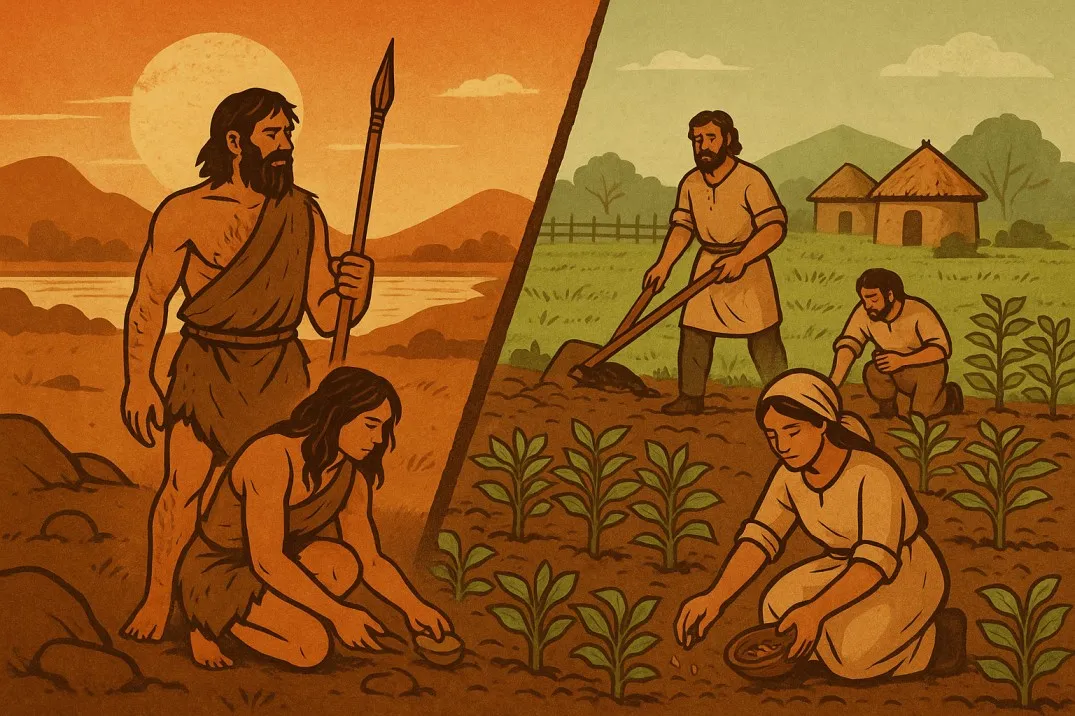
The usual question about the Neolithic is why people took up farming. A 2025 PNAS study asks a different one: what happened when farmers and the hunter-gatherers already living in a region met? Instead, it treats the spread of farming as a contest and exchange between two populations. For Optional Paper I, it is a good case of demography and interaction sitting beside the climate-and-resources explanations.
Source: Alfredo Cortell-Nicolau et al., “Demographic interactions between the last hunter-gatherers and the first farmers”, PNAS 122(14), 31 March 2025.
What the study did
The authors built a two-population mathematical model in which farmers and foragers compete and interact in the same space. Models of this kind come from ecology, where they describe predators and prey. Next, the team fitted the model to population trends inferred from radiocarbon dates in three regions: Denmark, eastern Iberia and the island of Kyushu in Japan.

Overall, the central result is a caution rather than a verdict. Interaction between the two groups alone can produce the rises and falls in population seen in the archaeological record. Such swings should be tested against this internal explanation before they are blamed on an outside force such as climate change.
What it does not say
First, the paper is about how farming spread, not about where or why it was first invented. Second, it does not claim that climate played no part. Its own authors describe the three regions as illustrations of the model, not as the full range of farmer and forager contact. However, some popular summaries turn it into “social factors beat the environment”, and that goes further than the evidence.
Using it in UPSC Mains
Use the study as a counterweight in an answer on food production. Begin with the standard explanations: post-glacial climate change, the Oasis model, the Hilly Flanks view and population pressure. Then add that recent work asks how incoming farmers and local foragers affected each other’s numbers, and that this can explain population swings without a separate climatic cause. Finally, note the limits: a theoretical model, three regions, and radiocarbon dates standing in for population.
The PYQ route is Theories on the Origin of Food Production (2025, Paper I). Further questions on the same theme sit under Prehistoric Archaeology PYQs. For a regional case of farming linking distant communities, read the Neolithic society at Oued Beht in Morocco. The wider syllabus map is in the Anthropology Optional complete guide.
Sources
Cortell-Nicolau et al. (2025), PNAS 122(14), DOI 10.1073/pnas.2416221122 (abstract read via the UCL Discovery open-access record); Archaeology News Online Magazine summary (1 April 2025).