
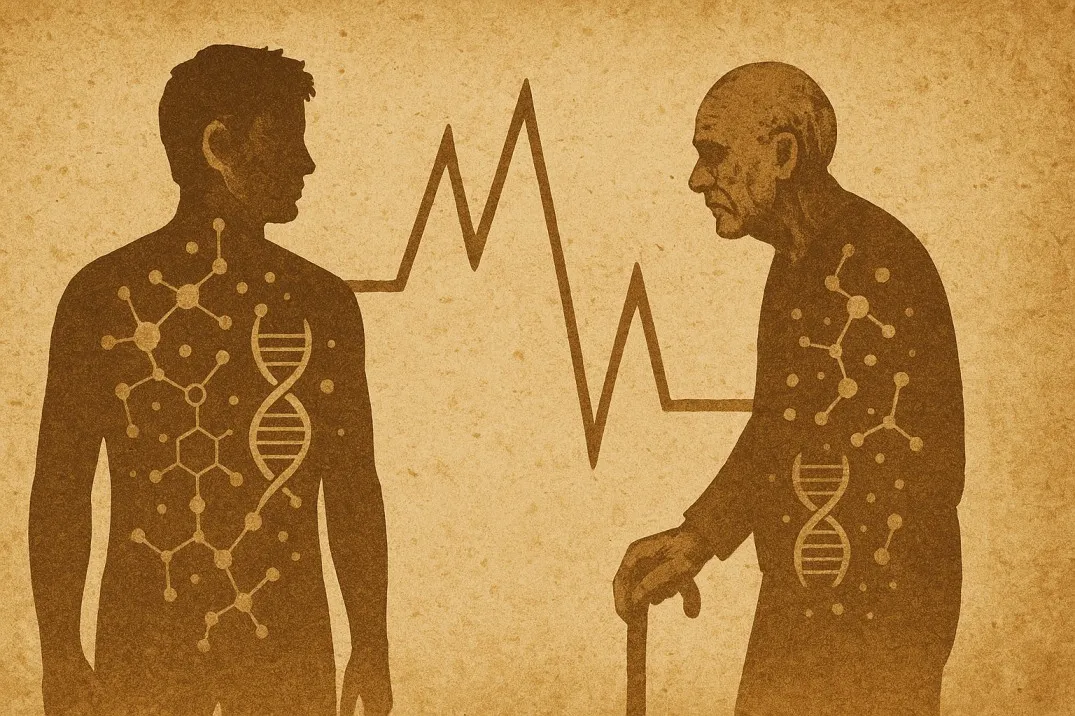
Does ageing proceed at a steady pace? A 2024 Stanford study says no: it reports that molecular change clusters around two ages, about 44 and about 60. The idea is striking. However, later critics question the statistics behind the peaks, so a good answer should hold both points.
Source: Shen, Snyder and colleagues, “Nonlinear dynamics of multi-omics profiles during human aging”, Nature Aging (August 2024). Evidence level: paper record, journal summaries and news coverage (GenomeWeb for the critique). The full text was not independently reviewed.
Who was followed and what was measured
The study followed 108 adults aged 25 to 75 in California, with a median follow-up of 1.7 years and a maximum of 6.8 years. The team tracked more than 135,000 molecular features, including RNA, proteins, lipids and microbiome taxa. The authors report that a large share of the molecules, 81% in coverage of the paper, changed in a nonlinear way. They also report that changes clustered around two ages.

Because the team sampled people over a short span, it inferred the “peaks” by lining up many individuals of different ages. Nobody watched a single person age from 40 to 60. The cohort is also small, and the researchers acknowledge it.
Peak one: the mid-40s
Around age 44, the reported changes involve lipid metabolism, caffeine and alcohol metabolism, cardiovascular health, and early signs in skin and muscle. Menopause may explain part of the pattern in women. Yet similar changes appeared in men, which points to broader factors. Co-author Xiaotao Shen (Nanyang Technological University, Singapore) put it this way: menopause may contribute in women, but “there are likely other, more significant factors” in both sexes.
Peak two: the early 60s
Around age 60, the changes involve carbohydrate and caffeine metabolism, cardiovascular disease risk, immune regulation, and skin, muscle and kidney function. Thus this second wave appears to reflect a shift across several organ systems as the body enters older age.
The dispute you should know
A later preprint argued that two statistical methods behind such peaks, LOESS smoothing and the DE-SWAN procedure, can produce similar peaks from noise. However, the critic did not dispute that ageing is nonlinear in general. Snyder replied that the nonlinear part is right, even if a technical issue produced the exact ages of the peaks. So treat 44 and 60 as markers of when changes cluster. They are not fixed biological deadlines for every person or population.
Using it in UPSC Mains
Paper I, clause 10 covers ageing and senescence, with theories and observations on biological and chronological longevity. Biological ageing here means molecular and physiological change, and it differs from chronological age. This study is a current observation to set beside the classical theories. Moreover, the nonlinear, two-step pattern argues against one smooth ageing curve. That is a good point of critique when an answer asks how ageing should be measured.
The closest PYQs are senescence (2020, Paper 1) and ageing and senescence (2014, Paper 1). The human genetics and human biology topic page has more. Related reading: human biological adaptation and the full optional guide.
Sources
Shen et al., Nature Aging (2024), PubMed Central record; GenomeWeb report on the critique; Fight Aging! summary.