
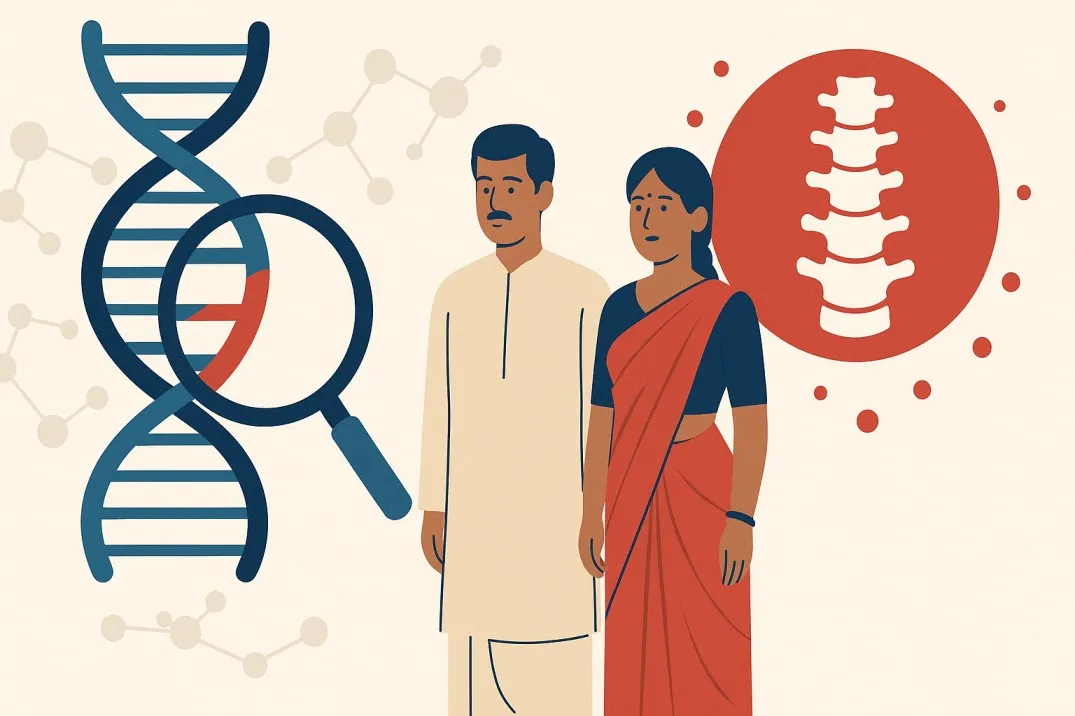
Why do some families in India carry a spinal disease far more often than others? A 2025 study from CSIR-CCMB points to marriage rules. When a community marries only within itself for many generations, a harmful variant can become common simply by being inherited again and again. This is a standard example for the Anthropology Optional, because it links a social institution to a measurable genetic outcome.
Source: Machha et al., Journal of Genetics and Genomics (February 2025), article page on ScienceDirect (pii S1673852725000384). Evidence level: institutional release (CSIR news item) and press reports. Source basis: CSIR news release and press report; the full paper was not independently reviewed.
What the study actually did
Ankylosing spondylitis is a chronic inflammatory disease of the spinal joints. It causes pain and stiffness, and in severe cases the spine can fuse progressively.

The team sequenced 281 high-coverage exomes from four anthropologically distinct South Indian populations. Press reports name them as Kalinga, Kallar, Reddy and Yadav. The aim was to measure the extent of inbreeding, to find novel variants, and to note pharmacogenomic markers, such as those that affect responses to tacrolimus and warfarin.
The CSIR release also links ankylosing spondylitis (AS) to the HLA-B*27:04 risk allele. It adds that Reddys of a specific region of Andhra Pradesh show a high rate of AS. Dr Kumarasamy Thangaraj, a lead scientist on the work, names endogamy as the primary cause of such population-specific diseases.
The numbers: what is solid and what is not
You will see “13 percent of Reddy individuals carry HLA-B*27:04” in many notes. That figure appears in press coverage, but the CSIR release does not carry it. So I treat it as a press-reported number and have not checked it against the paper. The South First (6 March 2025) quotes hospital records, which are also press-level evidence. They list about 140 Reddy patients among 2,963 AS cases at KIMS, and 40 of those 140 came from the specific region.
In an answer, attribute such figures to the report that gave them. Careful framing earns more marks than a borrowed percentage.
Endogamy, drift and the founder effect
Endogamy restricts the gene pool. Consequently, alleles that were present in a small founding group are passed on with little dilution. Even a harmful allele can rise in frequency through genetic drift and the founder effect. This is the authors’ interpretation of their data, and it fits what population genetics predicts.
It also helps to separate two ideas. HLA-B*27 is a risk factor, not a guarantee of disease. Many carriers never develop AS. Moreover, a higher disease rate in one community describes a genetic history and does not describe a “weaker” group.
Why it matters for health and policy
The study highlights the hidden health risks of long-term endogamy, especially where marriage outside the group is discouraged. Thangaraj calls for screening and counselling in such populations. In the same spirit, knowing which communities carry a known predisposition lets preventive measures and early intervention be targeted, which is the idea behind personalised healthcare.
The balanced conclusion is that cultural practices such as endogamous marriage shape the genetic landscape of a community over generations. Communities value these traditions, so the anthropological task is to explain their biological consequences without judging the people who follow them.
Using it in UPSC Mains
Use this case when a question asks how social institutions shape biological variation. Start with the marriage rule, then move to the founder effect and drift, and then close with screening and counselling as the applied response. Compare it with the full optional guide and with India’s genetic diversity, where founder events and consanguinity raise recessive-disease risk.
For related practice (these fit the endogamy argument and neither concerns disease), see the PYQs on genetic drift (2020, Paper 1) and marriage regulations and social solidarity (2023, Paper 1). Browse the topic pages for human genetics and marriage and family.
Sources
Machha et al., Journal of Genetics and Genomics (2025); CSIR news release on the CCMB exome study (read in full); The South First, 6 March 2025.
1 thought on “Endogamy and Genetic Risk: Why Reddys Face Higher Incidence of Ankylosing Spondylitis”
Comments are closed.