
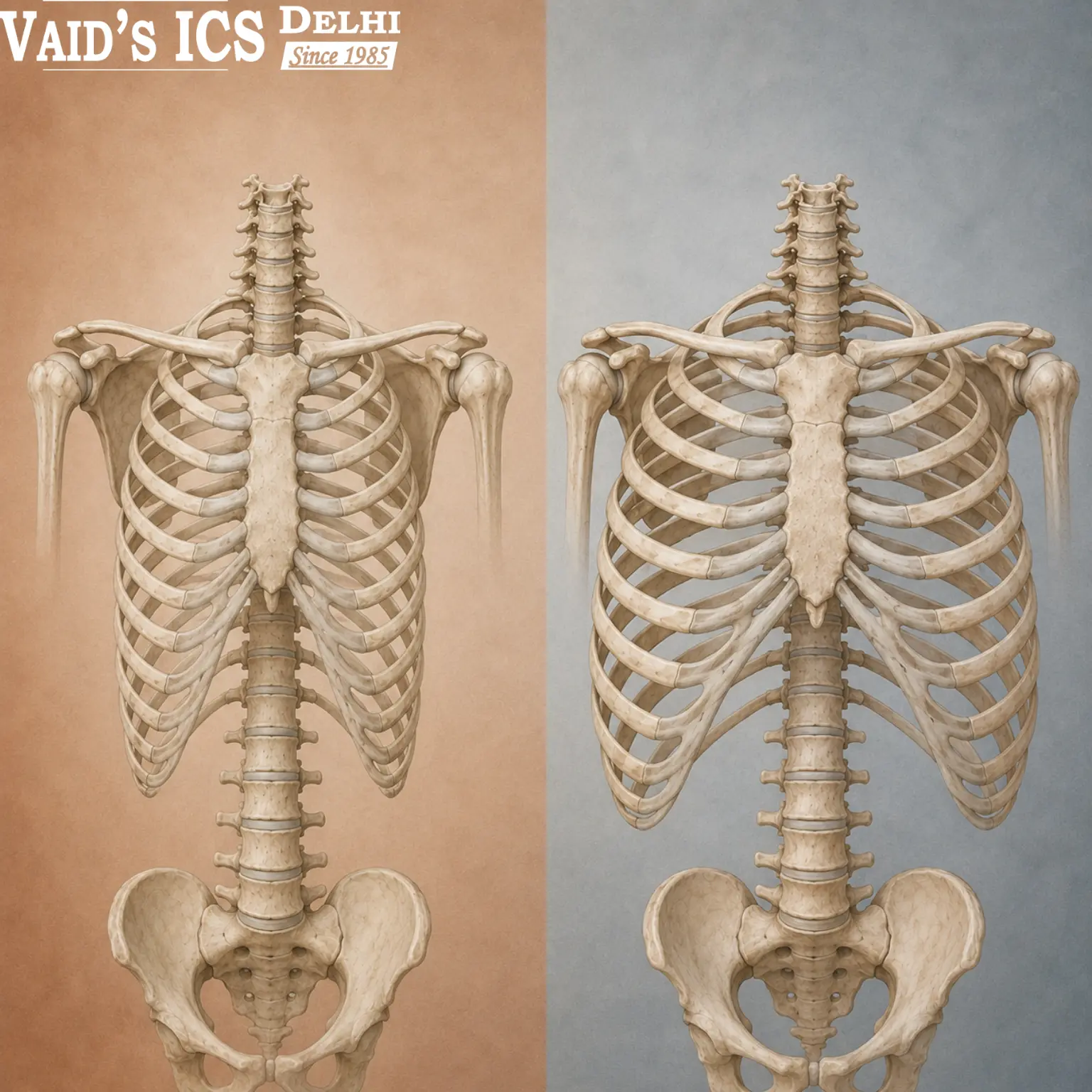
Human ribcage climate adaptation shows how environment can shape the human body. A 2025 study of early modern human skeletons (López-Rey et al., Communications Biology) finds that the shape of the chest tends to follow climate, in a way that echoes classic ecological rules.
Source: José M. López-Rey et al., Communications Biology, 10 July 2025.
Three Early Modern Humans, Three Climates
Warmer climates
Nazlet Khater 2 (Egypt)
Ohalo II H2 (Israel)
The article discusses a narrower-ribcage tendency in warmer climates overall, without assigning that pattern separately to either fossil.
Colder climate
Dolní Věstonice 13 (Czech Republic)
Its ribcage is described in the article as nearly as large as a Neanderthal’s.
This is a small fossil sample. Climate and ancestry can both influence body form.
What the study looked at
The researchers reconstructed the ribcages of four fossil Homo sapiens: Nazlet Khater 2 (Egypt, about 38,000 years ago, give or take 6,000), Ohalo II H2 (Israel, about 23,000 years ago), Dolní Věstonice 13 (Czech Republic, about 30,000 years ago) and Ötzi, the Alpine Iceman. Using geometric morphometrics, a method that compares shapes mathematically, they set these against 59 recent humans and three other Homo fossils: the Nariokotome Boy, Kebara 2 and Shanidar 3. The ribcage matters because it houses the lungs and heart and is tied to breathing and heat balance.

The climate pattern
The fossil ribcages show the globular proportions typical of recent humans. Size and shape also appear to depend on climate. Smaller, cylindrical ribcages occur in warmer and more temperate settings (Nazlet Khater 2 and Ohalo II H2), while a larger, broader one occurs in a colder setting (Dolní Věstonice 13). The paper describes the Czech ribcage as almost as large as that of Neanderthals, but relatively wider. Ötzi shows mixed features, which the authors suggest could have suited seasonal alpine transhumance. Earlier research had proposed that stockier, bigger ribcages help retain heat in the cold.
The study shows chest shape, and not the lungs themselves. Breathing efficiency, heat loss and body proportions are inferred from bone, so the link between shape and function is partly reasoned from living people.
Link to ecological rules
Bergmann’s rule predicts larger bodies in colder regions, because less surface area per unit of volume reduces heat loss. Allen’s rule predicts shorter limbs and more compact bodies in the cold. Ribcage shape extends this logic from limbs and overall size to the trunk. Humans are one species, but populations living in different climates for long periods show these tendencies as trends, not strict laws.
Caution
The fossil sample is small, and climate is not the only influence. Ancestry, body size and sex also affect ribcage shape. Do not present the pattern as a rule that predicts any individual.
The comparison also shows that the slender chest of many living people is not the only modern form. The authors conclude that Homo sapiens ribcage shape covers both slender and stockier forms, so human anatomical variation may be more context-dependent than once assumed. Recent work on the Nariokotome Boy suggests that the slender thorax of modern humans is a derived condition, meaning it appeared later in evolution.
Adaptation or inheritance?
Two explanations compete. Natural selection may have favoured certain chest shapes in certain climates. Or populations may carry shapes inherited from earlier ancestors who lived in similar places. The study supports a climate link but cannot fully separate the two. Mention both when writing the answer, and add that skeletal form reflects long-term genetic adaptation and not short-term physiological change.
Why it matters in anthropology
The finding adds a skeletal example to the standard list of human variation and adaptation. It also shows how modern humans moving into new regions faced the same pressures as Neanderthals, who are known for broad chests in cold Europe. This links human biological variation to the broader theme of adaptation to climate.
Using it in UPSC Mains
A short answer on human adaptation can run in three steps: state Bergmann and Allen, give the ribcage case, then note the limits. Keeping the limits in the answer shows balanced reasoning.
Use this under Paper I, clause 9.7, which covers biological and cultural responses to hot desert, cold and high-altitude environments. State the rule, give the ribcage example, and then add the caution about sample size.
Practise with the PYQs Allen’s Rule and Bergmann’s Rule in Human Populations (2018) and Biocultural Responses to Extreme Climatic Events (2020). More are in the Human Evolution and Primatology PYQs. For another adaptation case, read Humans evolving on the Tibetan Plateau. For the full syllabus and answer-writing plan, see the Anthropology Optional complete guide.