
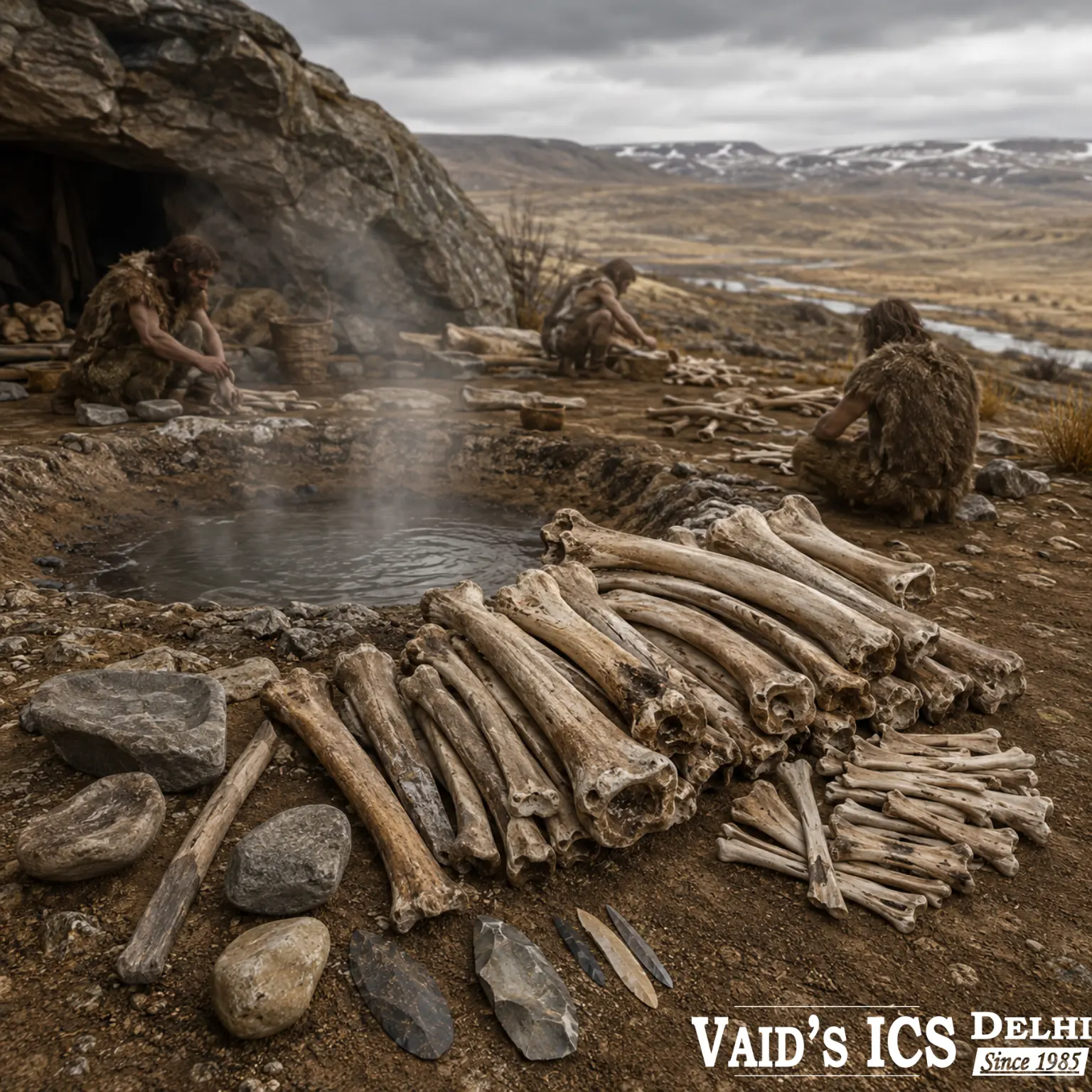
Neanderthal resource management is the theme of a 2025 study of Neumark-Nord 2 in Germany, a lakeside site about 125,000 years old. The excavators, led by Lutz Kindler and publishing in Science Advances, argue that Neanderthals here crushed large quantities of animal bones to extract fat, and that this required planning. Researchers have nicknamed the site a “fat factory”.
Source: Kindler et al., Science Advances, 2025.
What was found
The deposits contain the remains of many large animals, including the biggest herbivores of the time. People deliberately smashed the bones into small pieces. Cut marks and damage patterns show that people, not carnivores, did the work. Fat sits inside bone, especially in spongy ends, and escapes when people break and boil the bone.

The sample is large. The authors report remains from at least 172 large mammals and tens of thousands of fragments, which suggests repeated activity over time and not a single feast.
How the grease was probably made
The authors propose that people heated the fragments in water for a long time, so the fat floated to the surface and they could skim it off. Bone grease is rich in calories and useful in lean seasons. Processing it takes effort and time, which is why the amount of debris matters.
Why would anyone bother? Fat is a vital energy source, and lean meat alone can be a poor diet, especially in cold or seasonal environments. Bone grease provides concentrated calories.
Planning and foresight
The study suggests that the bones were not always processed right after the hunt. People appear to have stored some bones for a while and worked them later, while the fat was still recoverable. If that reading is right, it indicates caching, delayed use and a dedicated working area. These are signs of foresight, a trait once credited mainly to modern humans. Anthropologists often link planning depth to cognitive complexity, so the claim carries weight beyond one site.
Evidence and inference
The bone damage, fragment counts and species list are observations. Caching, planning and a deliberate “factory” are the authors reading of that pattern, and other explanations remain possible.
Treat the planning claim as a hypothesis with good support, not a certainty. Dating, taphonomy and the identity of the butchers all limit how firmly we can state it.
Why it matters in anthropology
Earlier views treated Neanderthals as opportunistic hunters with simple subsistence. This case points to organised resource management and a division of tasks around a processing area. It supports a wider shift towards seeing Neanderthal behaviour as flexible and planned, alongside evidence of care, burial and tool-making. It does not show that Neanderthals matched modern humans in every cognitive way.
A fair answer also notes that the site is one case from a warm period in northern Europe, where large game was abundant. Other regions and colder phases may show different patterns.
Using it in UPSC Mains
In an answer, build the case in three steps: what the team found, what the authors infer, and what remains uncertain. That order shows an examiner that you can separate data from interpretation.
This fits Paper I, Section 1.6(c) on Neanderthal man, and it supports answers on subsistence and behavioural complexity. No PYQ asks directly about fat processing, so use it as an example inside a broader question on Neanderthal behaviour.
The nearest practice questions are Classic and Progressive Neanderthals (2022) and Neanderthals and the African Origin of Humankind (2019). See also the Human Evolution and Primatology PYQs and Neanderthal care for a child with Down syndrome. For the full syllabus and answer-writing plan, see the Anthropology Optional complete guide.
Sources
Kindler et al., Neumark-Nord 2 bone grease processing, Science Advances (2025).