
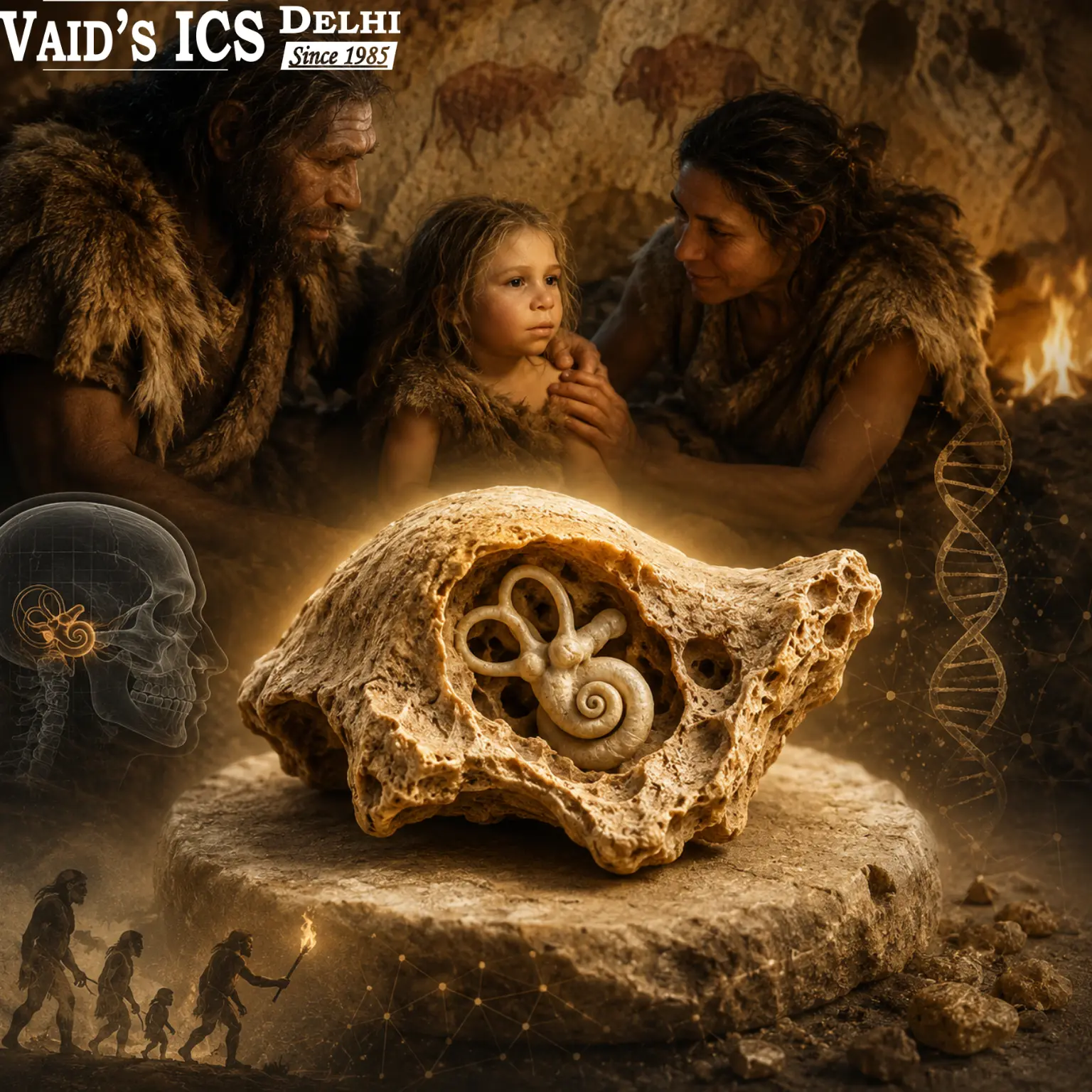
Neanderthal caregiving is one of the most discussed social behaviours in human evolution. A 2024 study in Science Advances (Conde-Valverde et al.) argues that a Neanderthal child from Spain, nicknamed Tina, had a condition consistent with Down syndrome and survived to at least six years of age. The authors read that survival as evidence of care.
Source: Conde-Valverde et al., Science Advances, 26 June 2024.
At a glance
Fossil: a temporal bone, which holds the inner ear. Site: Cova Negra, Xàtiva, Valencia. Claim: inner-ear anomalies consistent with Down syndrome, and survival beyond early childhood.

The fossil and the site
The bone was excavated at Cova Negra in 1989 but lay mixed with animal remains, and researchers identified it as a Neanderthal child only recently. The authors report it as the first known case of Down syndrome in a Neanderthal. Neanderthal remains at the cave fall between roughly 273,000 and 146,000 years ago. The temporal bone is the dense part of the skull that surrounds the inner ear, so it preserves well and can be scanned in detail.
Cova Negra has long been known for Neanderthal fossils and Mousterian stone tools, so the find fits a well-studied setting. What is new is the re-examination of an old collection with modern scanning, a pattern that is common in recent palaeoanthropology.
What the scans showed
CT scans revealed unusual features in the inner ear, including the semicircular canals that help with balance and the cochlea used for hearing. The researchers compared these with Neanderthals, modern humans and known cases of Down syndrome. They concluded that the combination fits Down syndrome and probably caused balance problems and hearing loss.
The child lived to at least about six years. A child with such difficulties would have needed more help than usual, so the authors suggest that others in the group supported her. That likely meant other members helping the mother with childcare. Because a six-year-old with a challenging condition could give little in return, the authors read the helpers as altruistic.
Evidence and inference
The measurable evidence is the anatomy of one small bone and the child’s estimated age at death. Everything about care is inference. It is a reasonable one, since survival without help seems unlikely, but a single specimen cannot show how often or how widely such care occurred. Down syndrome is also diagnosed here from skeletal clues, not from DNA.
Avoid wording such as “proved that Neanderthals were compassionate”. A safer line is that the evidence is consistent with social support and altruism in the group.
Why it matters in anthropology
Think of the argument as a chain. A diagnosis, a long survival, and a likely need for help lead to the idea of group care. Each link is plausible, and the chain is only as strong as its weakest link, which here is the diagnosis from one bone.
Older images of Neanderthals stressed brutality. Care for the injured or disabled, together with deliberate burial and ornament use, points to a richer social life. This is part of a long-running debate on how similar Neanderthal and modern human cognition were. The Cova Negra case adds a developmental disorder to the earlier examples of injured adults who survived for years.
Using it in UPSC Mains
This sits within Paper I, Section 1.6(c) on Neanderthal man. There is no PYQ that asks directly about caregiving, so use the study as an example in answers on Neanderthal behaviour and culture. A good answer pairs it with burial and tool evidence and notes the limits of a single specimen.
For practice, the closest questions are Classic and Progressive Neanderthals (2022) and Neanderthals and the African Origin of Humankind (2019), which concern Neanderthals more broadly. Find more in the Human Evolution and Primatology PYQs. For another view of Neanderthal behaviour, read the Neanderthal fat factory post. The Anthropology Optional complete guide shows where this topic sits in the full syllabus.