
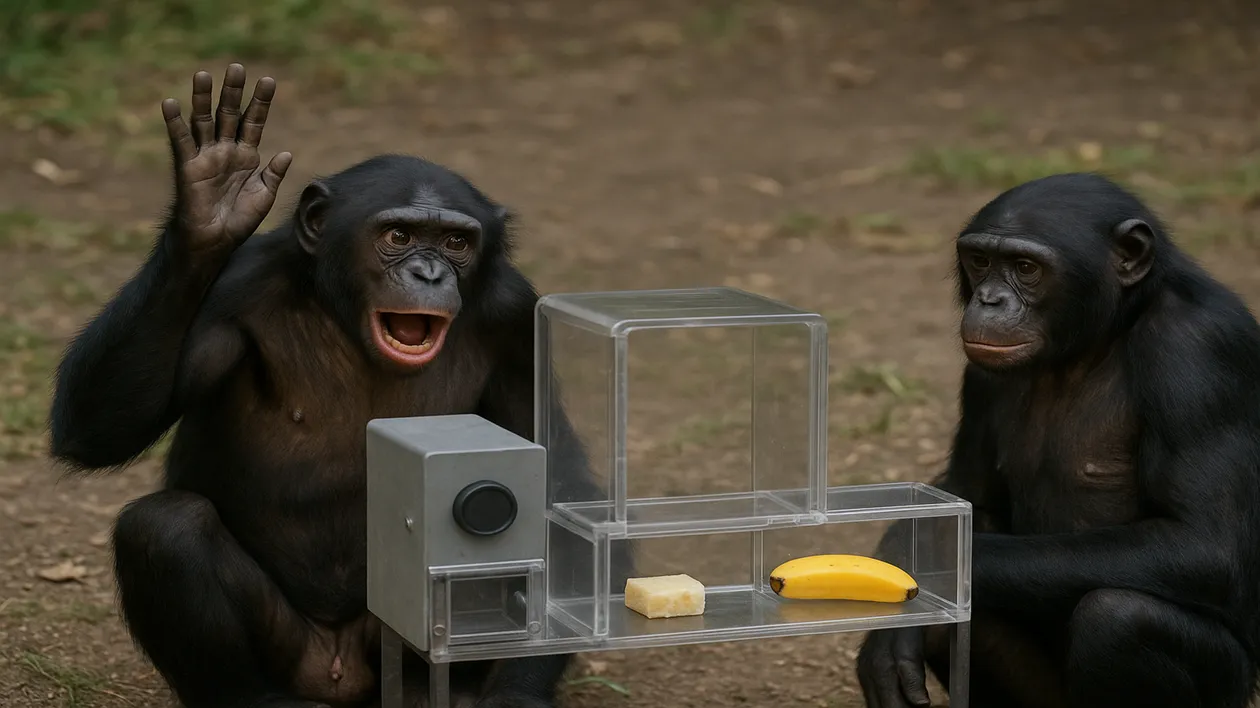
Inequity aversion in primates is the tendency to react badly to an unfair deal. It is one of the most debated windows onto the evolution of fairness. A 2025 study of bonobos adds evidence that our close relatives notice unequal outcomes, with some careful limits. For Paper I it is a precise example of primate cognition and cooperation.
Source: Kia Radovanović, Edwin van Leeuwen et al., "Bonobos respond aversively to unequal reward distributions," Proceedings of the Royal Society B (April 2025).
What the study did
The researchers worked with six bonobos at the Wolfgang Köhler Primate Research Center in Leipzig. The researchers ran two studies using two established set-ups: a token-exchange task and a social-disappointment task. In the exchange task, a bonobo trades a token for food. A partner may receive a better reward for the same effort. In both studies, disadvantaged bonobos refused to take part more often. That counts as an aversive response to inequity.

Why the control matters
The control is the clever part. In chimpanzees, social disappointment can sometimes explain refusals: the animal is frustrated with the person handing out rewards, not with the unequal split itself. In the bonobos, social disappointment could not account for the aversive response, so it looks more like a reaction to the unequal outcome. The authors are cautious, though, and note that the second study fitted the inequity-aversion explanation only partially.
Concept: inequity aversion
A negative response to unequal outcomes. The 2003 capuchin experiment by Brosnan and de Waal showed it vividly. A monkey rejected a cucumber slice after seeing a partner paid in grapes for the same task.
Who the partner was
A summary from the Max Planck Institute adds that bonobos tolerated inequity more when the partner was a close associate. This pattern resembles human behaviour. This is a useful nuance for an answer: relationships shape fairness reactions, so bonobos do not apply them identically to everyone.
A note on earlier reporting
Some early summaries said bonobos refused "most when a machine was involved." The published study says something different. Bonobos responded aversively to unequal distributions. Unlike chimpanzees, they did so for more than disappointment with a human partner. Use that version.
Why it matters for anthropology
A sensitivity to fairness may have roots shared with bonobos. If so, human ideas of justice may rest on an older cognitive base. That supports a cautious evolutionary argument about cooperation and morality. It does not show that bonobos have a moral code. It also tests only one direction of unfairness, being short-changed oneself, not guilt or concern when others receive less.
Using it in UPSC Mains
Use it under Paper I, Section 1.5, where the syllabus lists primate behaviour. Pair it with the capuchin study to argue that fairness and cooperation have primate roots, then state the limits: six animals, one research centre, and a measure based on refusals.
The nearest exam question is Forms of Primate Social Organisation (2022), though fairness is only one facet of it. More questions are in the Human Evolution and Primatology PYQs. For related reading, see Why primates people-watch and Chimpanzees, fermented fruit and food sharing. Place this topic in a complete revision plan with the Anthropology Optional complete guide.
Sources
Max Planck Society, Bonobos react negatively to inequity (summary). Brosnan, S. F. and de Waal, F. B. M. (2003), Nature.