
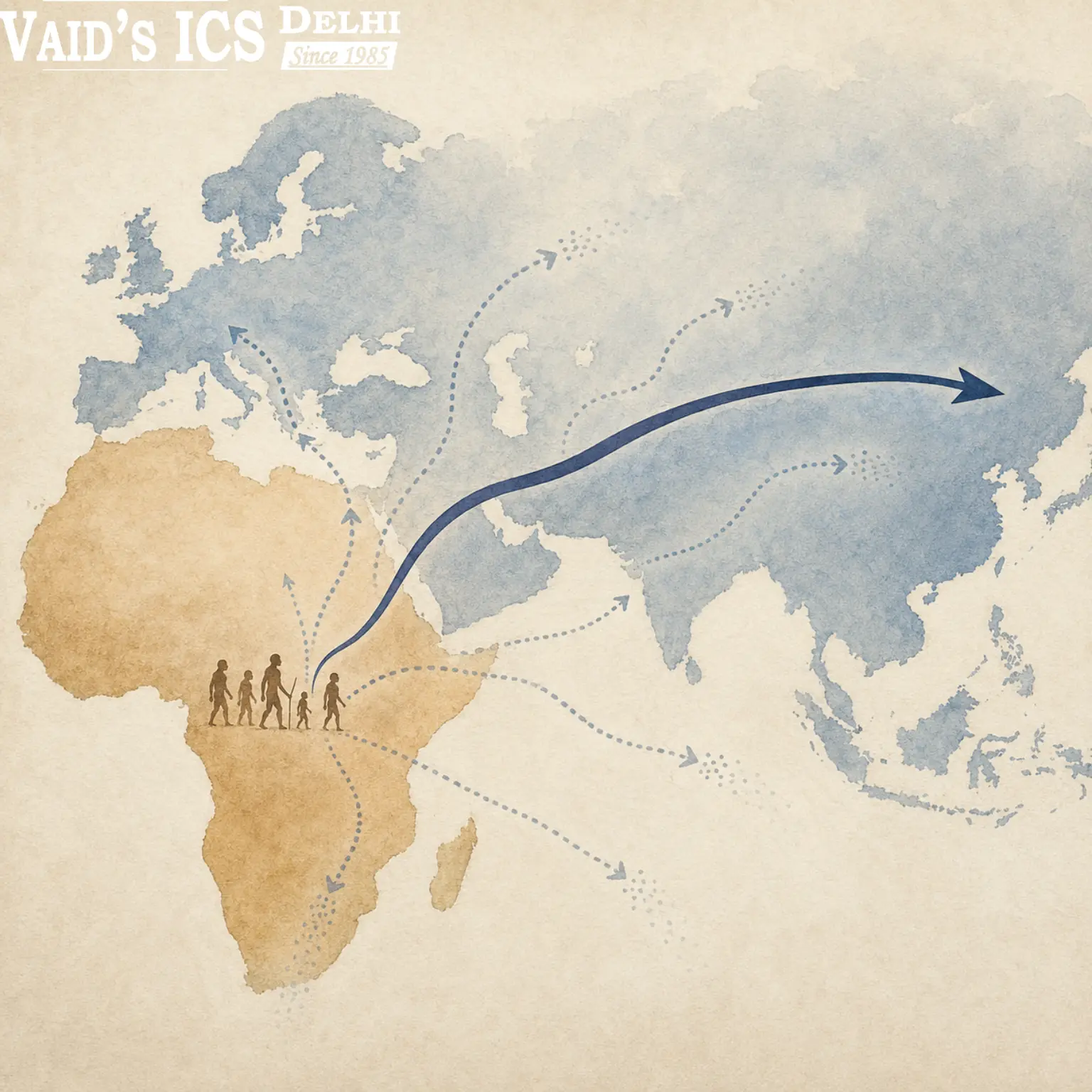
The out of Africa dispersal of modern humans was not one clean departure. Several earlier movements left little lasting trace, while one later wave spread across the world. A 2025 Nature study by Hallett, Scerri, Manica and colleagues argues that the difference lay less in tools or genes than in how flexibly people could live in new environments.
Source: Hallett, Scerri, Manica et al., Nature, 18 June 2025.
From Early Movements to the Major Dispersal
- Well before 100,000 years ago
Earlier movements, including into the Levant - From about 70,000 years ago
African populations broadened their ecological niche - About 50,000 years ago
The major dispersal that populated Eurasia
Dates are approximate. Most earlier dispersals left little lasting ancestry.
Many dispersals, few that lasted
Modern humans appear to have left Africa more than once. Some groups reached the Levant well before 100,000 years ago. Yet the genomes of living non-Africans trace almost entirely to a later movement, so these earlier pulses seem to have died out or been absorbed. Survival, not departure, is the interesting question.

Archaeology and genetics answer different parts of it. Fossils and stone tools show that people were present in a region. Ancient and modern DNA show whether those people left descendants. A site can therefore record a real dispersal that contributed almost nothing to later populations.
What the 2025 study proposes
The authors argue that African populations broadened their ecological niche from about 70,000 years ago. People began to use forests, deserts and other habitats that earlier groups had rarely occupied. A population able to live in many settings can recover from local setbacks, so it is more likely to persist on arrival in unfamiliar lands. The major dispersal around 50,000 years ago followed this expansion.
In plain terms, earlier groups may have travelled but found only narrow ranges of habitat they could use. Later groups carried a wider repertoire, which made small colonies harder to wipe out. This is an inference from patterns in the evidence, not a direct observation of any one group.
Claim and caution
The study links niche expansion to dispersal success. It does not prove that flexibility was the only cause, and all dates are approximate.
Not simply tools or genes
The study finds no clear technological leap that separates the successful wave from earlier ones. Interbreeding with archaic groups also does not explain it on its own. This matters for answers, because many students still reach for a single trigger such as better stone tools or a cognitive mutation. The paper points instead to behavioural flexibility and social learning, which let knowledge about new habitats pass quickly between people.
An anthropological reading
The argument echoes Julian Steward’s cultural ecology, in which a society’s subsistence strategy and its environment shape each other. Here the “culture” is a capacity to adjust, and survival depends on that adjustment. For an answer, this lets you present dispersal as a biocultural process, with biology supplying the people and culture supplying the means to live in new places. It also fits a wider pattern in human evolution, where lineages disappear and only some contribute to later populations. One suggestion is that cultural exchange within Africa played a part: as groups met and shared skills, their combined range of habitats widened. In that sense Africa worked as a training ground for survival beyond it, and the earlier failures were part of evolutionary trial and error, not a sign of weakness.
Using it in UPSC Mains
This is an example for Paper I, Section 1.6, where the syllabus covers Homo erectus, Homo sapiens and their spread. Dispersal is not a named topic, so treat the study as a contemporary illustration rather than a core heading. It can also support answers on early ecological adaptation in the Palaeolithic under Section 1.8(b). Use it to show that dispersal had several phases and that ecology, demography and behaviour worked together.
Practise with the PYQs Emergence and Dispersal of Modern Homo sapiens (2020) and Centrality of Africa in Human Evolution (2025). For more practice, see the Human Evolution and Primatology PYQs. A related read on early movement is Early Humans Walked from Turkey to the Mainland. Place this topic in a complete revision plan with the Anthropology Optional complete guide.
Sources
Hallett et al., Major expansion in the human niche preceded out-of-Africa dispersal, Nature (2025)