
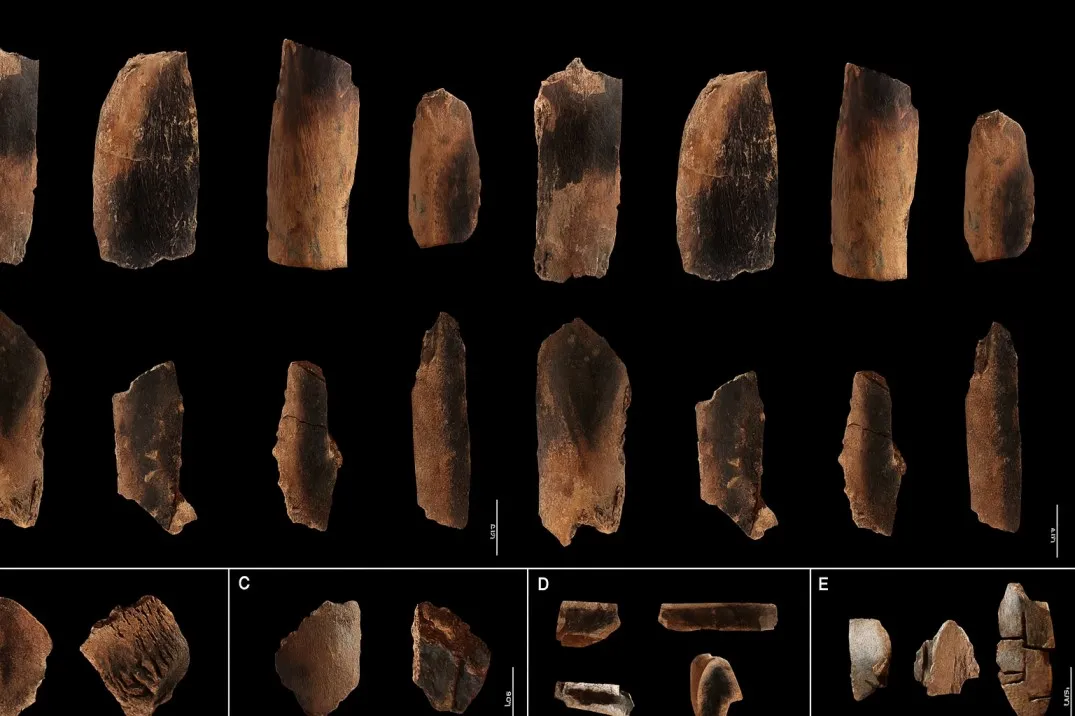
The controlled use of fire is usually told as a story about cooking. A 2025 study by Miki Ben-Dor and Ran Barkai argues for something quieter. In the period it covers, from about 1.8 million to 800,000 years ago, fire was probably an occasional tool, and cooking was probably not the main reason early humans bothered with it.
Source: Ben-Dor and Barkai, Frontiers in Nutrition, May 2025 (hypothesis and theory article).
What the researchers did
Ben-Dor and Barkai did not dig a new site. They went back through the published literature on prehistoric sites from that period that show any evidence of fire. They counted nine such sites worldwide, according to coverage of the paper. These were Gesher Benot Ya’aqov and Evron Quarry in Israel, six sites in Africa and one in Spain.

What they found
Ben-Dor’s reading of the record is that fire was not a given. At most sites older than about 400,000 years there is no sign of fire at all. At a few early sites the signs are clear, but there are no burnt bones and no sign that anyone roasted meat. The people involved, mostly Homo erectus, were therefore not using fire routinely. They used it now and then, in particular places, for particular purposes.
The reasoning rests on effort. Gathering fuel, lighting a fire and keeping it going is costly work. Early humans would have needed a strong reason that saved energy. The authors argue that cooking plant foods does not meet that test. Their bioenergetic comparison of hunting and plant gathering uses ethnographic data and adjusts it for Lower Palaeolithic conditions. It favours preserving meat and fat and protecting a kill from predators. Smoking or drying meat extends how long a large carcass stays usable. On this view cooking came later, as a secondary benefit.
Check the claim
The authors argue a hypothesis from a literature review. They have not found smoked meat at a site. Write “may have used fire for preservation and protection”, not “smoked meat”.
Why the cooking story is still taught
Richard Wrangham’s cooking hypothesis links cooked food to smaller guts, bigger brains and the rise of Homo erectus. However, this study does not erase that idea. It points out that the archaeological record for regular, widespread fire is thin before about 400,000 years ago, so any account that depends on daily cooking by 1.8 million years ago needs evidence it does not yet have.
Using it in UPSC Mains
The syllabus does not name controlled fire, so treat it as an example under Paper I, Section 1.4(a), which covers the biological and cultural factors in human evolution, and Section 1.8, which treats the Palaeolithic as a phase of cultural evolution. The strong move is to show that fire is a cultural innovation with biological consequences, then add a limit: scholars debate the dating, early use was occasional, and cooking is only one possible motive. Do not write that Homo erectus “cooked food” as if it were established.
For related practice, broad conceptual connections rather than questions on fire itself, see the PYQs Human Evolution as a Biological and Cultural Product (2026) and Geographical Distribution of Homo erectus (2024). More questions are in the Human Evolution and Primatology PYQs. For related reading, see The Diet That Shaped Human Evolution and Neanderthal resource management. The wider syllabus map is in the Anthropology Optional complete guide.