
Human Evolution as a Biological and Cultural Product — 2026 Paper I
Human evolution is a product of both biological and cultural factors. Elaborate.
Model Answer
VAID ICSApproach
|
Model Answer
Introduction Human evolution is characterized by a unique biocultural feedback loop, where biological traits and cultural behaviors have co-evolved, mutually reinforcing each other. Rather than sequential stages, human development is a recursive process: biological shifts (e.g., bipedalism) enabled cultural innovations (e.g., tool-making), which in turn created new selective pressures that drove further biological changes (e.g., encephalization).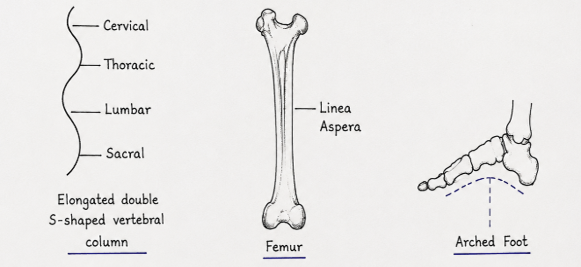
- The Biocultural Foundation: Bipedalism and Tool Use
- Anatomical Shift: Environmental volatility in the Pliocene necessitated efficient terrestrial locomotion. Bipedalism (lumbar lordosis, pelvic reorganization) was a biological solution to locomotion.
- The Washburn Hypothesis: Anthropologist Sherwood Washburn posited that bipedalism was the "prime mover," freeing the hands for tool use and carrying. This established a feedback loop: Bipedalism → Freed Hands → Tool Manufacture → Selective pressure for higher manual dexterity.
- The Fire-Diet-Brain Nexus
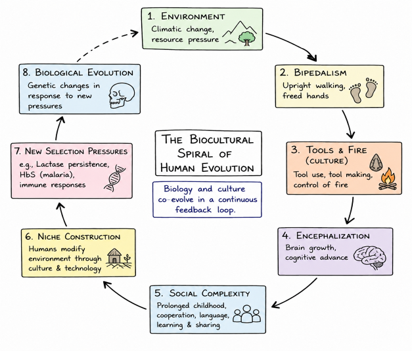
- Cooking Hypothesis: Richard Wrangham argues that the control of fire and cooking acted as a "biological accelerator." By predigesting food, it reduced the metabolic cost of digestion, allowing for a reduction in gut size and a massive redirection of energy toward encephalization (brain growth).
- Feedback: Larger brains necessitated longer periods of development and prolonged childhood dependency. This required intense social cooperation and alloparenting, fostering the evolution of complex social cognition and language.
- Gene-Culture Coevolution (The Lumsden-Wilson Model)Culture serves as an "environmental modifier" that creates new selective landscapes for human genes:
- Dietary Niche: The shift to dairying in pastoralist societies selected for the Lactase Persistence gene (a classic example of cultural practice directing biological evolution).
- Disease Ecology: The advent of agriculture increased population density and sedentary life, creating vectors for infectious diseases. This drove selection for protective variants like Sickle-cell (HbS) in malaria-prone regions—an involuntary biological response to a cultural change.
- Niche Construction: The Integrating PrincipleHumans are "niche constructors" who do not just adapt to environments; they transform them.
- Cumulative Culture: Unlike other primates, humans possess high-fidelity imitation, allowing for the accumulation of knowledge (e.g., complex hunting strategies, clothing, shelter).
- Result: This cultural buffering allows humans to inhabit diverse climates—from the Arctic to the Sahara—without requiring further anatomical specializations, effectively shifting our evolution from the physical to the technological domain.
Conclusion Human evolution represents a transition from reliance on genetic adaptation to cultural adaptation. As noted by Kevin Laland, the human capacity for culture is itself an evolved biological trait. Therefore, understanding human origins requires rejecting the dichotomy of biology vs. culture, recognizing instead that our biological evolution is the product of our cultural history, and our culture is the product of our biological evolution.
Want feedback on your answer?
Join the Anthropology workshop or get structured answer-writing guidance from VAID ICS.