
Strepsirhini and Haplorhini Primates — 2026 Paper I
What are Strepsirhini Primates? Describe their geographical distribution and mention the characteristics that distinguish them from Haplorhini Primates.
Model Answer
VAID ICSApproach
|
Model Answer
Introduction: Living primates are commonly divided into two major suborders—Strepsirrhini and Haplorhini. Strepsirrhini includes lemurs and lorisoids (lorises, pottos and galagos). It is a distinct evolutionary radiation and should not be described as a collection of “lower” or less-evolved primates.
Modern classification: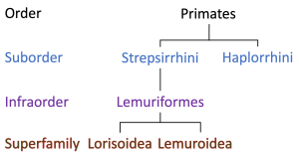
| Primates |
| → Strepsirrhini: Lemuriformes + Lorisiformes |
| → Haplorhini: Tarsiiformes + Simiiformes (monkeys, apes and humans) |
Geographical distribution:
- Lemurs, including the specialised aye-aye, are endemic to Madagascar and display extensive adaptive radiation.
- Galagos and pottos occur mainly in sub-Saharan Africa.
- Slow and slender lorises occur in South and Southeast Asia, including the Indian subcontinent and Sri Lanka depending on genus.
Major distinguishing tendencies:
- Nasal region: Strepsirrhines usually possess a moist rhinarium and relatively greater olfactory dependence; haplorhines lack a moist rhinarium and generally show greater visual specialisation.
- Orbit: living strepsirrhines possess a postorbital bar without complete bony closure. Anthropoids have postorbital closure; tarsiers have a postorbital bar.
- Dentition: most lemurs and lorisoids possess a tooth-comb; the aye-aye is a major specialised exception. Haplorhines lack the strepsirrhine tooth-comb.
- Grooming: a grooming claw is typical in many strepsirrhines, but it is not an absolute separator because tarsiers also possess specialised grooming claws.
- Vision/activity: a tapetum lucidum is common in many nocturnal strepsirrhines. Anthropoids lack it; nocturnal tarsiers compensate with very large eyes. Not all strepsirrhines are nocturnal.
- Sensory and cranial tendencies: strepsirrhines often show stronger scent marking and olfactory communication, whereas anthropoids in particular show increased encephalisation and visual/social specialisation.
Taxonomic clarification: The older “Prosimii” grouped lemurs, lorises and tarsiers together. Modern phylogeny places tarsiers with Simiiformes in Haplorhini. Therefore Strepsirrhini is not synonymous with Prosimii, and Haplorhini is broader than Anthropoidea.
Conclusion: Strepsirrhines are distinguished by a suite of nasal, olfactory, dental and orbital traits and by an Afro-Malagasy-Asian distribution, while modern taxonomy avoids ranking them as evolutionarily “lower” forms.
Want feedback on your answer?
Join the Anthropology workshop or get structured answer-writing guidance from VAID ICS.