
Phylogenetic Status and Lifeways of Paranthropus — 2026 Paper I
Discuss the phylogenetic status, characteristic features, geographical distribution and lifeways of Paranthropus.
Model Answer
VAID ICSApproach
|
Model Answer
Introduction
Paranthropus denotes the traditionally recognised “robust australopith” radiation of the Plio-Pleistocene, distinguished from gracile Australopithecus primarily by extreme cranio-dental specialisation for mastication, not by an exceptionally massive body. The genus generally includes P. aethiopicus, P. boisei and P. robustus and is usually placed as a side radiation rather than a direct ancestor of Homo.
- Phylogenetic status and chronology
The taxonomic history itself is significant. In 1938 Robert Broom recognised the Kromdraai fossils as sufficiently distinct to establish Paranthropus robustus; the name Paranthropus means approximately “beside man”.
| Species | Approx. age | Broad position |
| P. aethiopicus | 2.7–2.3 Ma | Early East African robust form; often considered close to the ancestry of P. boisei |
| P. boisei | 2.3–1.2 Ma | East African, most extreme megadont robust form |
| P. robustus | c. 2.0–1.2 Ma | Southern African robust lineage |
The KNM-WT 17000 “Black Skull” displays a combination of primitive and derived traits and strengthened recognition of P. aethiopicus as an early robust form. Its relationship to P. boisei is widely proposed, although whether all three robust species constitute a strictly monophyletic genus remains debated.
Possible phylogenetic pattern: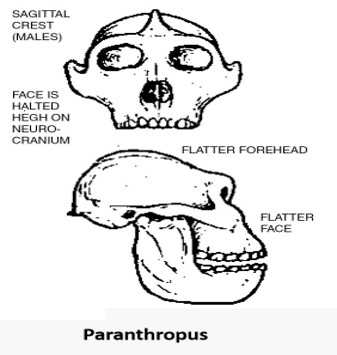
Gracile australopith stock
↘
P. aethiopicus → P. boisei
↘
South African robust lineage → P. robustus
→ robust side branch, not Homo
- Characteristic features: specialised masticatory complex
The clearest contrast with gracile australopiths lies in the skull, jaws and teeth.
Cranio-dental features
- low cranial vault with australopith-range brain size;
- sagittal crest, especially developed in many adult males, for temporalis attachment;
- extremely broad and flaring zygomatic arches;
- broad/dished facial architecture;
- deep, powerful mandible;
- very large premolars and molars — post-canine megadontia;
- thick enamel;
- relatively small incisors and canines;
- extensive surfaces for powerful masticatory musculature.
A useful exam comparison is:
Gracile Australopithecus → relatively lighter face/jaws, smaller post-canines
Paranthropus → flared face + massive jaws + megadont molars + enlarged chewing apparatus
Thus, “robust” refers principally to the masticatory apparatus, not simply to overall body size.
- Postcranial anatomy and locomotion
The older tendency was to treat the postcranium as broadly australopith-like. Current evidence allows a more nuanced picture.
Paranthropus was clearly capable of habitual terrestrial bipedalism, but some species retained features consistent with climbing and varied positional behaviour. Recent analyses of P. robustus lower limbs support bipedality while also suggesting comparatively frequent flexed-limb/climbing behaviour.
A major advance came in 2025, when a P. boisei partial skeleton, KNM-ER 101000, provided securely associated hand and foot bones. Its foot shows adaptations for bipedal push-off and a developed transverse arch, while its hand had a long thumb and manipulative capacities compatible with precision-type grasping, though not identical to later Homo.
Hence:
Bipedal terrestrial locomotion + retained climbing capability + effective manual manipulation
is preferable to portraying Paranthropus as either fully human-like or simply ape-like.
- Geographical distribution
East Africa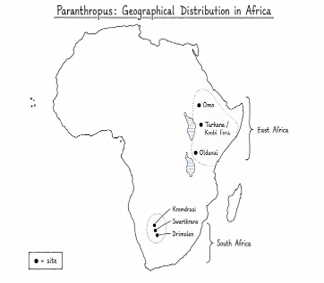
- aethiopicus
- Omo region, Ethiopia;
- West Turkana, Kenya;
- iconic specimen: KNM-WT 17000.
- boisei
- Ethiopia;
- Kenya — especially Turkana/Koobi Fora;
- Tanzania — Olduvai;
- further south into parts of East Africa.
Important fossils include OH 5 (“Nutcracker Man”) from Olduvai and KNM-ER 406 from Kenya. OH 5 was discovered by Mary Leakey in 1959.
Southern Africa
- robustus is concentrated particularly in South African cave deposits:
Kromdraai → Swartkrans → Drimolen
with additional occurrences in the wider Cradle of Humankind region.
- Lifeways: diet and ecological adaptation
Beyond the “Nutcracker Man” stereotype
Massive jaws and teeth once encouraged the view that robust australopiths specialised almost entirely in hard nuts and seeds. Modern dental microwear and stable-isotope studies make that interpretation too simplistic.
- boisei shows a very strong C4 dietary signal, but microwear does not indicate constant hard-object consumption. Mechanically challenging foods may instead have been important fallback resources, while grasses, sedges or other C4-derived foods contributed substantially.
- robustus appears to have had a comparatively broader and more variable diet, suggesting ecological flexibility.
Therefore:
Massive masticatory apparatus ≠ constant hard-food diet
It may represent the ability to process demanding foods when preferred resources were unavailable.
- Tools and cultural behaviour: changing interpretation
This is the strongest area for contemporary value addition.
Earlier interpretation
Raymond Dart’s osteodontokeratic hypothesis associated australopith behaviour with possible use of bone, tooth and horn implements. It is important historically but should not be treated as established evidence that Paranthropus manufactured tools.
South African bone tools occur in deposits containing both P. robustus and Homo and have been interpreted for activities such as termite foraging, but direct taxonomic attribution remains difficult.
Nyayanga evidence
At Nyayanga, Kenya, Oldowan tools approaching 3 Ma occur with Paranthropus molars and butchered animal remains. This reopened the possibility that stone technology was not exclusive to Homo, but association alone does not prove that Paranthropus made the tools.
Major 2025 advance
The securely attributed P. boisei hand from Koobi Fora now shows that its anatomy would not have prevented tool manufacture or use. The authors conclude that P. boisei was capable of tool behaviours “in some capacity”, while stopping short of proving that it manufactured a particular archaeological assemblage.
This allows an excellent analytical box:
Older view
Paranthropus = specialised robust feeder with limited technological significance
Current view
↓
Diet more flexible than “nutcracker” stereotype
- complex locomotor repertoire
- manipulative hand capable of tool behaviour
- archaeological association with early Oldowan contexts
But direct toolmaker attribution remains unresolved.
- Evolutionary significance
Paranthropus survived for well over a million years alongside early members of Homo. It was therefore not simply a “failed experiment”; rather, it represents a successful alternative hominin adaptive strategy characterised by:
Masticatory specialisation + dietary flexibility + bipedality + retained arboreal capacities + potentially significant manipulative behaviour
Its eventual extinction is better explained as an unresolved outcome of changing ecology and competition than as inevitable failure caused by “overspecialisation”.
Conclusion
Paranthropus represents a distinctive robust side radiation of human evolution, with its clearest specialisation in the cranio-dental apparatus. Yet modern evidence challenges the traditional picture of a narrowly specialised, culturally incapable hominin: dietary, locomotor and particularly 2025 hand–foot evidence reveal a more behaviourally versatile genus. Its importance lies in demonstrating that Plio-Pleistocene hominin evolution involved multiple successful adaptive strategies, not a single linear progression toward Homo.
Want feedback on your answer?
Join the Anthropology workshop or get structured answer-writing guidance from VAID ICS.