
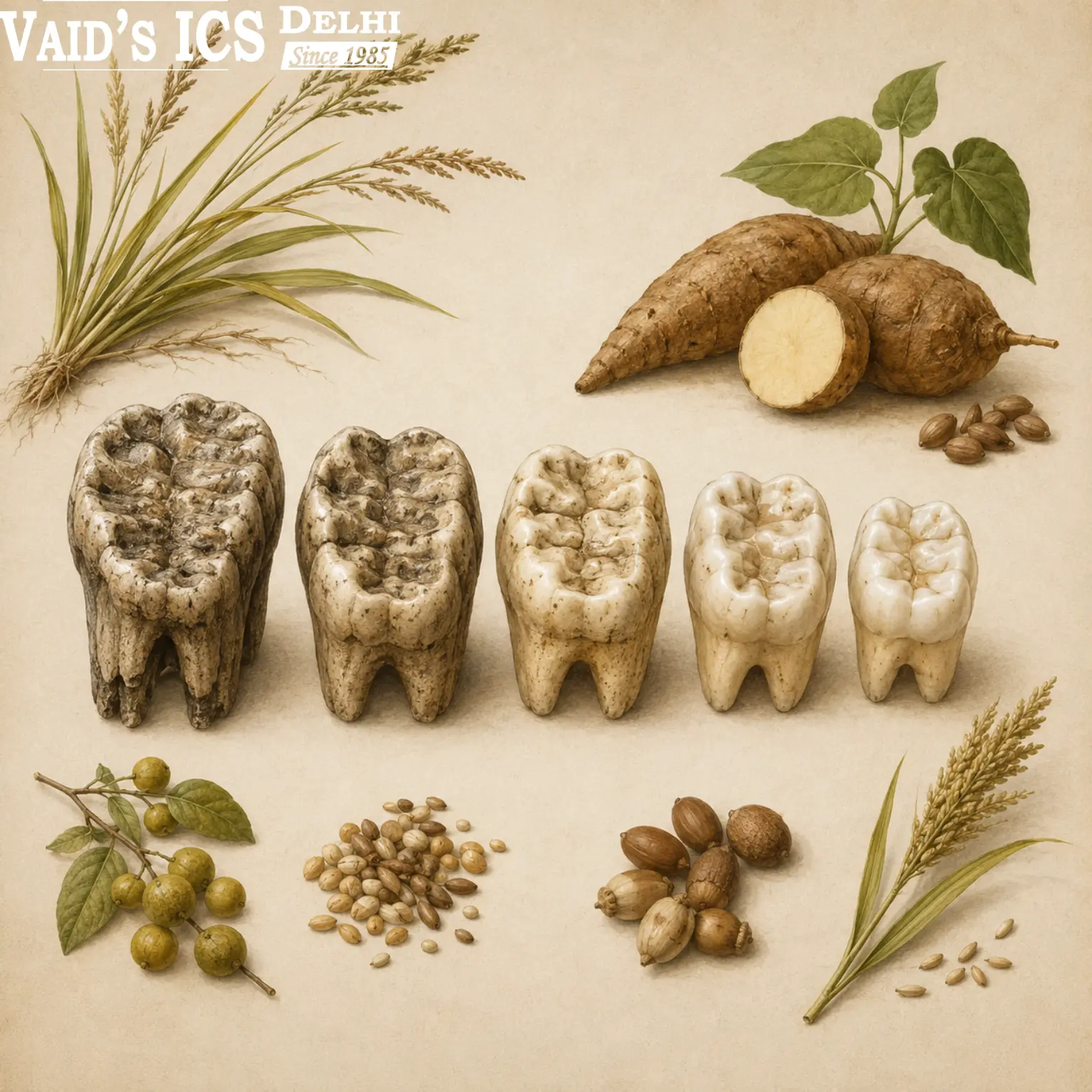
Diet and human evolution are linked most clearly in our teeth. A 2025 study reported in Science (Fannin et al.) follows dental evidence across almost four million years and argues that changes in what early hominins ate came first, with molar shape catching up later.
Source: Luke D. Fannin et al., Science, 31 July 2025.
Diet Changed Before Molars Did
- About 3.8 million years ago
Australopithecus afarensis: grasses and sedges, read from carbon isotopes in tooth enamel - About 2.3 million years ago
Homo rudolfensis: abrupt isotope change, read by the authors as a turn to underground plant organs; molars still lagging behind - About 2 million years ago
Homo ergaster: a spurt of dental change, suited to softened plant foods
Dates are approximate. The stages are not a simple straight line of ancestry. Firm evidence for the controlled use of fire is clearer only after about one million years ago.
Why teeth are such good evidence
Enamel is the hardest tissue in the body and survives fossilisation well. Its shape, wear and chemistry reflect what an animal chewed and where its food came from. Molar size and surface patterns suggest what kind of food was processed, while carbon isotopes in enamel indicate whether the plants eaten were mainly trees and shrubs or grasses and sedges.
Diet first, molars later
The central idea is a lag. The authors measured carbon and oxygen isotopes in fossil teeth. Carbon isotopes show that Australopithecus afarensis and its relatives began eating grasses and sedges (graminoids) between roughly 3.4 and 4.8 million years ago, long before their teeth were suited to chewing such tough plants. For comparison, the team also analysed two extinct monkeys, the theropiths and the colobines, which turned to graminoids in a similar way.

Around 2.3 million years ago the isotope signal in Homo rudolfensis changed abruptly. The authors set out three possible explanations and judged the most consistent one to be regular access to underground storage organs, namely tubers, bulbs and corms. Molar change came later. A press summary of the study puts the lag at about 700,000 years, and by about 2 million years ago Homo habilis and Homo ergaster show dental change in shape and size that the authors link to softened plant tissues, such as roasted tubers.
In other words, behaviour changed and anatomy followed. This is a useful example of how culture and biology interact, because new ways of getting and preparing food created pressures that natural selection later acted on.
Evidence versus inference
The teeth are real evidence of diet. Linking a specific change in diet to a specific change in molar size is an inference, and the stages are not a simple line of ancestry. Species named here are not necessarily direct ancestors of each other.
Caution on fire and cooking
The authors describe the later teeth as suited to softened tissues such as roasted tubers. That is an interpretation of tooth form, not direct evidence of cooking about 2 million years ago. Firm evidence for controlled use of fire is clearer only after about one million years ago.
How to read the timeline
Treat the dates as approximate and the species as snapshots. Hominin diversity at each time was wider than three names suggest, so the sequence illustrates a trend and not a family tree. When writing, say “a shift towards” rather than “evolved into”.
What it adds to the wider debate
Older explanations often stressed meat eating and big brains as the main drivers of human evolution. This study draws attention to plant foods, especially starchy underground organs that are rich in energy and available year-round. Meat and marrow may still have mattered, but the dental record suggests that plants and food processing deserve more attention.
Using it in UPSC Mains
Use it under Paper I, Section 1.4(a), which asks about the biological and cultural factors in human evolution. A strong answer can argue that diet acted as a link between the two: cultural change in food gathering and preparation, followed by biological change in the jaw and teeth.
Practise with the PYQ Human Evolution as a Biological and Cultural Product (2026). More questions are in the Human Evolution and Primatology PYQs. For a related post, read New Species of Australopithecus and Hominin Diversity. On the debate over early fire, see the controlled use of fire by early humans. The Anthropology Optional complete guide shows where this topic sits in the full syllabus.