
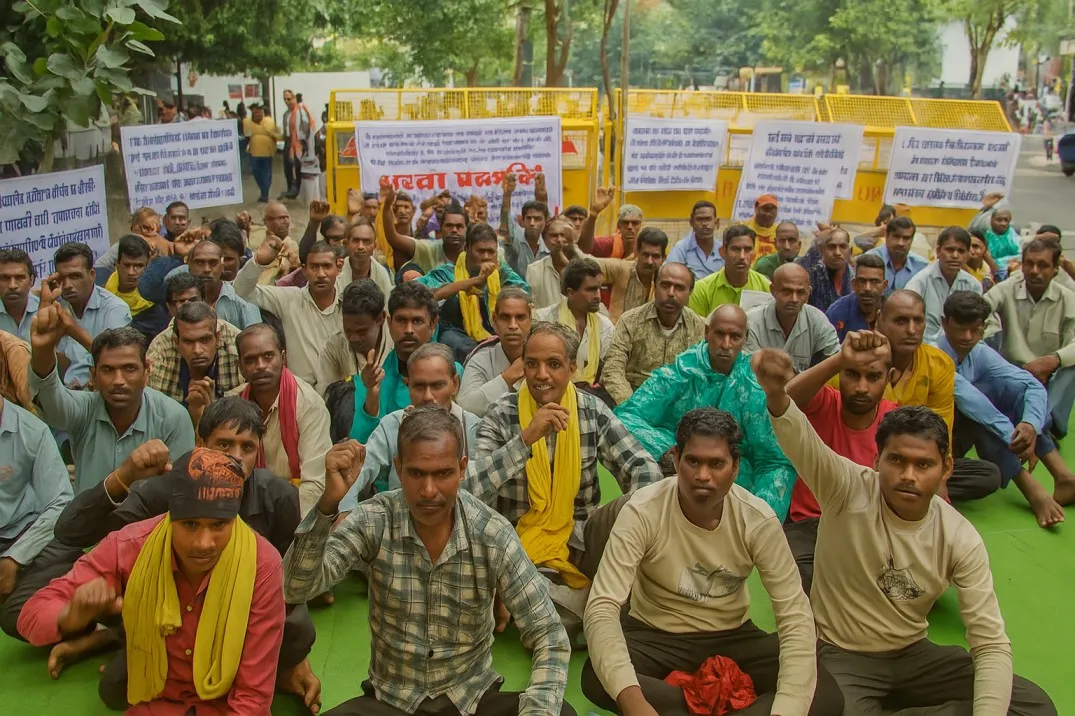
The Forest Rights Act was passed in 2006 to correct a historical injustice: forest dwellers had lived on and used forest land for generations, but the state never recorded their rights. Two decades on, however, the official numbers show a large gap between claims filed and rights recognised. The point for an answer is to pair those numbers with the reasons claims fail.
Source: Counterview (21 August 2025) triggered this note. Its figures were compared with press reports quoting Parliamentary replies (Lok Sabha, 24 July 2025; Rajya Sabha, data to 30 June 2026), and against a Ministry of Tribal Affairs review conference reported in October 2026. Evidence level: advocacy commentary and press reports of Parliament replies. The replies themselves were not reviewed.

What the figures say, and when
A Lok Sabha reply of 24 July 2025 gives 51,23,104 claims filed at gram sabha level up to 31 May 2025 and 25,11,375 titles distributed, which is 49.02 percent. Then a later Rajya Sabha reply, as reported, puts the position at 30 June 2026 this way: 54,01,561 claims received, 25,42,359 titles, 18,13,232 rejections and 10,45,970 pending. Likewise, reports of an August 2026 regional review conference give rounded figures that agree. They also note that the Ministry does not keep community-wise or district-wise segregated data.
So always say which date a number belongs to. The Counterview piece splits the 2025 titles into individual and community rights. However, its rounded split could not be matched to the official reply, so it is not repeated. Check the split in the reply’s annexure before quoting it.
Why the numbers alone mislead
Rejection figures are a contested indicator. Moreover, many rejections are reported to face challenge because officials issued them without gram sabha involvement or without stated reasons. The danger is therefore administrative apathy, and also pressure from commercial interests. In Assam, for instance, the source says the state government allotted nearly 3,000 bighas (about 990 acres) in Dima Hasao district to a private company for a cement factory. Dima Hasao is a Sixth Schedule area. There the autonomous district council has a role in land matters, and the allegation itself is contested. Hence I give it only as the source’s example of pressure on tribal land.
The anthropological argument
In fact, tribal communities have historically been custodians of forests and not destroyers of them. The Act holds real potential to combine their livelihoods with the regeneration of degraded forests. That needs policymakers who approach the issue with imagination and sincerity. Finally, a law born to heal historical wounds should not create fresh ones. For these communities, this is not about paperwork. It is about life itself.
Using it in UPSC Mains
Paper 2, clause 6.3 covers the development of forest policy and tribals. Likewise, clause 7.1 on constitutional safeguards for Scheduled Tribes is a secondary link. The FRA is the corrective to colonial and post-colonial forest policy, and its implementation record is the evidence an answer needs. Pair the statistics with the reasons claims fail. These include weak gram sabha processes and conflicting forest-department practice. Do not cite the figures alone.
Three PYQs have their own pages: the Forest Rights Act and livelihood (2021, Paper 2), the Recognition of Forest Rights Act, 2006 (2018, Paper 2) and Scheduled Tribes and the Forest Rights Act (2016, Paper 2). Browse tribal problems and displacement too. Related reading: the Dongria Kondh and Niyamgiri, the Jenu Kuruba at Nagarhole and the full optional guide. For a related forest-and-law case, see the Supreme Court ruling on Rajasthan’s sacred groves.
Sources
The Hawk on the Ministry’s 25 lakh titles statement; The Newsmill on the Kolkata review conference; LiveLaw on FRA implementation problems; Counterview (21 August 2025), cited from the earlier version of this article.