
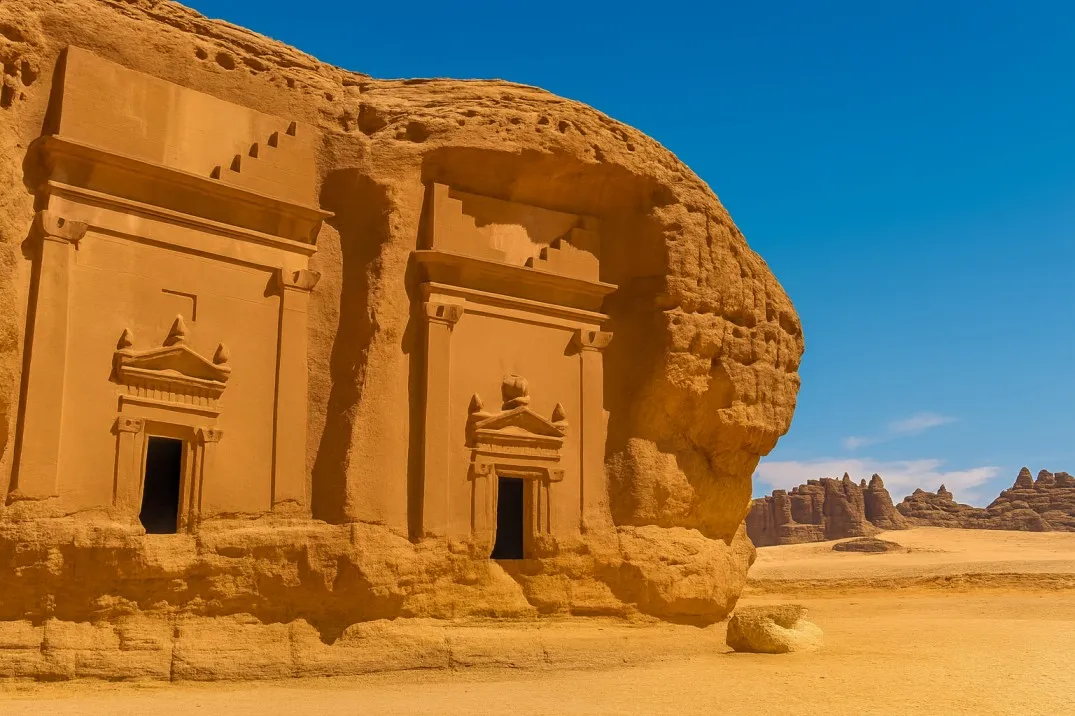
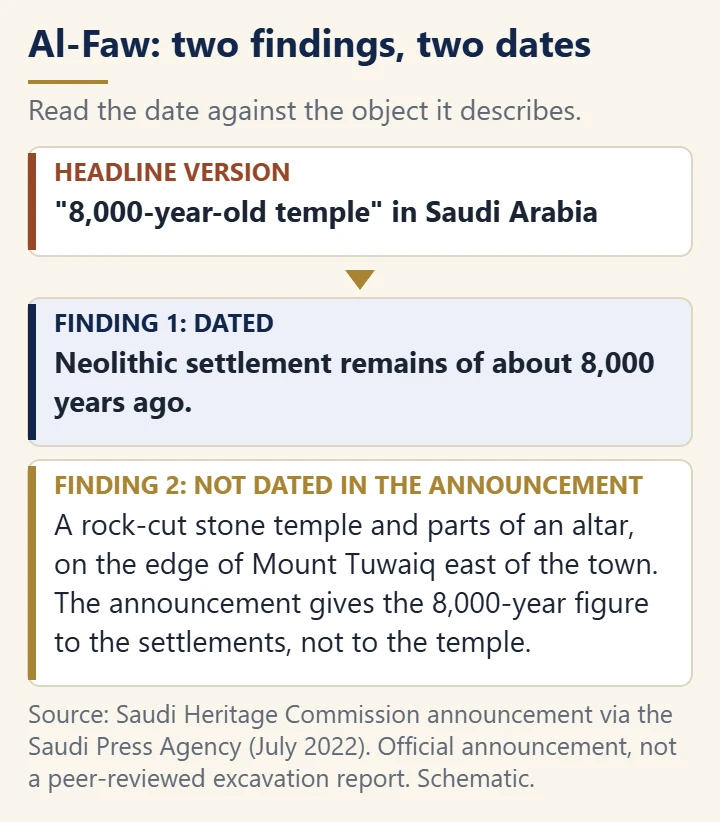
Headlines called it an “8,000-year-old temple” in Saudi Arabia. The official announcement says something more careful. A survey at Al-Faw found a rock-cut temple, and it also found Neolithic settlement remains of about 8,000 years ago, but these are two separate findings. For Optional Paper I, the lesson is to read the date against the exact object it describes.
Source: Saudi Heritage Commission announcement, reported by the Saudi Press Agency (July 2022); the story circulated widely again in 2025. Verification here rests on the SPA report, not a peer-reviewed paper.
What was announced
Al-Faw (Al-Fao and Qaryat al-Faw are variant spellings) lies at the edge of the Empty Quarter, about 100 km south of Wadi al-Dawasir. It was once the capital of the Kingdom of Kindah. First, a Saudi-led international team surveyed it with aerial photography, drone footage, remote sensing, ground-penetrating radar and laser scanning, plus walkovers and small test excavations.

In summary, the main findings were these:
- the remains of a rock-cut stone temple and parts of an altar, on the edge of Mount Tuwaiq east of the town;
- remains of Neolithic human settlements, which the announcement puts at 8,000 years old;
- 2,807 graves of different periods, which the team sorted into six groups;
- devotional inscriptions, including one that addresses Kahal, the god of Al-Faw;
- four monumental buildings that may have served trade caravans;
- an irrigation system of canals, cisterns and hundreds of pits for rainwater.
The dating problem
Here, the announcement attaches the figure of 8,000 years to the Neolithic settlements. It does not give that age to the temple. It gives no age for the temple. Al-Faw itself served as the capital of the Kindah kingdom, a far later period. As a result, “8,000-year-old temple” merges two periods, and it should not appear in an exam answer.
A second point concerns viral claims that link the temple to another religion. In contrast, the Commission’s own text ties the inscriptions to the religious beliefs of Al-Faw’s people, including the god Kahal.
Using it in UPSC Mains
For answers, use Al-Faw as a regional example of settled life, ritual and water management in an arid zone, outside the usual Near East and Europe focus. Also, say “Neolithic traces about 8,000 years old” and “later temple and inscriptions” as separate points. Finally, add one line on source quality: this is an official announcement, and firmer dates need a full excavation report.
However, no listed PYQ asks about the Arabian Neolithic. Use the Prehistoric Archaeology PYQs for Neolithic practice. For another regional Neolithic case, read the Neolithic society at Oued Beht in Morocco. The syllabus map is in the Anthropology Optional complete guide.
Sources
Saudi Heritage Commission announcement via the Saudi Press Agency and Saudi Gazette (2022); ABP Live report (2 July 2025), a re-report of the same finding.