
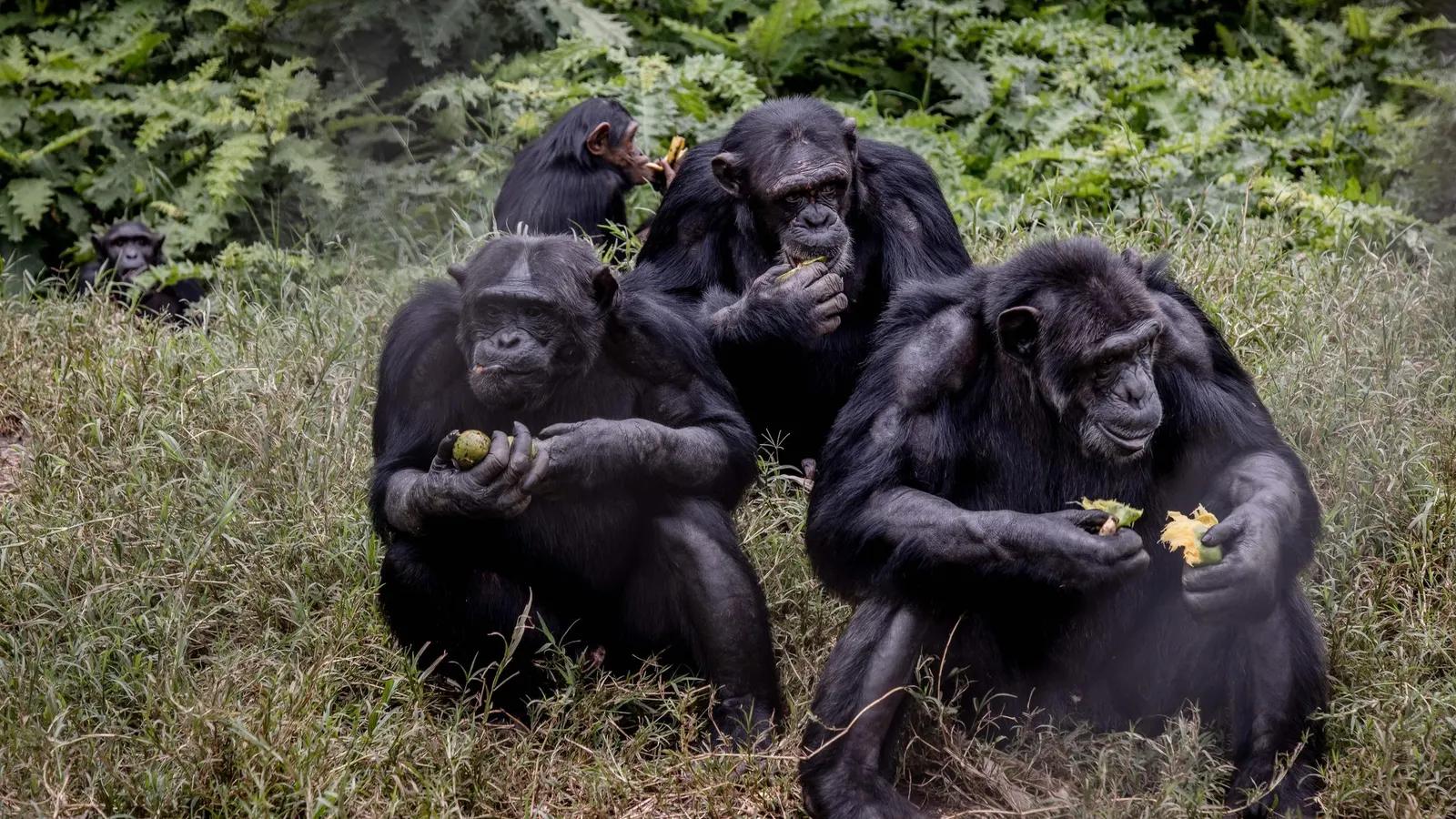
Source: Kirsty E. Graham, Federico Rossano & Richard T. Moore, Biological Reviews (27 August 2024).
Ape gesture communication has long sat at the heart of debates about how human language began. A 2024 review argues that great apes do not merely produce gestures — they grasp the communicative goals behind them. For UPSC Anthropology Paper 1, this offers a careful, current way to discuss primate communication and the deep roots of language.
Why this matters: it narrows the perceived gap between human and non-human minds and reframes how gestural communication may have scaffolded language.
Syllabus relevance: Anthropology Paper 1 — Primate behaviour and communication; the emergence of language; primatology.
Best use in answers: use it to show that language origins can be approached through comparative primate evidence, not speculation alone.
What the study found
Researchers led by Dr Kirsty E. Graham examined gestural communication in chimpanzees, bonobos, gorillas and orangutans. Across these apes, gestures appeared to be used with an understanding of their intended effect on a partner, rather than as fixed reflexes.
The “Recruitment View” of gestures
To explain this, the authors propose the Recruitment View. On this account, apes take familiar body movements — actions already meaningful in daily life — and repurpose them as signals. For example, the motion of reaching for an object can be recruited to request help or attention. Because an ape already understands what its body can do, it can adapt those actions for communication.

Bridging two older theories
The Recruitment View sits between two established positions. The Leipzig View holds that gestures are learned through repeated social interaction. The St Andrews View argues instead that gestures are largely universal and biologically inherited. The Recruitment View bridges the two: gestures emerge from a shared physical and cognitive foundation, requiring neither full imitation nor strict genetic programming.
Why this speaks to language origins
According to co-author Dr Richard Moore, the ability to recruit and reinterpret familiar movements as intentional signals may mark an important step from simple gestures towards spoken language. This fits a broader family of gesture-first theories of language evolution. It should be stated carefully, however: the evidence points to shared cognitive foundations, not to a finished language in apes.
Concept link
Connects to Paper 1 themes of primate communication and the emergence of language. Contrast gesture-first models with vocal-origin models when framing an answer, and anchor the discussion in comparative primate evidence.
Use in answer writing: cite the Recruitment View as a recent attempt to reconcile learned and inherited accounts of ape gesture, then link it cautiously to human language origins.
Paper 1 link: Primate behaviour and communication; emergence of language; primatology and comparative method.
Also read
• Early Human Hands: Climbing and Tool-Making
• The Diet That Shaped Human Evolution
• Complete Anthropology Optional Guide
FAQ
Does this mean apes have language? No. It suggests apes understand communicative intent behind gestures — a possible building block of language, not language itself.
What is the Recruitment View in one line? Apes repurpose familiar, meaningful body movements as intentional signals.
Studying primate communication for Paper 1?
Language origins is a favourite conceptual area. Our complete Anthropology Optional guide shows how to structure such answers. Mentored by Vaid Sir; Anthropology specialists since 1985.
References
Graham, K. E., Rossano, F. & Moore, R. T. (2024). Biological Reviews.